We Need a Socialist Feminist Defence Against Gender-Based Violence
The idea that capitalism brings ever-increasing progress toward equality has been swept away like the mirage that it always was.
On 23 November, ISA’s Socialist Feminist Commission met, with members from Canada, Brazil, England, Wales and Scotland, Germany, Quebec, Sweden, and the United States attending. We discussed the political situation ahead of 25 November – the International Day for the Elimination of Violence against Women – and drew up plans for the future.
Erin Brightwell began by giving an overview of the reactionary turn taken by the ruling class globally. The era of ‘woke capitalism’ is over. In the wake of powerful movements against oppression, sections of the capitalist class claimed to stand against discrimination, for example in schools and businesses. Their approach was based on the premise that oppression in society could be eliminated if individuals just improved their behavior or their thinking.
Today, the counter-revolution of the right is not just throwing away diversity initiatives but wants to go much further than that. They want to attack fundamental voting, labour, and reproductive rights which were won through the struggles of the 1960s and 70s. In the United States, these protections are being dramatically undermined and even eliminated. The Civil Rights Department no longer pursues cases of discrimination against women or people of colour. It now focuses not on protecting people, but on taking up cases against transgender people. They are also pursuing cases such as those brought by white people appealing against school initiatives aimed at supporting Black students.
There is a massive dismantling of all protections for victims of gender-based violence. Shelters are being closed due to lack of funding. There is an ideological offensive underway that reinforces patriarchal gender roles through a distorted discussion of “who is a woman” that targets trans women. Transgender people in the US are now threatened with a new draconian attack that would only recognize sex “at conception” on passports.
Misogyny was part of Trump’s election campaign, and sexism continues. Nick Fuentes, who wants to replace the murdered supersexist Charlie Kirk as leader of the far right, is an open Nazi but is still given space in mainstream media. What is getting the most attention are the demands for the Epstein investigation to be made public. Unfortunately, with MeToo and the women’s movement on the backfoot in the US, the most high-profile calls to release the Epstein files have been made by extreme-right, ultra-nationalist figures like Marjorie Taylor Greene. But we cannot let our movement be silenced. We need to build socialist feminist campaigns and struggles against sexist violence and abuse, to take on the root of the system that creates and enables monsters like Epstein and Trump, and makes violence and abuse a terrifying reality in the lives of so many women.
Leslie Kemp followed Erin, describing how the imperialist era means more and more wars, and that these wars are claiming a greater proportion of civilian casualties, especially women and children. Sexual violence and rape are used as weapons of war, as seen in Palestine, Sudan, Congo and Ukraine. In Ukraine, domestic violence has increased by 36 percent since the war began. On 22 November, protests were held in Canada calling to end the war in Sudan.
This year, the UN has designated the theme for 25 November as: Digital violence is real violence. There is #NoExcuse for online abuse. This could be, for example, an ex-boyfriend publishing revenge porn after his girlfriend broke up with him, cyberbullying, online stalking, or “deepfakes.” This type of abuse is extremely destructive to the mental health, wellbeing and livelihoods of victims, and once images or videos are posted online it can be extremely difficult, if not impossible, to get them taken down. 60 percent of women in Arab states have experienced sexual harassment online, 28 percent in Sub-Saharan Africa, and 23 per cent in the US and Europe. 58 percent of girls and young women have experienced online harassment, as have 73 percent of female journalists worldwide. When a person is victimised, they are isolated, but the answer is to join forces in a collective struggle.
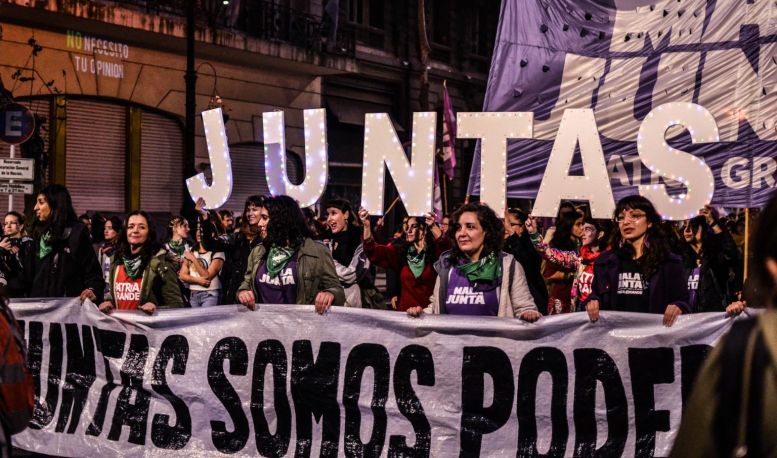
While movements against gender violence like MeToo and Ni Una Menos have receded from their heights, there are still important examples of a fightback of women and queer people against violence and abuse in the world today. France has finally after years of feminist struggle and the enormous Gisèle Pelicot case, passed consent legislation. Last Friday, there was a women’s strike against gender-based violence in South Africa. There have been new protests in Argentina after three horrific live-streamed murders of young women, Kenya was shaken by protests last year, and in Mexico, hundreds of thousands of people still gather on International Women’s Day on 8 March, for example. As Marxists, we are developing a revolutionary programme. The oppression of women is as old as class society, and capitalism works every day to reinforce it. Therefore, a total transformation of society is necessary to achieve a world with security for all.
Leslie ended with a poem from Marge Piercy: “Strong is what we make each other. Until we are all strong together, a strong woman is a woman strongly afraid.”
Many aspects and questions arose in the discussion that followed. Rosalie Bélanger-Rioux from Quebec discussed the rise of “tradwife” ideology and the desire of ruling classes around the world to reinforce “traditional” gender roles, racism, and nationalism to prepare the working class for a period of war.
Several contributions from Leah Stevens, Katja Raetz and Marie, among others, addressed the vulnerability of transgender people who have been scapegoated by the right. In Sweden, there are reports of an increase in attacks and negative comments against transgender people in schools. In the United States, statistics on hate crimes have been removed, so now there are not even any figures to rely on. Marie recounted her experience as a teacher telling her students that she is a transgender woman in the context of the onslaught of anti-trans talking points in all aspects of life. Increasing transphobia and the rise of the manosphere makes gender and sex education in schools even more important. Now it is crucial that New York stands up to Trump’s threat to remove funding from schools that allow transgender students to use the bathroom of their choice and to discuss issues relating to gender identity in class.
Miranda Schenk spoke about the women’s strike in South Africa. Thousands of women stopped both paid work and housework. They were silent for 15 minutes to symbolise the 15 women murdered by their partners every day in South Africa, the highest rate in the world. Legislation has been tightened, but violence is still on the rise, increasing by 33 percent last year. The women’s organization Women for Change first collected a million signatures without getting any response. When this strike took place coinciding with the recent G20 meeting, the government was forced to respond and declared gender-based violence a national crisis in South Africa. But the question is, what will they do about it?
A working-class answer to this crisis is needed with genuine solutions to address gender based violence in the home, workplace, and on the streets. This includes addressing the factors that make it so difficult for working class women to escape violence and abuse including things like low wages, lack of access to stable and safe childcare or trauma therapy, and substandard and unaffordable housing.
Bia Lacombe brought up the horrific murder of Amber Czech in the United States, a young woman welder who was murdered by her co-worker at their job site. While this situation has received little to no coverage in the mainstream media, it has sparked a response among tradeswomen who are speaking out online about sexual harassment and violence on their work sites. Socialist Alternative US member Hannah has also contributed to this discussion with a video about her experience as a woman in the trades and the type of fightback that is needed.
Elin Gauffin brought up the women’s struggle taking place in Latvia. There have been several demonstrations, the latest one involving 10,000 people in Riga, protesting against the government’s plan to withdraw the country from the Istanbul Convention – a legally binding agreement from the Council of Europe to prevent and combat violence against women and domestic violence.
Right-wing politicians in Latvia and war governments such as Putin’s are pulling in the same direction as the internet trend of the manosphere. They want to take away the voice of the women’s and LGBTQ+ movements. They argue that there should no longer be a word for domestic violence. That there should be no statistics on harassment or violence against LGBTQ+ people. They claim that it is actually men who are oppressed. All while oppression of women is on the rise. For example, the wage gap between men and women is increasing in countries such as the United States and Sweden. One in three women worldwide is subjected to violence by men at some point in her life.
Ellie Costain and Sofia Wiking discussed how politicians in power try to divide the opposition by pitting groups against each other. Racism is being whipped up in the UK, where politicians claim to be defending the country’s white women against “dangerous” brown and Black men, perpetuating racist tropes about these men being more likely to commit sexual violence. Anna Barnett pointed out the need for a socialist program that puts forward economic demands that unite us – such as affordable housing and living wage jobs for all – but that must be linked to a program and struggle to root out all forms of oppression. Anti-racist and socialist feminist demands against all forms of oppression must always be given prominent space in the workers’ movement if it is to be effective.
After this motivating discussion, we moved on to plans for 2026. The Socialist Feminist Commission will focus on a joint open meeting around 8 March and plans to delve deeper into the history of the women’s struggle in Latin America and a theoretical understanding of the roots of LGBTQ+ oppression.
The International Day for the Elimination of Violence against Women this year takes place with the backdrop of a rising right wing. The idea that capitalism brings ever-increasing progress toward equality has been swept away like the mirage that it always was. In a world engulfed in devastating wars, alienation, poverty, violence and abuse, the need to get organized and fight back could not be more urgent.