The single most important development in American history—perhaps second only to the defeat of the slaveowners in the Civil War—was the rise of the Congress of Industrial Organizations (CIO), the union federation which had its founding convention 90 years ago on November 9, 1935. In the 20 years of its existence, 42 million workers went out on strike. It was the greatest and widest period of self-organization of the US working class in history and affected lives and events even to this day.
Martin Luther King Jr., who lived through this period, argued that the rise of the labor movement was the principal force that transformed misery and despair into hope and progress. At his “I Have a Dream”speech, the former CIO leader Walter Reuther stood next to him. Hundreds of thousands of Black workers entered the labor movement for the first time during the rise of the CIO. The radical approach of the CIO also helped shape the Civil Rights Movement with the lunch counter sit-ins that were, in part, influenced by the wave of sit-down strikes organized by rank-and-file workers in the CIO.
The colossal movement into the unions in the 1930s and 1940s forced an end to child labor and the creation of unemployment benefits and social security. It led to workers’ compensation and the end of the six-day week with the advent of the weekend.
In the last period of the CIO, post-war US capitalism looked to contain Stalinism (popularly known as communism) around the globe. It needed a stable base at home, which led it to make significant wage and other concessions to organized labor. At the same time, it unleashed the Second Red Scare, allowing labor leaders to reign in the militant ideas that had flowed into the CIO during its rapid rise.
When the CIO merged with the American Federation of Labor (AFL) in 1955, it was unfortunately on the basis of the business unionism of the AFL. Nonetheless, the unions continued to grow in membership until 1980, when the crisis of US capitalism was in full swing and the old militant methods of the CIO were long gone.
The End of the Swinging Twenties
The key features that led up to the CIO were the 1917 Russian Revolution, the post-war economic boom of the 1920s, and its collapse in 1929.
The Russian Revolution hugely affected working-class thinking, leading to growth of the radical socialist and communist movement in the US. The US bosses, fearing revolution, initiated the Palmer Raids in 1919, part of the First Red Scare, arresting 10,000 union and socialist activists with hundreds deported. Defeats like the Great Steel Strike of 1919 led to major setbacks in organizing. The post-war rise in union membership soon levelled off and became stuck in the mire of a relatively conservative union leadership who feared the outlawing of unions altogether.
The twenties saw an increase in living standards for many workers, with an acceleration of car ownership; telephones and radios entered homes. American capitalism was emboldened until it hit the wall of the 1929 Wall Street crash. Workers suffered unemployment and near starvation, and by 1931, wages had fallen to half their 1925 level. The small but bold Communist Party organized illegal rallies against unemployment all across the US demanding financial relief for those without work, built anti-eviction struggles, and sunk roots in the industrial working class.
1933, the fourth year of the Great Depression, represented a low point for the labor movement. The AFL’s membership had fallen by a third from 1930 to 1933. By that year, not a single recognized union existed in any plant of basic industry in the United States.
The reformist labor leaders had no clue how to respond to the bosses’ offensive against wages and jobs of the Great Depression. The American Federation of Labor leader, William Green, promised employers that if they didn’t cut wages, the unions would not go out on strike. However, the wage cuts kicked in quickly in 1930. And, still the conservative union leaders refused to organize strikes. The miners’ union leader John L. Lewis toured coal mines forcing strikers back to work and red-baiting socialists. This same leader was to later become the key radical labor leader and founder of the CIO.
In March 1933, President Roosevelt came into office. This was in the midst of a first strike wave after almost no strikes following the 1929 crash. With the passage of the National Industrial Recovery Act which legalized both company unions and genuine unions, at least on paper, the AFL leaders argued that all the problems of labor were behind them. Hundreds of thousands flowed into the unions in early 1934. The employers, however, refused to recognize any of these unions, while Roosevelt did nothing to enforce the law. Of the 100,000 workers who joined the AFL’s steelworkers union in 1934, only 5,000 were still paying union dues by the end of the year.
Conservatism of the AFL
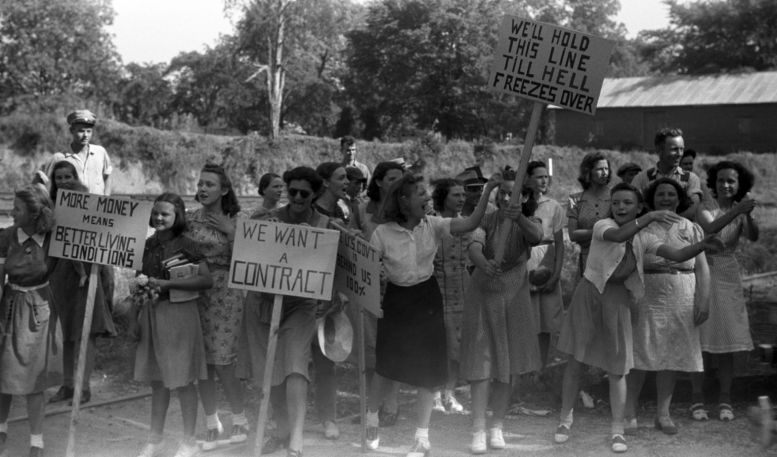
In the South, textile workers in 1933 joined the AFL en masse with 300,000 workers signing union cards. In early 1934, almost half a million workers walked out on strike across the region for union recognition. The president and southern state governors worked together to bring out 40,000 National Guardsmen to restore order on behalf of the employers. Democratic President Roosevelt, in cooperation with the racist Dixiecrat wing of his party, told the labor leaders to call off the strike in exchange for a government survey to investigate conditions in the textile industry. The AFL leaders called off the strike. The whip of counter-revolution then reigned through the South with mass arrests and over 15,000 union activists and local leaders banned for life from employment in the textile garment industry. This betrayal would be felt for decades as the South then largely missed out on the gains of the rise of the CIO.
The thinking of the old union leaders was that organizing unskilled workers was impossible because they could so easily be replaced in the event of a strike. They had long ago concluded that only skilled workers could be organized. This gave the union movement a specific character and outlook that tended to reflect higher-paid craft workers. However, capitalism was changing fast, and craft jobs were being replaced by automation and increasingly simplified unskilled tasks. Craft unions were a product of a previous period, and the abrupt shift in automation and massive industrialization of work was creating a shockwave for the labor movement.
The AFL leaders’ conservatism was an expression of their craft-based unionism. They saw themselves as valued artisans, a kind of labor aristocracy who deserved higher pay than other workers. This attitude was also reflected in the hierarchy of the unions, with workers’ leaders being paid lavish wages. For them, until 1929, capitalism seemed to work. This was the source of their conservative outlook, which made them an increasing obstacle in the period of strikes that was about to explode.
The 1934 Strikes That Turned the Tide
History’s turning point required new labor leaders and activists who did not seek an accommodation with capitalism, but rather were anti-capitalist. The key moment in labor history was 1934. Three city-wide general strikes rocked US society breaking the spell of defeatism and putting the organized working class in the center of the struggle over the way forward for society. It is not coincidental that in each of these strikes: Toledo, Minneapolis, and San Francisco, the local leaders were bold socialists: in Toledo, the American Workers Party; in Minneapolis, the Trotskyist Communist League; and in San Francisco, the Communist Party.
In the Toledo autoworkers strike, the strikers’ picket lines were deemed too large and too effective by the courts, and an injunction was ordered to restrict them, with the National Guard deployed to execute the ban. The workers linked up with the American Workers Party and their affiliated Unemployed League, who sent a letter to the judge declaring that they would defy this order that was intended to keep the workers shackled to low pay. They invited the entire working class to their picket lines, including the unemployed, to break the injunction. This contrasted starkly with the statesman-like approach of the AFL.
Ten thousand auto workers and unemployed workers showed up. The participation of the unemployed, a third of Toledo, was crucial in cutting across the company’s strikebreaking efforts. Workers made appeals directly to the rank-and-file National Guardsmen. Despite brutal and violent repression from the bosses and police, workers only became more galvanized. By the end of the week the whole of Toledo’s union locals voted for a city-wide shut down of all work. The bosses at Toledo Auto-Lite signed the union contract the following week in May 1934.
Teamster Rebellion
In Minneapolis, socialists expelled from the Communist Party for opposing Stalinism led a fight to unionize truck drivers and related jobs with the Teamsters. The union had been reduced to a shell through unemployment and the bosses’ use of terror to discourage membership. The socialist truck drivers began from the position that they had confidence in the willingness of the workers to fight and win and that they should put no faith in the courts, the government, or big business’ politicians. This approach proved critical to the strike’s success.
The union utilized mass picketing and widened the strike to involve workers outside of the trucking industry. As drivers themselves, they innovated the use of automobiles and trucks to chase down and stop strikebreakers: what they called flying pickets. The employers rallied a “citizens army” of small businessmen and college students to beef up the police lines being used to break the strike. In one battle between Teamsters defending themselves with baseball bats and cops wielding live ammunition, two strikers were killed. But this only further enraged the workers, causing the entire city to join a general strike against police brutality and to force union recognition. In many ways, Socialist Alternative considers this specific strike, documented in Farrell Dobbs’ Teamster Rebellion as the model of strike action.
On the West Coast, longshoremen, who unloaded Pacific cargo off ships in San Francisco, had long been low-paid and employed casually, which had worked well for the bosses. A similar process unfolded here as did in Toledo and Minneapolis, with mass picketing being attacked brutally by the police. For 83 days, a pitched battle took place in San Francisco with the town’s wealthy calling for more oppression and the city’s working class support increasingly consolidated behind the longshoremen. In July 1934, in what became known as Bloody Thursday, two workers were killed: one a striker, one a kitchen worker who supported the strike. Under the leadership of the Communist Party and other socialists, a general strike was organized through the union locals, a contract was eventually signed, and San Francisco became a union town.
For more than a hundred years bosses in the US had been using deadly violence against workers. What changed in 1934 was that these new socialist union leaders were not cowed by the attacks, but instead escalated organizing and widened strike action, pointing to the dead end that capitalism and its repressive police actions represented.
Each of the 1934 strikes laid down the bold methods and approach that was later adopted and improved by workers in the CIO, in particular with the United Auto Workers’ (UAW) use of factory occupations as a means of winning strikes. When the Minneapolis Teamsters began strike preparations in 1934, they sent a request for strike authorization to their conservative national leader, Dan Tobin; he sent a letter back refusing to allow them to strike, which was received after the strike had already been won. The old failed methods of the AFL were discredited and remained on the shelf for the coming decade.
The Union Leaders Are Split
The victorious 1934 strikes shook up the old union leadership, who watched in awe as the working class stepped into the void and shaped the world. A division in the AFL leadership was heading towards an open split, with one wing supporting this rising movement towards strike action and organizing unskilled workers, and the other wing, at least initially, holding onto the past, refusing to open up to the fresh working-class militants banging on the unions’ doors.
At the October 1935 AFL Convention, John L. Lewis, president of the miners’ union, led the fight for organizing the unorganized, recognizing that the union movement was at a crossroads. At the podium, Lewis argued that the AFL policy of building the labor movement had been “a record of 25 years of constant, unbroken failure.” Some 60% of the delegates voted against motions aimed at organizing the unorganized. Those delegates that wanted to join the fight to expand strikes and worker organizing then initiated a Committee for Industrial Organization within the AFL. Within a year, almost all unions that had affiliated to this committee within the union federation were expelled from the AFL.
Within two years, the CIO rose from 900,000 members to 3.7 million members. Lewis, who headed the CIO, had only a decade earlier led a battle to drive communists out of the United Mine Workers. He was now hiring them, in their hundreds, as organizers. Lewis was as opportunist as any of the other leaders, but unlike most other leaders, he also had foresight, a vision, and superior moral fiber to the old AFL leaders. Lewis was also very top down. Nonetheless, he was probably one of the greatest of the US’ national labor leaders because of the stand he took in starting the CIO and because he didn’t block the militant movement of labor that rose from the rank and file, and that ultimately transformed the US.
In 1936, the CIO sent 450 organizers into the steel industry, many unpaid or paid minimally, and many couch surfing in workers’ homes. This paved the way for the unionization of one of American capitalism’s most important industries.
The Ascent of the United Auto Workers
The UAW joined the CIO in July 1936. It was a brand new union, coming out of the trial and errors of the previous three years. Communists and socialists, who proved to be the union’s best organizers, had significant influence in the early years of the UAW. Their conventions passed motions against racism, for a labor party, and for union leaders to be paid a workers’ wage.
The biggest and most important labor developments were in the auto industry. Here, workers combined mass picketing with a new form of militant organizing sweeping Europe: the sit-down strike. In the summer of 1936, one million workers in France, instead of walking out of their workplaces and setting up picket lines, decided to down tools on the job and occupy their factories. It was a much safer way to strike. Police were quite happy to bust heads on a picket line but were much more cautious about invading a factory and potentially damaging the employer’s expensive machinery. In a sit-down strike, the boss is essentially locked out. If a strike highlights that bosses can’t make a profit without workers, then a sit-down strike ups the ante, raising the question of whether we even need bosses at all.
Sit-Down Occupations & Why They Matter
The Gettysburg of the CIO was the Flint auto sit-down strike in the winter of late 1936. It followed a series of small sit-downs across the Midwest in the preceding weeks. On December 28th, three union supporters inside the Flint GM plant were told they were fired and needed to leave the plant. Workers began downing tools, and department after department closed down with the workers striking but refusing to leave the plant.
The UAW’s sit-down strike demands were: reinstatement of fired union organizers, recognition of the union, abolition of piecework in favor of hourly pay, a 30-hour workweek and a 6-hour day, time and a half overtime pay, a minimum wage for all workers, and union control of the beltline. These bold demands swung the majority of workers behind the fight for the union.
In January, the county sheriff entered the plant and read out the legal injunction telling the workers they had to vacate the factory. The workers literally laughed the sheriff out of the plant. Attempts to tear gas the workers out only resulted in the workers smashing windows to let fresh air in. Many tear gas canisters were thrown back at the police. Throughout the strike some 14 workers were shot, overwhelmingly while outside the plant. This was the very last time that GM attempted to retake one of their factories by force.
While the workers did not win all their demands, after 44 days, GM recognized the union and this constituted a huge victory for the new UAW. At its height, the sit-down strike involved 150,000 autoworkers. The leadership of the CIO had initially tried to prevent the strike, but the unstoppable force of the workers quickly prompted Lewis to declare his support. The CIO officialdom was never enthusiastic about the sit-down tactic, nervous about its potential, but their approach stood in contrast to that of the AFL, whose president William Green sharply disavowed the sit-down.
After Flint, 1937 was dominated by hundreds of thousands of workers around the country adopting the sit-down tactic, from factory workers to retail and restaurant workers. Within a month of Flint, some 200,000 workers were involved in 250 documented sit-downs across the US, doubling to half a million workers by the end of the year.
This was the crest of the wave of the rise of the CIO.
The right to a union was not won by paper agreements with the boss, but by action. The sit-downs raised the question of who really controls production in a capitalist society, striking a lightning bolt of fear in the hearts of big business. These workplace occupations proved to be the most effective and safest method of striking yet devised by the working class. The sit-downs were later adopted at lunch counters by civil rights activists a couple of decades later.
There were many struggles of the CIO that union members and young people should study after the Flint moment. With the opening of the Second World War in 1941, debate raged in the CIO against “no-strike” pledges, which the government demanded to assure labor peace at home during the war. Many CIO delegates and locals did not accept the “no-strike” position. After an initial plummet of strikes in 1942, workers in mines and defense industries pushed back against the bosses with a rapidly rising strike movement that culminated in 1946 with 116 million days lost to strikes, the highest number in US history.
Post-War Period & The AFL-CIO Merger
The working class was filled with pent-up anger and frustration by the end of the war, feeling correctly that they had paid for this war and suffered for it. Fueled by this, both union federations, the AFL and the CIO, fought for very clear demands around shortening the workweek to create jobs for the flood of returning soldiers. The UAW led the fight with a demand for a 30% raise to make up for rising prices, and 1946 saw the greatest number of days lost to strikes in US history. By the 1950s the six-day week was rare, and the idea of the two-day weekend had been established.
By the beginning of the post-war economic upswing (1950-1975), US capitalism had managed to create an unwritten compact with the union leaders, whereby the bosses accepted a multitude of economic concessions to labor in return for the union leaders reigning in their militants.
Labor leaders like Walter Reuther abandoned past sympathy for the Russian Revolution and socialism, instead aligning himself with the idea that capitalism could be reformed and labor needed to show more caution. While the UAW ran its vice president as a labor candidate for Mayor of Detroit in 1945, securing a quarter million votes but losing through a racist campaign by the business candidate, the unions did not use the post-war moment to establish a Labor Party—a huge mistake.
Instead of continuing to fight for socialized medicine, today broadly understood as Medicare for All, the UAW instead began a process of unions fighting for medical insurance in their contracts. This removed the labor movement from the center of the fight for universal healthcare for all workers, including non-union workers.
By 1955 when the AFL and CIO merged, the new federation was increasingly dominated by the narrow political outlook of the old AFL. Strikes continued to dominate the landscape, but after the Democrats passed the Taft-Hartley Act in 1947, solidarity strikes were outlawed and the most bold initiatives of the early CIO were not only outlawed, but the law was effectively accepted by the national union leaders. Taft-Hartley also forced unions to expel communists.
Labor Under Trump
Today, the unions are increasingly facing a political landscape that looks more like the 1930s than the 1950s. The National Guard are being used not yet against unions, but currently against immigrants. But billionaires’ real enemy is the organized working class, the unions. The National Labor Relations Board, whom the union leaders became dependent on for decades, has been incapacitated and appears to be in the process of dismantlement. As some union leaders have articulated it, the bosses are taking the guardrails off in the class struggle.
With the federal workers unions being busted by Trump, the bosses have the initiative and are cheering Trump on. If the union leaders continue to refuse to lead a fight that will unite union and non-union workers for their wages and their civil rights, then workers will have no choice but to kick out those leaders or find ways around the failed policies of conservative union leaders. The unions have abided by the law, while the billionaires break them. The laws have gotten increasingly anti-union. Workers have to think about what works for us, as a class. That will mean challenging the laws that impede striking and unionization, and ultimately ending the employers’ dictatorship in the workplace.
As Marxists within the labor movement, we need to recognize reality as it is, but unlike the reformists we do not accept reality as it is. We do not accept the rules of engagement with the bosses of so many union leaders today: of compromise and working in a team with the bosses. We fight for the greatest possible unity of the working class and the fullest engagement in fighting for what working-class people need. These are some of the lessons of the rise of the CIO.
On the 90th anniversary of the CIO, the labor movement should be celebrating this earth-shattering moment in US history. The successful methods of the CIO should be studied and discussed. As the billionaires eventually go too far, the sleeping giant of US labor will rise again and take the world by surprise. In the debate over how to fight, splits will break out at the top, and new leaders will emerge from below. Young people and labor have less and less to lose by fighting.
For further reading:
- Labor’s Giant Step by Art Preis (1964)
- Teamster Rebellion by Farrell Dobbs (1972)
- The Communist Party and the Auto Workers by Roger Keeran (1980)