Events around the world look grim: the war in Ukraine continues, the genocidal war in Gaza is escalating, and Trump is threatening to push the world economy into a recession that will harm workers. Since Trump’s January 20th inauguration, tariffs, mass layoffs, cuts to social programs, attacks on migrants and the fraying of democracy in the US have dominated the news. This has led many activists to despair for the future.
While it is hard to ignore the doom and gloom that has dominated the last few months, it is important to be open to the sites of resistance and struggle. Socialists look at reality to understand the world as it is and to develop perspectives on where events are likely to lead. This means looking squarely at events and issues and recognizing that actions, like the ones cited above, cause reactions. Does the working class let reactionary policies sweep away all that it has fought for? Or does the working class stand up and demand change?
There is a tremendous desire among working people to fight for a better world, yet both consciousness and struggle experience ups and downs. Progress is not a straight upward trajectory. Trotsky reflected on the complexity of this rhythm of struggle: “The political feelings of the proletariat are far from changing automatically in one and the same direction. The rising of the class struggle is followed by its tailings, the floodtides by the ebbs, depending upon complicated combinations of material and ideological conditions, internal and international.”
US movement builds against Trump
It is not hard to see these complications in the aftermath of Trump’s inauguration. In the months since Trump came back into power, there was a very muted response among activists and by those directly affected by his many threats and moves. Most Democratic Party members did not actively oppose him and when they did, they relied on legal challenges. The opposition to Trump could barely be called a movement. However, on April 5, the growing movement took a huge step forward as millions across the US poured into the streets at over 1,200 rallies for what was the biggest day of nationwide protest action against Trump 2.0. Socialist Alternative US is calling for building unity between the various anti-Trump struggles and for the next day of coordinated mass protests against Trump to be on May 1st, International Workers Day.
Protests against Israeli slaughter
Life for Palestinians in Gaza as well as for those in the West Bank could hardly be more dire: Palestinians are literally fighting for their survival against the Israeli state’s brutal genocidal slaughter and its blockade of food, water, electricity and medical supplies. In response to the Israeli state’s escalation and to Netanyahu’s visit to Washington, where he and Trump again called on Gazans to “leave voluntarily” in accordance with Trump’s transfer plan, the international solidarity movement organized an international day of action on April 7. Thousands participated in demonstrations and protest strikes from Jordan, Lebanon, Tunisia, Morocco, through Pakistan, Mauritania, to Europe and the US. The international solidarity movement has called for a global general strike to stop the war of annihilation in Gaza. A general protest strike was held in East Jerusalem and the West Bank. Students and teachers boycotted schools. Thousands demonstrated in Ramallah and other places in the West Bank. Despite the threats, oppression and political persecution, solidarity actions and protests also took place within the “Green Line,” in Nazareth and at the Hebrew University in Jerusalem.
Argentina’s working class fights Milei’s repression
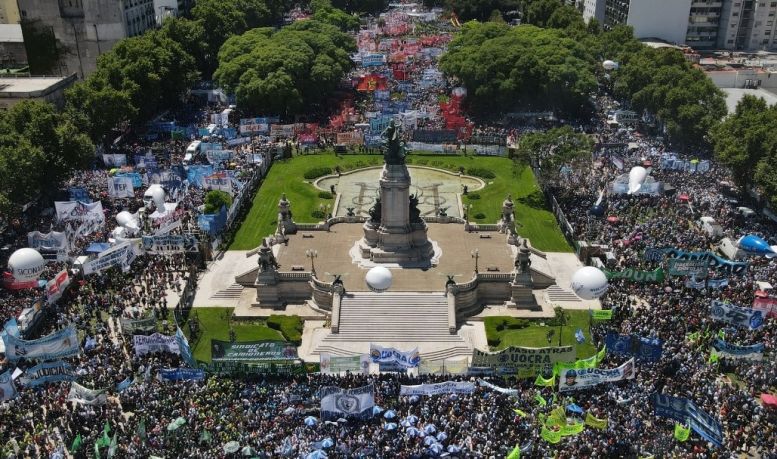
Early April saw the third general strike since Argentinian president Javier “Chainsaw” Milei took office in late 2023. This strike paralyzed travel: domestic flights were cancelled and trains and metro services in Buenos Aires and other parts of the country were shut down. Last October, hundreds of thousands of Argentinians flooded the streets to defend public universities and against Milei’s cuts to services, deregulation and tax cuts for big companies. Students, teachers and university staff were joined by workers in the state airline struggling against privatization, civil servants, trade unionists, social movements and political parties. While it is clear that the Argentinian working class is fighting back against the brutal cuts, the lack of coordination and combative leadership has left the struggle fragmented and weakened. Yet the working class has not been defeated.
Serbians and Turkish protest corrupt regimes
In mid-March, 5 percent of Serbia’s population participated in historic protests against the corrupt government of President Alexsandar Vučić. Sparked in late 2024 by the sudden collapse of the Novi Sad railway station canopy that killed 16 people, almost daily protests have gone from demanding the publication of documents related to the collapse, no persecution of student protesters and a 20 percent increase in higher education budgets to now demanding Vučić’s resignation, no more corruption and no more rigged elections. Nearly 60 percent of Serbians are supporting the protests.
In Turkey, over two million protesters are calling for an end to President Erdogan’s increasingly autocratic regime. Erdogan’s political rival, Istanbul Mayor Ekrem İmamoğlu was arrested and charged with being part of a criminal network, although it is more likely that İmamoğlu is guilty of being able to win the 2028 presidential election, even if it’s rigged. With annual inflation rates fluctuating between 40 and 90 percent over the past 5 years, a massive debt mountain and the Turkish lira falling by over 80 percent against the US dollar since 2018, food prices, rents and harsh austerity have undermined the living standards of both Turkish workers and the middle classes across all ethnic groups. İmamoğlu is the most widely supported opposition politician because of his “popular” style and unifying rhetoric towards Kurds and other minorities. He has also called for some welfare policies such as free bread, and green infrastructure.
So far, Serbian and Turkish protestors have not put forward alternatives to the deep economic, social and political crisis of capitalism in their nations, navigating between the imperialist interests of Russia, the European Union and the US. Trade unions and student groups must call for mass organizing meetings to debate the alternative needed. Coordinated general strikes could bring Vučić and Erdogan down, while new mass working-class parties should be formed to help organize the fight for this alternative.
Working-class struggle in France
France has seen major struggles in unions, climate movement, and movements against sexism over the last year. Insoumise (LFI) needs to urgently turn to the streets and the workplaces, using its resources and profile to initiate and build these struggles. Opening up and democratizing LFI has to be a crucial part of this, including organizing regular democratic decision-making conferences for the party’s rank and file, with debates and free discussion to decide LFI’s strategy and program. The estimated 400,000 supporters of LFI are largely detached from the party machine and have no democratic participation in making policy and selecting leaders. To face up to the tasks of this period, LFI needs to relaunch itself as a genuine mass party that workers, fighting trade unionists and youth, feminist and climate activists can not only support, but join and control — a party to call their own.
Revolution: well-burrowed old mole
Time and time again working-class people rise to fight for democracy, for better living conditions, for dignity. This is reason for optimism. It is not a question whether workers will fight for a better world, but rather a question of tactics, organization and program that will determine how far these struggles will go.
Whether these uprisings will result in the overthrow of regimes or even of capitalism will depend not just on material conditions and the strength of the working class. Guidance by a strong leadership, grounded in Marxist theory and practice, can make all the difference. As Trotsky wrote in 1930, “The characteristic of our epoch is the especially sharp changes of different periods, the extraordinary abrupt turns in the situation and this puts upon the leadership unusual obligations in the matter of correct orientation.” This is as true today as it was then.
Marx talked about revolution as a “well-burrowed, old mole.” Beneath the surface, the working class is stirring. When it bursts through the crust of the earth, the corrupt regimes that capitalism fosters will tremble.