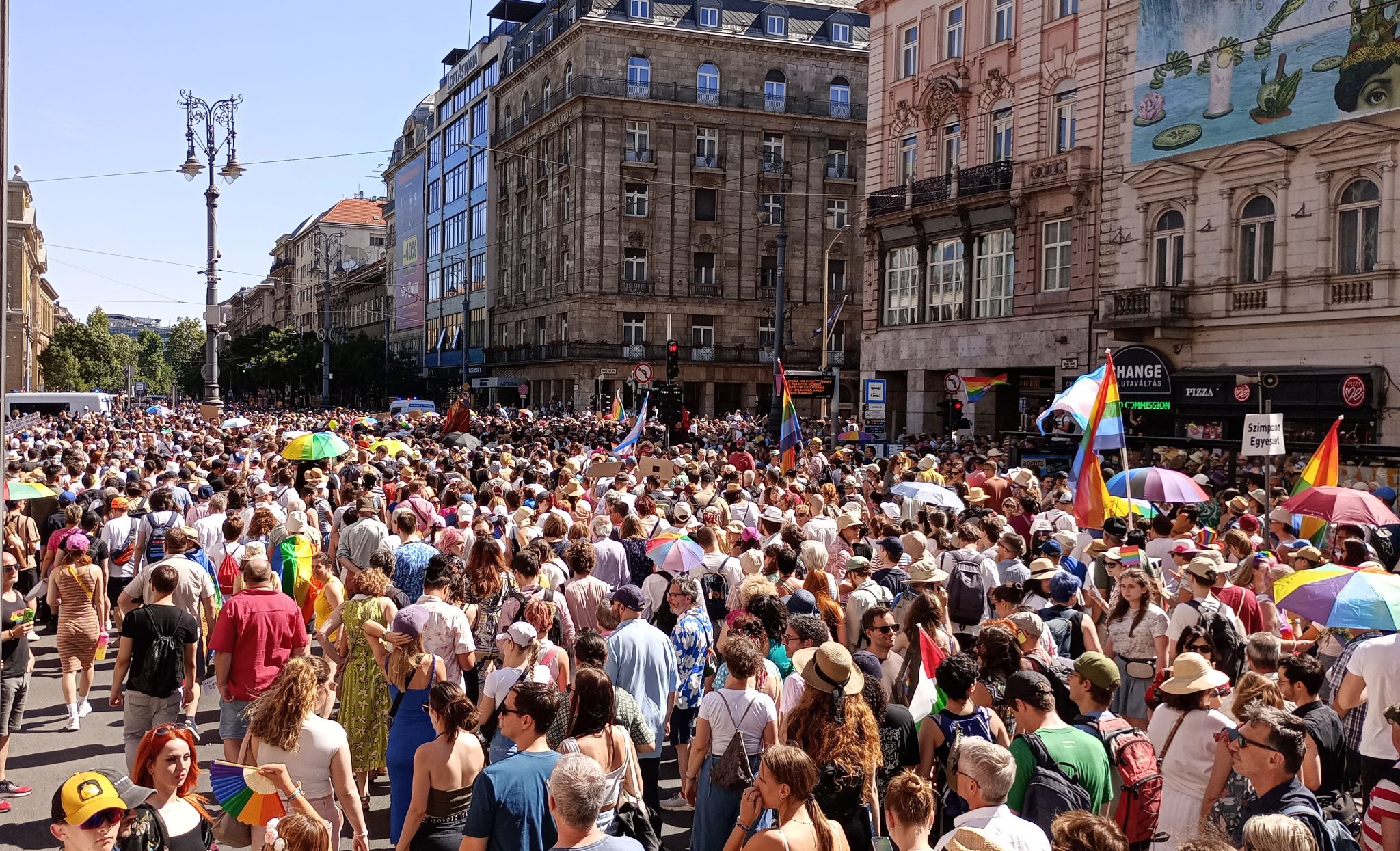
On June 28, 200,000 people took to the streets of Budapest in defiance of police orders not to gather. This was the date of Budapest Pride, an event which has taken place every year since 1995 and that Hungary’s far-right prime minister Viktor Orbán’s attempted to ban. Instead, the turnout at this years’ illegal Pride celebration was at least triple what the organizers anticipated, as people came out not just in support of LGBTQ+ people, but to show their opposition to the increasingly authoritarian Orbán government.
Orbán has been in power since 2010 as the leader of the national-conservative and self-identified “illiberal” Fidesz party. In 2021, the Hungarian Parliament passed its “anti-LGBTQ law” that prohibits promoting or displaying homosexuality or gender reassignment to people under the age of 18. In March 2025, Parliament passed another bill that bans “holding or attending assemblies that violate the law on the protection of children”, and therefore explicitly banning Budapest Pride.
The result of Orbán’s authoritarian overreach was not to suppress the Pride parade, but to transform it into a mass protest against his regime. People who would normally have stayed home from the Pride parade were incensed by the brazen violation of democratic rights of assembly and were inspired to come out into the streets, openly defying police orders to disperse and the regime’s threat of mass surveillance using facial recognition technology. This is just the most recent example of state repression backfiring on a government, including the events in Turkey, Kenya, and Bangladesh last year. In June, Trump’s mobilization of the national guard and US marines into Los Angeles to crack down on protests against deportations provoked the largest day of protest in US history.
These events highlight the ironic fact that authoritarian methods of rule are a sign, not of strength, but of weakness on the part of a governing regime. The ruling class turns to extreme methods of repression when it fears the strength of the working class, and these very same methods risk sparking a backlash that can threaten the stability of the regime itself. Once it was clear that the people were coming into the Budapest streets in record numbers, the police stood aside and took no action. This was not an act of restraint by the government, but rather it was to avoid exposing how the government’s unjust laws are unenforceable in the face of the mobilized power of the masses.
This is a stinging blow against Orbán’s regime, but Orbán is far from defeated. The government will now be regrouping and biding its time for a crackdown if and when it sees an opportunity. So far, the authorities have not engaged in mass arrests or reprisals against the protest organizers, but it should not be taken for granted that this will not be attempted. Pride organizers, trade unions, and other independent organizations of the working class and the oppressed must be prepared for future confrontations with the government.
Build a Real Opposition to Orbán and the Right
Dozens of Members of the European Parliament reportedly traveled to Hungary to attend Budapest Pride in defiance of the ban. International solidarity in defense of democratic rights and against the oppression of LGBTQ+ people is very important, but no trust can be placed in the liberal “progressive” capitalists and politicians. There is also a far-right backlash against LGBTQ+ rights across western Europe. There have been attempts to block LGBT-inclusive sex education from school curriculums, and an increasing use of “anti-propaganda laws” to suppress public discussion of these issues. So-called “progressive” capitalist politicians in the west are trying to portray themselves as the defenders of democratic rights and liberation of LGBTQ+ people against Putin-aligned eastern autocrats, but they have not been able to stop the rise of the far-right in their own countries and in many cases are echoing right-wing talking points. They don’t have any answers for the economic and social crises facing the working class across Europe, and their continued defense of the status quo in the face of declining living standards is the reason why the far-right has been able to gain in the first place.
The main political opposition in Hungary is Péter Magyar of the Tisza Party, who is currently polling ahead of Orbán in polls for the 2026 election. Magyar was an appointed official in the Fidez government since 2010, and has only recently fallen out with Orbán. Magyar cited corruption as the reason for his break with Orbán’s rather than significant ideological differences. He accused Orbán of trying to force him into coming out in support LGBTQ+ rights, something he has refused to do, and he opposed the ban of Budapest Pride only as a defence of the right of freedom of assembly. Magyar will be portrayed as the lesser-evil and Hungary’s best chance to get rid of Orbán in 2026. But Magyar fully supported the Orban government during the period from 2010 to 2024 when housing costs in Hungary increased by 234%, well over the EU average of 55.4%, and incomes increased by only 86%. Even if he’s elected, Magyar’s government will not resolve the significant social and economic crises in Hungarian society, and will only pave the way for a potentially even more extreme right government in the future.
What Way Forward?
The only reliable defense that workers and the oppressed have against state repression is their collective strength in numbers, linked with the economic power of the working class to stop the flow of profits for the bosses by withholding their labour. We have already seen this year the power of labour in Argentina where multiple one-day general strikes were organized against the Milei government’s ‘chainsaw massacre’ of cuts and attacks on LGBTQ+ people.
Despite attempts by these right-wing governments at divide-and-rule, events in defense of LGBTQ+ rights ballooned into generalized anti-government demonstrations. This exposes the completely incorrect instinct by some on the left to shy away from so-called divisive issues like LGBTQ+ rights to focus on purely economic questions. Rather than avoiding taking a stand against attacks on oppressed people, these issues should be linked to a broader working class program against repression and for things like affordable housing, union rights, and education.
Budapest Pride should not be a one-off event. Great care must be taken to ensure the safety of a movement in an authoritarian regime that will be willing to use violence against protestors. But the next steps must be to build for future mass protests, including possible strike action, that would seriously threaten the Orbán government.
The working class has no interest in supporting lesser-evil capitalists like Magyar in elections. Workers in Britain, including members of ISA, are showing a way forward by rejecting Starmer’s pro-capitalist Labour Party and beginning the difficult but necessary process of building a new independent working-class opposition. The process of building working-class political representation will be even more difficult in Hungary given the degree of state repression and a more fragmented trade union movement, but there are no shortcuts around the need for the working class to organize to fight on its own behalf. International solidarity from socialists and trade union activists in other countries can play a role in the building of a workers’ opposition in Hungary. Workers and youth in Hungary need to get organized now to build on the success of Budapest pride, not take a wait and see approach to the 2026 elections. If you agree, join International Socialist Alternative.