Per Johansson is a member of Socialistiskt Alternativ (ISA in Sweden)
In 1942, the US began secret work on developing an atomic bomb—it became known as the ‘Manhattan Project’. By 1943, enormous resources were being invested in the project, mainly at Los Alamos in New Mexico. The now legendary Robert Oppenheimer became the scientific leader. No cost was too high. Physicists from the United States, the United Kingdom and Canada were hired, as well as many physicists from Europe who had been forced to flee the Nazis because of their Jewish ancestry.
The driving force behind the development of the atomic bomb was the fear that Hitler’s Germany would be the first to develop this terrible weapon. Physicist Albert Einstein had already warned the US President of this risk in 1939. Soon the Manhattan Project had taken on a life of its own—by 1945, it employed 120,000 people.
The concern that Hitler’s Germany would get ahead was specifically about physicist Werner Heisenberg, a German physicist who won the Nobel Prize in 1932. Concerns about what Hitler’s Germany might develop were, of course, justified. US intelligence devoted resources to trying to find out what Heisenberg knew and how far Germany’s nuclear program had come. Their intelligence work showed that Germany and Heisenberg were nowhere near developing a bomb, and seemed to be on the wrong track technically.
However, US intelligence chose to conceal this fact, fearing that it would reduce the motivation of those involved in the Manhattan Project.
In May 1945, Hitler’s Germany finally surrendered, mainly due to the advance of the Soviet Red Army from the east and the advance of the United States and Britain from the west. The acute threat of the atomic bomb could thus have been called off. But the atomic bomb project continued.
On July 16, 1945, the first nuclear test was finally carried out, marking the culmination of the Manhattan Project. Robert Oppenheimer, usually referred to as the father of the atomic bomb, commented on the test: “We knew that the world would no longer be the same. Some people laughed, some cried, most were silent.”
War in Japan
The nuclear test had been carried out with a certain urgency. The US government wanted to have it ready before the Potsdam Conference held in July, when the leaders of the Soviet Union, the United States and Britain would meet to draw up new plans. The US could now hint to Stalin that it had a powerful new weapon.
The plan was to use the atomic bomb against Japan. The context of the war against Japan in July-August 1945 is important to understand.
Historian Christer Bergström describes: “Japan had by then been utterly crushed by the vastly superior American war effort. The navy was out of action and when all oil supplies were permanently stopped in April 1945, it was only a matter of time before Japan would collapse. In the meantime, the US Navy had entered the sea off the Japanese homeland. Every day, every night, Japan was haunted by American B-29 ‘superfortress’ bombers that could lay the Japanese cities in ashes and ruins almost undisturbed.”
Armadas of bombers had systematically bombed Japanese cities with napalm bombs. In Tokyo, as many as 100,000 people were killed in the firestorms that followed the firebombing of a city built mostly with wooden houses—at a time when Japan no longer had a functioning air force. In the case of Tokyo, this meant more deaths than the atomic bombing of Hiroshima. Estimates are that as many as 70 cities were destroyed in this way in 1945. Hiroshima was chosen as a target for the atomic bomb because it was one of the few cities that had not yet been bombed to pieces.
Japan had been trying to surrender for a long time, but the US would not agree to their demands. The Japanese military wanted, among other things, to keep the main Japanese islands and to keep the Emperor in office. The US said no and demanded an unconditional surrender.
The bombing of Hiroshima took place on August 6 and 90,000 people, mainly civilians, died instantly. On August 9, the US bombed Nagasaki and killed 70,000. Both attacks caused largely civilian casualties of no military significance. Further deaths would occur afterwards due to secondary diseases caused by radiation and radioactivity. But for the reactionary Japanese military leadership, it was just two more cities wiped out by US imperialism.
In the US narrative, the atomic bombs were necessary to force Japan to surrender. Nothing could be further from the truth. It was not the destruction of civilian cities that decided the outcome—wars are decided by military defeats. Even after Hiroshima, the Minister of War, Korechika Anami, pushed for the war to continue.
More decisive than the US atomic bombing was therefore what happened at midnight on August 9, when the Soviets finally broke the Japanese-Soviet Non-Aggression Pact that had been in place since 1941. That night, the Soviet army launched a massive surprise attack on the Japanese mainland army in Manchuria. This was so significant because Japan’s leaders had seen continued peace with the Soviets, in particular, as crucial to their ability to wage war against the United States. The Soviet attack resulted in the deaths of 80,000 Japanese soldiers and another 600,000 were taken prisoner. It was Japan’s biggest military defeat of the entire war.
It is important to point out that we are not supporters of the Stalinist Red Army. The war in Manchuria involved abuses of the civilian population by both the Red Army and Japanese soldiers. But unlike the atomic bombs, that attack had military targets.
On August 15, Japan finally surrendered. The surrender was due to the Soviet Union’s entry into the war and the United States’ eventual decision to agree to protect the Emperor.
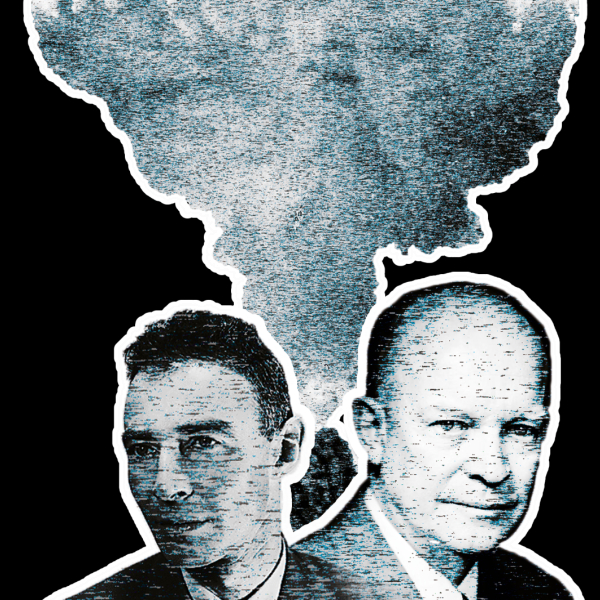
Several senior US generals had opposed the use of the atomic bomb against Japan. This included Dwight Eisenhower. Even the ‘father of the atomic bomb’, Robert Oppenheimer, had early doubts about what he had helped to create. He quoted the Hindu scripture Bagavad-ghita: “I have become death. A destroyer of worlds.”
The Most Powerful Weapon in History
Soon, everyone realized that a new era had begun. The bombing of the civilian cities of Hiroshima and Nagasaki had no military significance, but were political displays. US imperialism could now show the world that it had developed the most powerful weapon in history.
The atomic bombs are usually seen as the last battle of World War II and the first battle of the Cold War between the US and USSR. Major global superpowers quickly acquired nuclear weapons on a scale sufficient to destroy the entire human race.
The Nobel Peace Prize is sometimes awarded for seemingly incomprehensible and perverse reasons. However, in 2024, it was awarded to a well-deserving laureate: the Japanese grassroots movement Nihon Hidanko. The association was established in 1956 and is an organization of survivors of Hiroshima and Nagasaki, and of victims of nuclear testing in the Pacific.
No one can remain unmoved when hearing the testimony of one of its members from Hiroshima. Setsuko Thurlow was 13 years old when the atomic bomb was dropped on his city:
“I still remember that morning clearly. At 8:15 a.m., I saw a blinding blue-white flash from the window. I remember that I had the feeling of floating in the air. When I regained consciousness in the silence and darkness, I found myself pinned down by the collapsed building. I began to hear the faint cries of my classmates: ‘Mom, help me. God help me.’”