Governments across Canada have once again proven whose interests they serve — and it’s not those of working people, Indigenous communities or the environment. The federal Bill C-5, Ontario’s Bill 5 and BC’s C-15 are all assaults on democracy, land rights, and ecological protection in favour of corporate profit and unchecked development.
The Carney Liberals, Ford’s Conservatives and BC’s NDP claim they are acting in the public interest in response to a trade war by allowing rapid development of the Canadian economy through the speedy processing of plans for resource extraction and pipelines. In effect all these new bills use the machinery of the state to grease the wheels for massive infrastructure projects, pipelines, and mining operations — all while ignoring Indigenous sovereignty, weakening environmental assessments, and creating a fast track for private capital.
Other provinces, while not yet introducing sweeping legislation, are getting on the “Build, Baby, Build” craze. Alberta’s Danielle Smith wants pipelines “in every direction.” Manitoba’s Wab Kinew talks of an energy and goods corridor to export through Hudson Bay.
At the same time as rushing legislation to boost the fossil fuel industry, Carney’s Liberals plan to slash public spending by 15 percent in three years. So much for the claim of helping Canadians in a trade war. The reality is governments are helping big business, using the Trump’s tariffs as an excuse.
What is Bill C-5?
While the Carney government claims that Bill C-5, also known as the One Canadian Economy Act, restores “clarity and certainty” to the federal environmental review process, in reality, it weakens federal oversight of projects that cross provincial boundaries — particularly pipelines and extractive industry ventures.
Bill C-5 narrows the scope of federal environmental assessments, shifting power back to provinces — many of which have gutted their own environmental protection standards. The new framework conveniently makes it easier for fossil fuel projects to be approved with minimal federal scrutiny. This is a gift to corporations like Enbridge and Teck Resources — and a slap in the face to communities fighting to protect land, water, and future generations.
Ontario’s Bill 5: the same story
Meanwhile, Doug Ford’s Bill 5 pushes a similar agenda at the provincial level. Under the guise of speeding up infrastructure projects, Bill 5 allows the Ontario government to bypass environmental assessments and public consultations for large-scale developments — including highways, quarries, and transit expansions. This is not just about streamlining. It’s about bulldozing.
Bill 5 empowers the Minister of Infrastructure to override local opposition, ignore scientific assessments, and roll out projects on fast-forward mode — all while curtailing legal challenges and removing “red tape” (read: democratic processes). The bill includes provisions to establish “special economic zones,” where the government can suspend or overrule laws to protect labour rights, health and safety, and environmental protection. The province can even overrule local government regulations. Bill 5 is essentially a legalized wrecking ball aimed at Ontario’s environment and communities.
Entirely correctly, labour and Indigenous organizations have expressed strong opposition. Nine First Nations in Ontario argue that they are not anti-development. Rather, they advocate for “doing it right” by ensuring that necessary information is gathered before proceeding and rights and protections are respected “so the real costs of development do not end up far exceeding their asserted benefit.”
This follows the Ford government’s push for Highway 413, a multi-billion dollar boondoggle that threatens prime farmland, parts of the Greenbelt, wetlands, and Indigenous heritage sites. Ford’s government passed Bill 162, the Get It Done Act, to reduce the environmental review process of this proposal and other highways, such as his idea to build a 55 kilometre tunnel under Highway 401 across northern Toronto.
BC’s Bills 14 and 15: more of the same
BC’s NDP government has joined the dash to build with Bill 14 and 15. Both are to speed up projects by weakening oversight, environmental assessment and Indigenous rights. First Nations, environmentalists and local governments all oppose these Bills.
Bill 14 claims it is to help clean energy projects be approved faster. However, it has a clause to say clean energy can include a “prescribed resource,” no doubt at some stage this will include fracked gas. It already covers a new high voltage powerline to northern BC to support mining and liquefying fracked gas.
Bill 15 is to fast track construction. It is dressed up as speeding the building of hospitals and schools but no doubt the main beneficiaries will be building mines and other resource extraction projects by big business.
First Nations rights undermined
All three bills amount to continued colonialism. They violate the spirit of the United Nations Declaration on the Rights of Indigenous Peoples (UNDRIP), which Canada claims to uphold. UNDRIP requires free, prior, and informed consent for development on Indigenous territories.
These bills accelerate projects that disproportionately impact First Nations — pipelines through unceded land, quarries near sacred sites, and highways that disrupt ecosystems essential to traditional livelihoods. These laws treat Indigenous nations as obstacles to be managed rather than sovereign partners.
The Wet’suwet’en struggle in BC, where hereditary chiefs continue to resist the Coastal GasLink pipeline, illustrates the conflict between Indigenous law and the capitalist state’s priorities. These bills will entrench that conflict, using legal mechanisms to further marginalize Indigenous voices and deny land-back movements.
Carney has attempted to claim that Indigenous communities will be consulted and will see real benefits. However, many Indigenous people are rightly skeptical, given the long history of Canadian governments’ mistreatment and ignoring of Indigenous rights. Carney is dressing this up as “economic reconciliation,” where an Indigenous community or Nation gets a decade or two of royalties and then is left with seven generations of polluted and devastated land and water and all the life that depends on them. Some communities will sign on as they have been underfunded for decades and lack clean water or adequate housing and lack well-paying jobs.
On July 17, Carney had a meeting to “consult” with First Nations, but it was conveniently scheduled for after the legislation was already on the books. Doubts about the government’s commitment to the meeting grew as Carney’s office delayed providing information to chiefs about the plan for the event, asked for questions to be submitted in advance and put restrictions on who could attend. One national leader commented that a single day of face time is not enough. Some leaders were hopeful but many either walked out or expressed their dissatisfaction.
Environmental destruction as policy
At a time when climate scientists are issuing red-alert warnings about climate disasters, biodiversity collapse and ecological tipping points, capitalist leaders are doubling down on destruction. These bills are designed to weaken environmental protections in order to push forward more highways, oil infrastructure, and resource extraction projects.
They ignore that the world is in a climate emergency — an emergency created and perpetuated by capitalist exploitation of land, labour and resources. Rather than investing in mass public transit, retrofitting buildings, renewable energy or protecting watersheds, these bills reward the very industries responsible for ecological collapse.
Ford’s obsession with suburban sprawl and private car culture is paired with an indifference to transit funding and green infrastructure. The Liberals, for their part, continue to fund the Trans Mountain pipeline with public money while paying lip service to net-zero goals. It’s greenwashing on a national scale.
Infrastructure for who?
Working people need safe, reliable roads, clean water systems, housing and accessible public transit. But infrastructure under capitalism is built for corporations, not for communities.
When corporations dictate development priorities, pipelines are more important than clean water in Indigenous communities. Luxury mansions and condos are built, not affordable housing. Highways plough through farmland to spread suburban sprawl instead of strengthening transit for working-class neighbourhoods.
Whose laws? Whose interests? Why the rush?
Capitalists’ profits come from exploiting workers and robbing nature. When environmental protections stand in the way of profit, they are rolled back. When Indigenous land claims conflict with mining operations, they are ignored. When people rise up to defend the land, they are met with injunctions, police and surveillance. Bill C-5 received royal assent in late June, just 20 days after the Liberals first tabled the legislation.
Fortunately, the leaders of Indigenous communities have not just rolled over and accepted the hurriedly implemented laws. Nine Ontario First Nations have launched a court challenge which, in part, states “While the laws do leave open or commit that there will be some First Nation consultation at the very first stage … involvement in that decision alone is a smoke and mirrors trick, deflecting attention from all the other ways the laws necessarily diminish the ability of First Nations to engage on the regimes’ broader consequences.”
The courts and RCMP are used to protect profits and private companies, rather than the right to clean water, land and air.
What’s the alternative?
Socialist Alternative rejects this corporate-dominated model of development. We demand:
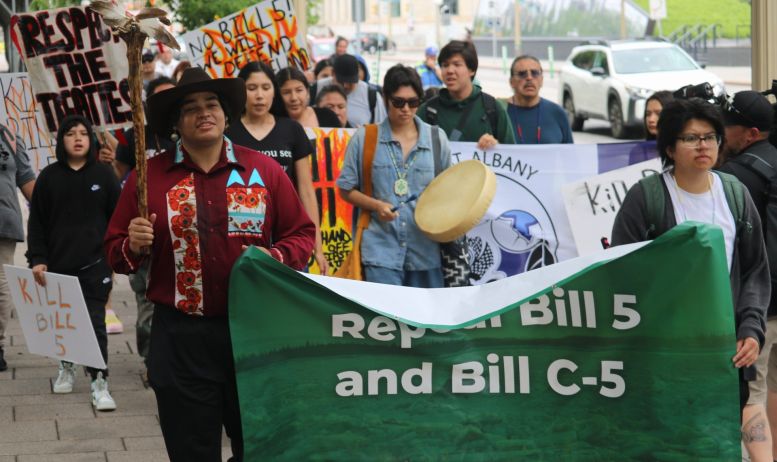
- The repeal of Bill C-5, Ontario’s Bill 5 and BC’s Bill 14 and 15.
- Full respect for Indigenous sovereignty.
- Planning of infrastructure, with workers’ and land rights, including the right to veto projects on Indigenous territories.
- Democratic planning of infrastructure with workers, communities and Indigenous nations at the table.
- A just transition away from fossil fuels and toward a green, worker-led economy.
- Nationalization of key industries (energy, construction, transit) under public ownership and democratic control.
These policies will not be implemented by the present politicians who have shown that they will side with developers and extractive industries. Real change will only come through mass movements, grassroots resistance, and socialist organization.
From the front lines of Indigenous land defence to the picket lines of striking workers, there are the makings of a fight back. But we must unite our struggles — link the climate fight to the labour movement, tie Indigenous sovereignty to working-class solidarity, and fight not just individual policies but against the capitalist system that produces them.
The fight for climate justice, Indigenous rights, and democratic development is a fight against capitalism itself. Workers need a massive green public infrastructure program that is publicly owned and democratically controlled. That is a society that no longer favours corporate profits but instead puts workers, Indigenous peoples and nature at the centre.