Air Canada and Government Defeated
Flight attendants working for Air Canada have won a victory for themselves and the entire the labour movement. In addition to winning important gains for themselves, their determination to defy the Labour Board’s return-to-work order has reinforced workers’ right to strike. The 10,000 members of the Canadian Union of Public Employees (CUPE) Air Canada Component, over 70 percent of whom are women, stood strong against the company’s penny-pinching pay offer and government bullying.
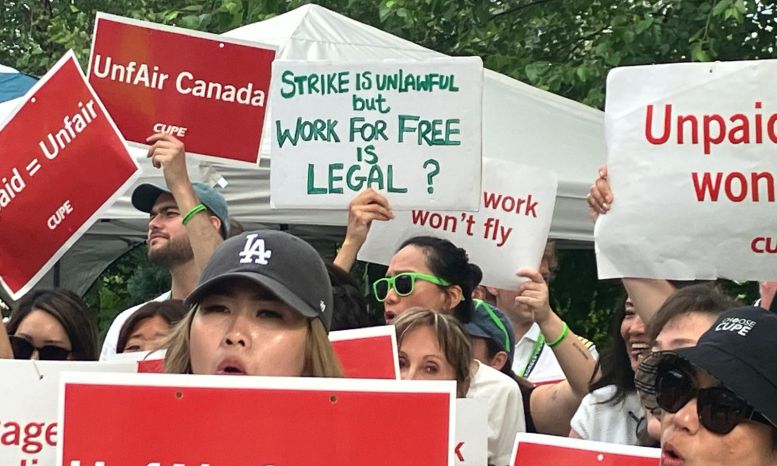
Their last contract, which ended in March 2025, had been for ten years so there was a lot of ground to catch up. Their key demand was to end unpaid work. In addition, the workers wanted a pay increase to compensate for recent years’ inflation. The time flight attendants work before takeoff and after landing — groundwork — was unpaid and often added up to 35 hours a month. Groundwork includes helping passengers board and leave the plane, loading baggage, often heavy, into the overhead bins, during safety checks before take-off and, if needed, evacuations on the ground.
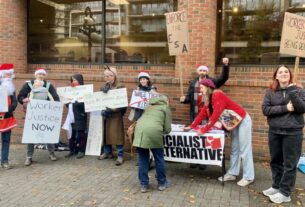
After an overwhelming 99.7 percent voted in favour of a strike in July, they walked off the job on Saturday, August 16. After three days of the strike, with boisterous and determined pickets and rallies at airports across the country, the workers forced the company to back down, and the workers had a victory.
Air Canada and government’s strategy failed
Air Canada’s senior management’s strategy in the negotiations seemed tried and tested. They aimed to short-change the workers to boost the corporation’s profits and their own pay. They made a low-ball pay offer and refused to consider paying for groundwork. They negotiated in bad faith, dragging out the negotiations, assuming, rightly, that once the workers went on strike the government would intervene to order the strike to end. This had been done successfully in many previous strikes. In the past the government used back-to-work legislation, but recently they have turned to Section 107 of the Labour Code, which avoids the inconvenience of having any debate or vote in parliament.
All was going to plan on the first day of the strike. Less than 12 hours into the walkout, the government used its favoured anti-worker weapon, ordering the flight attendants to resume work and appointing an arbitrator to impose an agreement.
But there was a problem. The workers and union refused to go along with the plan and stayed on strike. On Monday, August 18, the government declared their action “illegal,” which carries the risk of court orders that could include fines or prison. Still the union stood firm.
The company and government saw their foolproof plan backfire. So confident were they that the workers would quietly obey that there was seemingly nothing to fall back on. Michael Rousseau, Air Canada’s CEO, admitted as much in a Monday morning interview on BNN Bloomberg, where he said, “Well, we thought, obviously, the Section 107 would be enforced, and that they wouldn’t illegally avoid Section 107.” That evening, Air Canada returned to the negotiating table. Within a few hours a tentative agreement was reached and the strike ended. The flight attendants had shown that they do have power when they stand strong. Union power is a great educator as Air Canada and the government discovered!
What have the attendants won?
While the official details of the agreement have not been released, reports show significant gains for the workers.
Most importantly, groundwork is now accepted as work and should be paid. While the union did not win full pay for all groundwork, it has established a principle that it is part of the collective agreement and can be improved in future contracts. The 1937 auto-workers sit-down strike at General Motors in Flint is viewed as a historic victory for workers. It gained little in pay but gained the right to organize the union. Having won the union, autoworkers went on to win real pay rises in future years. The win at Air Canada will spread to other airlines. The federal government has announced it will investigate unpaid work in the airline industry, which may bring further changes.
Another win is a bigger pay increase, of an extra 4 percent for workers with less than five years employment, as many of the newer workers were earning below Canada’s federal minimum wage of $17.75 an hour. This is a welcome reversal of two-tier contracts that have been common in recent decades, which had worse pay and conditions for new starters than longer-standing employees.
The union did not win its full demands and might have won more if the strike had continued longer. It would have been better to continue the strike until the members had time to see and vote on the agreement. On the other hand, the show of defiance in the face of the government’s and employer’s bullying won a much bigger victory: a potentially fatal blow to Section 107 and a historic defence of the right to strike.
A win for all workers
What is crucial is that the airline attendants have emboldened workers, unions and the labour movement to stand up against the recent efforts of employers and governments to weaken this fundamental right. The biggest win of all is successfully defeating the tactics of Air Canada and the government. Section 107 is now much discredited, now the unions will fight to abolish it. Other unions will draw the conclusion to follow the fight attendants’ example of standing firm against government attempts at intimidation.
This victory will strengthen workers’ power and force employers to seriously negotiate, rather than go running to the government. This is a gain for all workers.
For more on the background to the strike.