Times are tough for working-class people in Canada. The cost of living keeps going up, including the cost of housing, debt, transportation, and groceries. Wages aren’t keeping up with inflation. People are struggling to pay rent in inadequate or poor-quality housing, and welfare rates are insufficient to keep recipients above the poverty line. Youth face record levels of unemployment and university graduates increasingly find that their degrees can’t get them a job that can pay off their student debt. When unionized workers fight for better pay and working conditions, they face nothing but resistance from the Liberal government, which intervenes to help the bosses wherever possible (page 6).
On top of all this, Donald Trump is coming after the Canadian economy and threatening people’s jobs and livelihoods, even threatening to make Canada the 51st state. Mark Carney’s Liberals won the federal election because he was seen as best able to lead the country through these crises and stand up to Trump. But after a few months, the Carney government is capitulating to Trump in the trade war in order to protect big business, pushing through massive public spending cuts that will make working people’s lives even harder. Yet at the same time the government can find billions for weapons of death and destruction.
Carney cuts deep
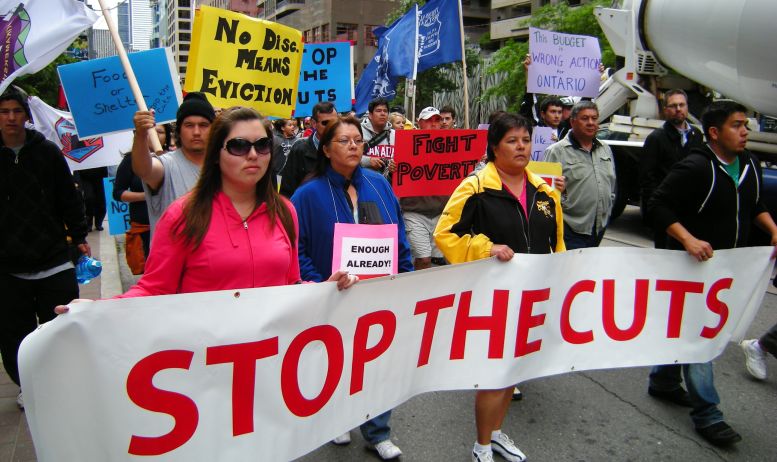
A July Canadian Centre for Policy Alternatives report estimates that Carney’s plan for federal departments to cut their budgets by 15 percent could result in up to 57,000 full time job losses in the federal government between 2024 and 2028. These are workers who help people get their Employment Insurance and pension payments, issue passports, and ensure food and medications are safe. Other national public services, including CBC/Radio-Canada, Via Rail, the National Gallery of Canada, the Canadian Museum of Human Rights, and Statistics Canada face the same across-the-board cuts. Things like dental care, services for Indigenous communities, environmental protection programs, scientific resources, and veteran support, are all at risk. These cuts will be historically deep. As CUPE National President Mark Hancock put it, “not even Stephen Harper could dream of cuts this deep.”
Not all departments face such deep cuts. The Department of National Defence, the RCMP, the Canada Border Services Agency, the Supreme Court and the Parliamentary Budget Office are only being asked to cut 2 percent from their existing budgets. In other words, the repressive state apparatus is being spared, while services that help working-class people are being slashed.
There’s always money for war
Carney plans to redirect all this public spending towards the largest increase in military spending in 75 years. For the last 25 years, Canada has typically spent between 1 and 1.2 percent of GDP on the military, and never more than 1.4 percent. Now Carney has announced he’ll join Trump and other NATO allies in raising defence spending to 5 percent of GDP by 2035! This would cost the Canadian government an estimated $150 billion per year.
That’s $150 billion that will not be spent to build desperately-needed public housing, mass urban and long-distance transit and rail, or improving healthcare, pharmacare, dental care, long-term care, or childcare. Instead that money will be spent on weapons, bombs, and military bases. Not only that, the Canadian government continues to aid and abet a genocide in Gaza. Despite multiple assurances from the Canadian government to the contrary, a report in July by Arms Embargo Now revealed that it has continued to send arms and military equipment to Israel.
Is this what “elbows up” means?
In the trade war with Trump, Carney is under fire for backing down, rescinding the Digital Services Tax, and signaling that any negotiated deal with Trump would include some tariffs. In August, Trump increased the across-the-board tariff on Canadian goods not covered by the Canada-US-Mexico free trade agreement (CUSMA) to 35 percent. While 95 percent of Canadian goods exported to the US are covered by CUSMA and thus exempt from the 35 percent tariff, Trump’s Commerce Secretary Howard Lutnick signalled that Trump will want to renegotiate CUMSA next year. The US ambassador to Canada, Pete Hoekstra, has questioned the future of the agreement. He criticized the Canadian government’s 25 percent counter tariffs on some US goods, including those covered by CUMSA. Carney has now backed off on many tariffs.
In a recent meeting between Mark Carney and Ontario Premier Doug Ford the two leaders agreed that if they could not prevent Trump from imposing tariffs, they should instead focus on “the things they could control” by building up the Canadian economy. But their plans will only protect big business profits, they won’t protect jobs or the environment. The so-called “one Canada economy” plan to remove inter-provincial trade barriers is really a race to the bottom on environmental and labour protection as actual barriers to trade between provinces are grossly overstated. Carney’s plan to support prefabricated housing construction and to protect the Canadian steel and softwood lumber industries are sold as plans for more affordable housing and to protect jobs. His real purpose is corporate handouts to the steel and softwood lumber bosses and to private housing developers.
Workers need a socialist alternative
Carney’s policies will not actually make housing more affordable, and there is no guarantee that jobs in the steel or softwood lumber industries will be protected. All they will do is line the pockets of the bosses and help them to continue to export resources and products for profit. These policies won’t create new jobs and provide needed goods and services.
A socialist plan to protect jobs and the environment would involve the public ownership of steel, softwood lumber, and housing development corporations. This would allow democratic control, with society collectively deciding how to use the steel and lumber produced by Canadian workers to improve the lives of their families and communities. This would include a mass program of public housing construction and an expansion of transit and rail infrastructure, including electrifying and twinning most of the railway lines. Passenger rail would be re-established between all the country’s major cities and towns, with high-speed rail between Windsor and Québec City, and between Calgary and Edmonton.
To protect working-class people’s homes, livelihoods, and the environment, fossil fuel companies should be taken into public ownership for a planned phase-out of fossil fuel and nuclear power, along with a rapid expansion of renewable energy production and storage including wind, solar, water and geothermal energy, including guaranteed jobs and reskilling for workers.
For an international working-class anti-war movement
Unfortunately, for the working class, none of the major political parties are putting forward alternatives to Carney’s cuts, corporate handouts, and jacked up military spending. The NDP has opposed Carney’s plan to spend 5 percent of GDP on the military, but only as an “excessive focus on security.” The NDP does not oppose the imperialist Canadian military or NATO, believing that they just need to be managed more responsibly. Working-class people that are horrified by the escalating war, destruction, and genocide in Gaza are not likely to be impressed by the NDP’s pledge to be the kinder, gentler, imperialists.
Working-class people have every right to defend themselves and their communities from invasion, including by force of arms. But NATO military forces, including the Canadian military, do not exist to protect working-class people; they exist to protect the Canadian bosses and corporate profits and the interests of their imperialist allies, including US imperialism and the genocidal Israeli government. Working-class solidarity and opposition to all forms of imperialism is needed.
International Socialist Alternative is calling for an international anti-war movement and for the working class in every country to organize and to use its power to block ever-expanding militarization and prevent the bosses from marching us off to the next world war. The working class in Canada is not in this together with the Canadian bosses, nor with the bosses in any other country. Workers share an interest with the working classes of all counties and can best secure these interests through solidarity and a common struggle against the global capitalist class.