
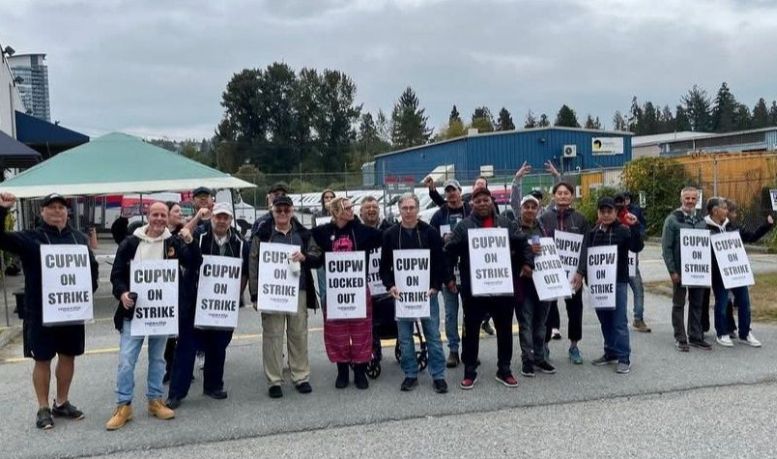
Mark Carney’s Liberal government launched a surprise assault on Canada’s 55,000 postal workers on September 25. This intensifies the battle for the future of Canada Post. In November 2024, the 33-day strike of CUPW members was stopped by then-Labour Minister Steven MacKinnon’s invocation of Section 107 of the Canada Labour Code, forcing the posties back to work. To stop the Liberal government’s latest attack, the postal workers walked off the job on September 26. Now, with all-out war declared, it will take a major increase in union militancy and public support to save the public postal service from a government determined to gut it.
Encouraged by the assault on Canada Post’s services, the top management made a new and worse offer to the union. On October 3, the latest offer weakened language on job protection and withdrew a signing bonus of $1,000. The bosses at Canada Post have no interest in bargaining in good faith.
Carney’s new lieutenant in this bloodletting is Joël Lightbound, the minister of government transformation, public services and procurement. His mandate from his boss is plain: to transform Canada Post from a public service into a shell of a public service. In his speech from Parliament Hill, Lightbound went by the Carney playbook: that in these troubled times, we are making the tough choices that the Canadian people gave us a mandate to make. The fact that these tough choices are uniformly made to the benefit of big business and the detriment of workers is not simply an unfortunate coincidence — the government wants to slice away the biggest and most profitable parts of the postal service, so that their friends in the private sector can gobble them up.
Canada Post is a public service. It is supposed to serve all Canadians, regardless of where they live, with quality postal delivery. No one, except a few extreme reactionaries, suggest that firefighting, the health system or sewage treatment should make a profit. So, there is no reason to expect it of the postal service.
What’s in this attack?
In a press conference of less than 45 minutes, Lightbound confirmed that the Liberals are taking up every one of the attacks against the postal service that the previous Conservative government of Stephen Harper could not push through, the same attacks that the Liberals swore they were opposed to in the election of 2015.
The ending of all door-to-door mail delivery is the most glaring attack. Outdoor community boxes, already forced upon about 75 percent of households over the past several years, are to become the norm across the country. For those who can’t or don’t wish to make the trip down the block (or, in some smaller towns or rural areas, several kilometres) in rain and snow that posties currently make daily, the private sector and their low-paid workers will somewhat fill the gap.
These community boxes, new and existing, will also be serviced less frequently, as the government is ordering an end to daily deliveries for most residential addresses. With other cuts, most people can expect to wait longer and pay more, directly or indirectly, for new passports, government documents, credit cards, and the “final leg” of private deliveries.
Lightbound claimed that “rural, remote, and Indigenous communities” will continue to receive Canada Post service. In the same speech, he announced that he was opening the door to widespread closure of rural post offices. Coverage will still exist but will be greatly reduced and operate at a proportionately worse loss than Canada Post currently does overall. Will a future government further cut or even end this reduced service, as rural emergency rooms and other services have been ended?
He’s also trying to make postal workers and the public pay for the myopia of Canada Post’s leadership, which for decades has been focused on attacking working conditions and benefits instead of effectively transitioning the company to the new mail landscape. CUPW had indicated a willingness in negotiations to move to seven-day-a-week deliveries from five, to make Canada Post package deliveries more attractive to customers, so long as these new shifts were filled by full-time workers with scheduling based on seniority. If Canada Post’s management had as its top priority strengthening the postal service, it would have gladly taken up this offer. But as the real top priority is driving down benefits and casualizing the workforce, management continued to insist on part-time and temporary workers taking up this new load.
“While letter mail volumes have declined,” Lightbound said, “Canadians have been sending and receiving more packages than ever before. But they are turning increasingly away from Canada Post and toward private competitors who are faster and more cost-efficient. In 2019, Canada Post delivered 62% of all parcels sent in Canada. Today, it’s less than 24%, and shrinking fast.”
The drop in Canada Post’s delivery of parcels is due to bad management. Canada Post is cheaper than the private companies and delivers to the door unlike the private companies. In rural areas and small communities, the private companies use Canada Post to do the last leg of the delivery!
Yet the decline in parcels has no consequences for Canada Post’s very well-paid and very numerous executives, though Lightbound said that the company must now address administrative bloat at the top. But Canada Post management’s failures of vision have led to very profitable results for private parcel delivery companies FedEx, UPS, and Amazon. It’s also true for Purolator, a private deliverer 91 percent owned by Canada Post, which has enticed business away from the public service through special lowered rates during both phases of this dispute and posted a $294 million profit in 2024.
Workers face existential crisis
The response of postal workers to Lightbound’s salvo was nearly immediate. Less than an hour after the minister’s announcement, Atlantic region CUPW members walked off the job, without a blessing from headquarters in Ottawa. CUPW’s national leadership had been successful in cracking the whip in December to prevent locals or regions from defying the government’s Section 107 back-to-work order. But this time, presented with the Atlantic region’s fait accompli, they knew they could not hold back a full nationwide strike and so decided to call it themselves. Postal distribution centres across the country were full of chaotic energy as shop stewards dashed from room to room telling their fellow posties to down tools straight away, and as calls went out to letter carriers on their routes to not deliver to one more address and instead return to their station. The picket lines went up the next morning and continue now.
In the strike of November and December of last year, the privatizers couldn’t quite keep their talking points aligned. Most of the big-business-owned media tried to paint a public postal service as antiquated or even irrelevant: “the government must smash the union’s right to strike because these jobs are pricey relics.” But the voice from small business was the opposite: “the government must smash the union’s right to strike because we are so dependent on the postal service.” This time, big business will be much more plainly in the driver’s seat, and small businesses will have to endure a very bumpy ride. Canadian Federation of Independent Businesses president Dan Kelly said that the “federal government must push forward with the needed changes ordered today by Minister Lightbound. Now is not the time to turn back.”
The choice isn’t “austerity or bust”
It is undeniable that the postal service cannot continue along its current path. But that does not mean an inevitable embrace of Carney’s mania of cuts and preparation of privatization. A far more inspiring and egalitarian future is possible for the 158-year-old national mail outfit.
Socialist Alternative has long been a proponent of CUPW’s Delivering Community Power program, launched in 2016. This plan is not one to simply keep Canada Post on its current track for a bit longer. It is a deep-going expansion and redefinition of what a modern public postal service ought to be — in ways that make it easier and more appealing for ordinary users, and which the powerful would like far less. It includes such measures as postal banking, in which Canada Post offices in every city and town would also accept deposits and perform basic banking functions such as loans and insurance. This could be done at more advantageous rates for customers, as the removal from the system of billions of dollars through private profit would not take place. This is just the reason that the private banks successfully got the Liberal government of Lester Pearson to kill postal banking in 1968.
An aspect of Delivering Community Power which posties are especially passionate about is elder check-ins. Elderly people, in addition to being more reliant on door-to-door deliveries of everything from bills to letters to medications, can often live isolated lives. A letter carrier may be the only person they see for several days. An opt-in program of postal workers checking in on seniors along their route would provide some brief but valuable social interaction most days and be potentially lifesaving if they’ve suffered a medical emergency that a postie notices in time.
What is CUPW leadership’s plan?
Over the course of last year’s month-long strike, morale at picket lines was initially high and there was plenty of pointed language directed against Canada Post’s horde of executives, their high salaries and their implementation of out-of-touch policies ranging from separate sort and delivery to fleets of electric delivery vehicles with barely any charging stations to plug them in to.
But as days stretched to weeks, workers wondered what their leadership’s plan for victory in the strike was, or if one existed at all. There were some sporadic actions of local officials targeting Liberal MPs, but even these were largely kept secret and divorced from members on the line. Most postal workers were left simply to cover their picket shift and wonder to one another what might happen next. What if there had been large and consistent rallies in city centres, designed to draw other unions and the public into action, headlined by the positive and exciting demands laid out in Delivering Community Power?
A union press release from May 2024 declared that “[f]or nearly a decade, CUPW has been promoting its solutions as part of its Delivering Community Power campaign.” But did this really take place? Releasing a good plan of worthwhile reforms and truly campaigning for it are not the same thing. Unfortunately, CUPW’s leadership seems to have mostly shelved active and public organizing around Delivering Community Power shortly after its launch in 2016. Socialist Alternative took part in the initial public meetings, but the campaign was soon relegated to the same old backstage lobbying of politicians that so many unions turn to with such little effect. As a result, not only is the Canadian public almost totally ignorant of Delivering Community Power and its many demands, which would prove popular, even many rank-and-file CUPW members unaware of its existence.
The years lost are being felt now, but it’s not too late. Those public rallies can still be built, and meaningful links with other unions — some of whom are in active struggles of their own, like BC government workers and Alberta teachers — can be forged. Indeed, this is crucial to escalate and bring a sense of forward momentum to the strike, instead of simply waiting for funds to run low or the government to unleash another attack. The decision by CUPW to picket Purolator is encouraging, and the leadership of the International Brotherhood of Teamsters must declare that its members will not cross those lines, which it has so far failed to do.
The brave stand of the Air Canada flight attendants in August, disobeying a Section 107 strikebreaking order, made another use of that tactic much harder for the government. But Carney, Lightbound, Labour Minister Patty Hajdu and their friends could bring heavier guns to bear — perhaps passing back-to-work legislation through Parliament with Conservative help, although the Tories may hesitate in order to keep up their pretense of being pro-workers. The Liberals could utilize Sections 100 and 101 of the labour code that provides for large fines to unions and workers who dare to stand up.
A big fight against big odds
The alliance between the federal government and the heads of Canada Post has been a durable one over the decades, but Carney is as popular now as he’s ever likely to be and he needed to get a win back over labour after the setback of the flight attendants’ defiance. This government- and management-created crisis is one that the government and management don’t intend to waste. The consequences of a defeat are dire: thousands of job losses, worse conditions in surviving jobs, far worse postal coverage. The ruling class is aware of this and it’s what they want, even if some of them would prefer the benefits of a strong and stable postal service in the interest of their own operations. Dealing the working class a defeat is higher on their list of priorities.
Avoiding that defeat will require a major push from the rank-and-file of CUPW to spur on, and even overtake, their leadership. A public-information campaign, belated as it is, to show what a healthy and ambitious twenty-first century postal service can be is necessary, as is major solidarity from other unions and their own members. The energy and bravery of the flight attendants must be replicated and expanded. Carney and the Canada Post bosses can be beaten, but CUPW and the Canadian labour movement can’t return to the old road.