One year before the provincial elections, Québec’s premier, François Legault, no longer needs to pretend at “social dialogue.” He now openly exposes his anti-union agenda.
Various propositions for attacks on unions have circulated within Québec’s Labour ministry, even suggesting a questioning of the Rand formula, which is a foundation of Canadian unions since 1946. This requires employers to deduct union dues at source, from the payroll.
Québec Labour Minister Jean Boulet confirmed in mid-October 2025 that he will move forward with an attack on union regulations. The Rand formula would remain intact, but part of the contribution — the one intended for political activities — would be subject to separate rules. Each union will have to hold an annual general meeting to submit a political activity budget to a vote. Members will then be able to opt out of that budget. The project would also provide for a revision of the rules governing strike votes and the publication of financial statements.
This is a continuation of the Legault government’s anti-union agenda and is inspired by so-called right-to-work policies in the United States, which allow workers to refuse to join a union, even when they benefit from a union-negotiated contract. This freeloading on other workers’ dues aims to weaken the political and social capacity of the organized working class.
A logical continuation of previous attacks
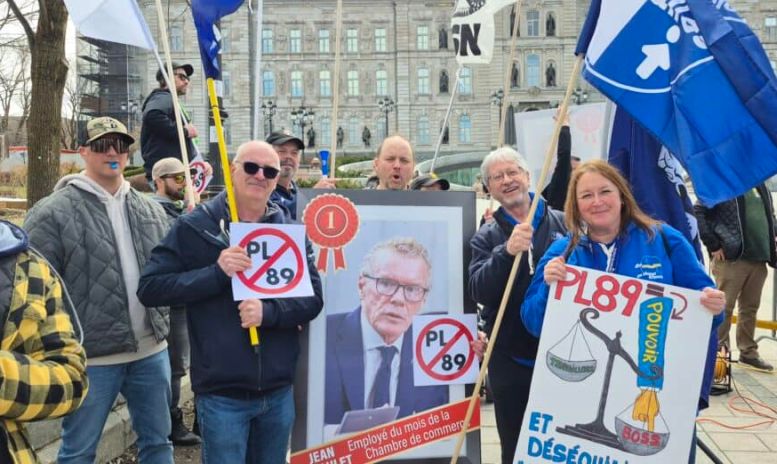
The Boulet changes are part of a sequence of attacks against the trade union movement. Adopted in spring 2025, Law 89 — An Act to better consider the needs of the population in the event of a strike or lockout — introduced a mechanism allowing the Minister of Labour to intervene in private sector conflicts. If a strike is deemed too long or too disruptive, the minister can impose arbitration, thus removing workers from their main means of leverage.
This provision, inspired by repeated interventions by the federal government in conflicts such as those of Canada Post, the rail sector and more recently Air Canada, marks a turning point in the management of labour relations in Québec.
While the purpose of Law 89 was to weaken the economic balance of power of workers, the proposed new law will have a more political scope.
A strategy inspired by American conservatism
Boulet’s attack is inspired by anti-union policies implemented in the US. An initial version of the bill even envisaged allowing employees to withdraw individually from their union unit, putting an end to the obligation to contribute.
The union density rate in the United States today is around 10 percent, compared to nearly 40 percent in Québec. In the American private sector, it falls to 6 percent. This decline from a high point of 35 percent in the 1950s, is the result of a sustained employer and political offensive, led by all fractions of American capital. The decline in the union density rate is also the result of the poor strategies adopted by union leadership to respond to these attacks. Rather than mobilize resistance, they preferred to collaborate with capitalist political forces, notably the Democratic Party.
Recent years saw a wave of mobilization, labour disputes (Autoworkers) and unionization (Amazon warehouse, Starbucks chain). The return of Donald Trump, and with him the most reactionary face of capitalism, increases the pressure on unionized workers. Most of the union leadership, rather than putting forward an independent workers’ political alternative, have tied the unions even closer to the Democrats. Others, such as Sean O’Brien of the Teamsters, have even tried to ingratiate themselves to Trump.
Québec unions: a social force against the reactionary agenda
For their part, Québec unions are not officially linked to any party. If specific unions occasionally maintain links with certain parties, today they refuse to align themselves with any party, invoking the restrictions of the electoral law imposed by the Parti Québécois during the 1970s.
This “political neutrality” does not prevent unions from being the main force of labour and social movements in Québec. They have considerable resources — contributions, legal expertise and mobilization capacity — and can support social struggles on the financial, logistical and organizational levels. There are more than 1.3 million unionized workers in Québec.
Despite conservatism and the too-often institutional approach of their leadership, trade union organizations remain the main bulwark against the reactionary agenda of bourgeois parties, whether it is the increase in the federal military budget or the racism and xenophobia of the CAQ. The support of the Autonomous Education Federation (FAE) in the fight against Law 21 (law that prohibits public sector workers from wearing religious symbols such as a turban, cross or kippah) bears witness to this.
By splitting contributions and restricting their political use, the Legault government seeks to neutralize this capacity for intervention and divide the union ranks.
An attack that goes beyond the anti-union DNA of the CAQ
This anti-union offensive is not a simple case of electoral opportunism. It is part of a global economic dynamic marked by the end of free trade, the rise of protectionism and inter-imperialist tensions.
The Canadian economy, strongly integrated with the US, is suffering the repercussions of the increase in customs tariffs and protectionism. To maintain profit rates, or limit their decline, Canadian employers seek to reduce variable capital costs — wages, benefits — and intensify work by integrating new technologies such as artificial intelligence.
The state, both federal and provincial, intervenes more and more in favour of capital, even if this leads to the loss of billions in public funds: industrial subsidies (Northvolt, Lion Électrique, SAAQclic), arbitrations imposed in labour conflicts, the increase in the military budget. These policies herald increased social tensions between the working class and state-assisted employers, especially in a context where inflation may resurface and employers are reluctant to make concessions.
In this situation, weakening unions becomes a structural necessity for capital. Boulet’s policies aim to reduce the unions’ capacity for political action before economic contradictions open the door to new social movements. Even if the CAQ loses power, this trend will continue under future governments, whether PQ or Liberal.
Beyond symbolic union actions
In this context, economic union struggles must take on a political dimension to succeed. But reacting symbolically, through press briefings, spontaneous actions and lobbying among capitalist elected officials is not enough. No appeal to reason, dialogue or good moral arguments will change the trajectory of the next government.
Despite how radical unions may be in their public declarations, if campaigns rely solely on public relations to shame the government into listening, they are, and have been, doomed to fail. Even the most militant actions can leave a bitter taste when used for purely symbolic objectives. Instead, they need to pave the way for an authentic social movement. The goal of such movements should be to build long-term struggle, prepare for new battles and politicize members.
Union bureaucracies may not realize it, but the strategies they adopt over the coming years risk sealing their fate for the period to come.
According to a Léger survey commissioned by the CSQ (public sector education union federation), three-quarters of those questioned believe that “union activities must be limited to defending union members.” This is in line with the discourse of the CAQ. Furthermore, everything indicates that the majority of members of the FTQ and the CSN (two of the largest unions in Québec) voted for the CAQ in the last elections. And the risk is they will vote for the PQ next year.
A political voice for the working class
The Boulet attack should be resisted. According to the Léger-CSQ survey, 68 percent of people think that “it is only up to the members of a union to freely decide what they want to do with their union dues.” But the real antidote against government interference and bad union strategies remains local unions holding broad and open debates and then taking democratic political positions concerning the concrete problems experienced by members. “Politicization” thus takes place through economic struggle, not alongside it.
For example, the fight to improve the working conditions of Canada Post union members raises the political question of state management of the state corporation and the fight against a government that will undermine Canada Post for the benefit of competitors of the private sector. The fight against compulsory overtime for nurses raises the question of political priorities in terms of public funding in opposition, for example, to that of the electric battery sector (a massive investment in Québec that was largely wasted).
By combining union action against the employer with independent political action on these issues, union organizations will be able to develop independent political awareness among their members. Armed with such awareness, union members will understand that the use of part of their contributions for political purposes is absolutely necessary.
To achieve this shift, union members need to push for open grassroots democratic debates on the reforms to be wrested from the capitalists and the means necessary to get there. Ultimately, this would make it possible to build a workers’ perspective independent of bourgeois parties.
However, to break not only Boulet’s plans, but also the next ones, unions must break with the false “neutrality” of unions towards political parties. It will be necessary to build a political organization capable of carrying out social struggles that place the working class at the centre and that fights for its interests.
Today, the working class exists within itself: it works, struggles, runs social services, businesses, public administration, etc. But it does not yet exist for itself, that is to say as a conscious and organized political force, which understands that it must direct society.
Any form of union refusal to engage in the construction of a political organization independent of the bourgeois and originating from the working class, plays into the hands of the capitalists and their governments. The greatest union gains of the last 50 years were made against the PQ and the Liberals, thanks to actions and strikes, often illegal. Much more could have been gained with revolutionary union leadership and a working-class socialist party. These gains have been undermined, as no workers’ political organization was created to protect them and lead the struggle for socialism.
It is time to launch discussions on the construction of an independent, democratic workers’ political organization, rooted in workplaces and in workplace struggles. Such an organization will enable the working class to move from defence to offensive and become a force capable of governing and transforming society to end oppression and exploitation.