“A week is a long time in politics,” British Prime Minister Harold Wilson is said to have remarked in response to the twists and turns in the currency crisis that shook Britain in 1964.
All the various so-called peace proposals presented over the past week as a basis for ending the war in Ukraine give new relevance to Wilson’s words. After the contents of the Trump administration and Putin regime’s first peace proposal were made public on November 21, new negotiations and peace proposals with less “Russia-friendly” content followed.
The revised peace proposal that was then presented was hailed by European governments as a victory and claimed to have stopped Trump’s policy of appeasement toward Putin. “But it is astonishingly naive to declare victory. Ukraine and Europe are in a worse position now than they were two weeks ago, not to mention compared to last spring when Trump first called Putin,” commented Dagens Nyheter in an editorial on November 30.
And on the last day of the week, reports emerged that the US president intended to recognize Ukrainian territories as part of Russia in order to secure an agreement with Putin.
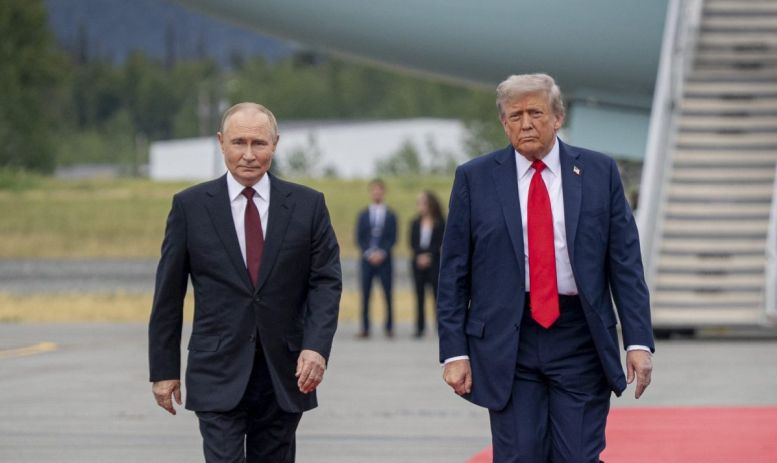
According to the British newspaper The Telegraph, Trump will send both his special envoy Steve Witkoff and his son-in-law Jared Kushner, both of whom are wealthy real estate moguls, to Moscow to secure an agreement on Ukraine.
Far above the heads of the Ukrainian people, the imperialist powers are deciding the country’s future. This reflects the main character that the war in Ukraine has taken on: a proxy war between different imperialist powers. However, it remains to be seen whether an agreement will be reached. Any analysis must necessarily be conditional, and there is more than one possible scenario. Or, as the British BBC commented on November 26: “Given Trump’s fickle attitude toward the war in Ukraine, Putin’s remaining ambitions, and Zelensky’s domestic difficulties — the current diplomatic round is taking place amid a corruption scandal that is undermining his domestic position — it is extremely difficult to know where this process will lead.”
Trench Warfare and Modern Weapons
Alongside the secret diplomacy, drone terror continues against civilians, energy supplies, and infrastructure in Ukraine, which faces a hellish fourth winter of war. On the battlefield, fighting is being waged with the most modern weapons in combination with trench warfare reminiscent of the First World War.
This diabolical combination has resulted in appallingly high death tolls. Between May 1 and July 9 alone, 31,000 Russian soldiers were killed or wounded, and total Russian losses may amount to 900,000 – 1.3 million, according to The Economist. Unlike Ukraine, however, Russia can currently still replace the soldiers it sacrifices and thus continue to slowly conquer new territory, which has cemented the turnaround in the war since the end of 2023. At present, there is nothing to suggest that the war will take a different course, which would force Russian imperialism to give up some of the areas it has conquered in Ukraine.
Any settlement will be based on the situation on the battlefield and the new map that the war has drawn.
Zelensky Government Weakened
As a result of setbacks on the battlefield (the course of the war), forced conscription of soldiers, corruption, and increasingly authoritarian rule, the Zelensky government’s position is weaker than ever. War weariness is widespread, which both the Trump administration and Russian imperialism are trying to take advantage of. “The US armed forces stand behind Ukraine, but it must be said honestly that, according to assessments made by the US military, Ukraine is in a very bad situation and that now is the best time for peace,” said Trump administration Army Secretary Dan Driscoll to representatives of both the Ukrainian government and a number of Western countries at a meeting in Ukraine’s capital Kiev on November 20, according to the Financial Times.
At around the same time, Trump told Fox News that Ukraine also “has to give up some land that they haven’t lost in the war.” These and other statements, as well as repeated threats to withdraw all support for Ukraine, paint a picture of both the Trump administration’s stance and the content of the agreement that it will try to bring about with the help of mafia diplomacy, threats, and empty promises.
Zelensky’s government is caught between a rock and a hard place.
At the same time, European governments remain on the sidelines, and European capitalism is too weak to replace US imperialism and bear the costs of a continued war in Ukraine on its own. Continued war, which several European governments are calling for out of their own cynical self-interest, as well as a large dose of prestige, would likely mean that Ukraine under Zelensky would be further weakened. Or, as the think tank Carnegie Europe wrote on November 25: “European allies have hidden behind the statement that the country, as a sovereign state, must decide when and how it wants to end the war. This is easier said than done, as they have not put Kiev in a position to make such a decision. Some European leaders still use the same rhetoric — but it sounds almost cynical when it is so obvious that Ukraine is balancing on a tightrope that could snap at any moment.”
Furthermore, the fact that US imperialism and Trump, out of the same cynical self-interest, see this “peace process” as a business opportunity makes it even more difficult for European imperialism to move forward with its plan to grant a €140 billion loan to Ukraine, to be financed with frozen Russian assets, money that is mainly held in Belgian banks.
The Trump administration, for its part, wants a share of the frozen assets, and through a complicated proposal, proposes that $100 billion in frozen Russian assets would be invested in the reconstruction of Ukraine, with the US taking 50 percent of the profits. The rest of the frozen funds would be invested in joint US-Russian projects. Economic considerations weigh heavily in the Trump administration’s quest for an agreement.
The overall picture therefore suggests that the war is increasingly being taken to the negotiating table and that a settlement and a ceasefire may be reached. However, there will still be a long way to go before peace is achieved. The Trump administration’s alleged peace will mean that Ukraine will in practice be divided between the imperialist powers and with the real risk of war returning.
Nevertheless, a temporary pause in the fighting could give the working class in Ukraine and Russia a welcome opportunity to gather new strength and organize independently. Only a global mass movement based on the organized working class and a revolutionary socialist program has the potential to put an end to the imperialist power struggles, warmongers, and militarism that stand in the way of a world of peace and freedom.