War and militarism are an inextricable part of imperialism. Even in periods of relative stability and less sharp inter-imperialist tensions—like during the height of neoliberal globalization in the 1990s and early 2000s when the number of wars decreased—the contradictions that produce war under capitalism did not go away.
Now the war drums are beating as loudly between the main imperialist powers and their allies as they have at any point since World War II. This does not make a global conflict imminent or inevitable. But it does pose squarely the question: how is the drive to war to be stopped? And how can the growing number of actual wars we already see in the new era of inter imperialist conflict—from Gaza to Ukraine to Sudan—and their unspeakable horrors, be ended?
Mass protests against the onset of war—even on a significant scale—while important, are not in themselves sufficient to stop war from happening or bring it to an end if the powers involved are determined and have the means to continue. There was mass international opposition to the American invasion of Iraq in 2003, but it went ahead because the U.S. ruling class was united in its determination to proceed. Likewise, the proxy war in Ukraine drags on with no end in sight in part because Putin sees more territorial gains to be made by continuing.
World War I
If we go further back in history, before the outbreak of World War I in August 1914, protests and resolutions from social democratic workers’ parties in Germany and France consistently declared their opposition to war. But as soon as the governments of the Allied and Entente powers actually declared war, these antiwar declarations were abandoned and most of the parties of the Second International lined up behind their “own” ruling class. The parliamentary representatives of the German Social Democratic Party (SPD) voted for war credits (which meant approving government borrowing to fund war spending) on August 4. On the same day, the French socialists voted for war, followed by the British Labour Party on August 5.
At the start there was indeed “war fever” and “rallying to the flag.” The horrors of mechanized warfare were not generally understood and there was a widespread illusion that it would “all be over by Christmas.” But it also speaks to the ideological levers available to the ruling class, particularly its ability to whip up nationalism. This was made a hundred times easier by the capitulation of the leadership of mass workers’ parties.
Lenin, Trotsky and the Russian Bolsheviks were among the exceptions in the Second International who stood against the war. They drew the conclusion that the betrayal by key social democratic parties, the culmination of a long process of adaptation by the leadership to bourgeois society, showed that a new international needed to be established. At first, they and others who did not abandon their internationalist, antiwar positions were an isolated minority. A key moment came when Karl Liebknecht, a leader of the left wing of the German SPD and member of the Reichstag, broke with party discipline and voted against further money for the war in December 1914. He was literally the only one of 110 SPD deputies to do so.
Despite Germany’s initial military gains, the war quickly turned into a bloody stalemate characterized by the horror of the trenches, with hundreds of thousands dying in pointless assaults that shifted the front line a few meters one way or the other. Opposition began to grow. In 1917, there were a series of mutinies in the French forces, as troops refused the order to advance into withering machine gun fire. The French command ordered hundreds of mutineers executed. But the decisive turning point came hundreds of miles to the East.
How World War I Ended
In February 1917, the first of two revolutions that year in Russia brought to power a Provisional Government that ended the rule of the Tsar but deliberately refused to go beyond the bounds of capitalism. It left the landlords and capitalists in control of the economy and also continued Russia’s involvement on the Allied side in the war despite massive casualties, terrible conditions for soldiers and widespread desertion among the Russian troops.
The Bolsheviks opposed the Provisional Government and called for “bread, peace and land.” When the working class—organized in soviets (councils) and led by the Bolsheviks—came to power in the second revolution in October, they kept their word. They immediately halted cooperation with the Allies and repudiated debts to the other bloodsucking powers. For good measure, they published the secret treaties whereby the Allied powers were preparing to divide the spoils at the end of the war and redraw maps in their interests.
The Allied governments predictably refused to recognize the existence of the soviet government, the most democratic the world had ever seen. For honoring their commitment to overthrow landlordism and capitalism and remove Russia from the slaughter of World War I, the Russian workers’ government was rewarded by the invasion of forces from 15 capitalist countries. But the Russian Revolution also lit a flame that threatened to burn down the rest of the imperialist system.
The German Revolution
Wars can end because of the decisive defeat of one side by the other, as at the end of World War II with the defeat and occupation of Germany and Japan in 1945.
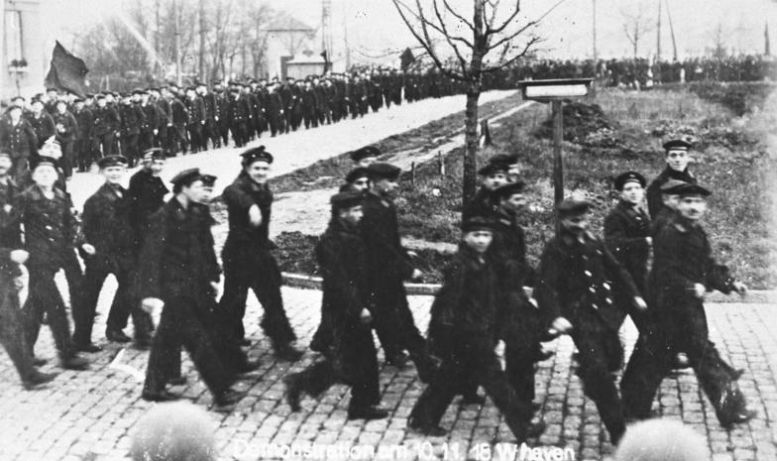
But the stalemated slaughterhouse of World War I was ended by revolutionary developments. The example of the Russian working class in 1917 inspired millions. In Germany, developments were heading to a breaking point in 1918. The sailors in the German High Seas Fleet, based in Kiel on the Baltic Sea, mutinied on November 3, refusing the order to head out for one more battle with the British fleet. This signaled the end of the war on the Western Front and the beginning of the German Revolution.
Workers, sailors and soldiers formed councils (rate) across the country inspired by the soviets in Russia. Kaiser Wilhelm fell, bringing to an end the German monarchy. But the leadership of the SPD, which had betrayed the working class at the start of the war four years earlier, now worked overtime to save capitalism and limit the revolution to establishing a democratic (capitalist) republic. Karl Liebknecht, Rosa Luxemburg and others were working to build a revolutionary political force to fight for socialism, but this was not yet strong enough to lead the working class.
Over the following years, a mass communist party was built in Germany, taking its place in the new Third International (Comintern). There were a number of opportunities for the working class to come to power in Germany, but these opportunities were squandered because a sufficiently tested leadership was not built in time. The consequences of this failure were truly tragic. If the German working class had come to power, the alliance of German industry and Russian resources would have created a powerful basis for the socialist revolution to spread and triumph in many other countries. Future history would have been profoundly different. Stalin and Hitler would not have come to power nor would there have been a Holocaust or World War II. All of this underlines that the key to ending imperialist war is dismantling the social system that feeds it. It requires the triumph of the socialist revolution.
Vietnam War
For a more recent example, we can look to the Vietnam War. This was the first time in history that the United States lost a war. A country armed to the teeth with the latest in modern weaponry, which had marched to victory in two world wars, found itself stopped in its tracks against a poor, colonized peasant nation struggling for freedom.
The U.S. military was faced with a different kind of enemy: the popular resistance of the Vietnamese workers and peasants, a rising tide of social struggles at home, and increasing dissatisfaction within its own army. As the socialist historian Howard Zinn put it, “it was organized modern technology versus organized human beings, and the human beings won.”
The scale of the war was massive. A total of 2.7 million American soldiers served in the war, representing 9.7% of their generation. Vietnam and its neighbors Laos and Cambodia were hit by seven million tons of American bombs, more than twice the amount of bombs dropped on Europe and Asia in World War II. Almost 20 million gallons of chemical herbicides were sprayed as well, including the notorious Agent Orange. Nonetheless, the power of collective struggle in the U.S. and Vietnam led to the defeat of U.S. imperialism.
The defeat in Vietnam had immediate consequences for the future of U.S. foreign policy that reverberate to this day. The draft was abolished and the military switched to an all-volunteer army. And an overall hostility to war among ordinary people led to “Vietnam syndrome” where the U.S. government became unwilling to engage in direct warfare for fear of provoking immediate massive opposition.
Ever since, U.S. imperialism has been trying to reverse the Vietnam syndrome. They celebrated the fact that they were able to intervene and occupy Afghanistan and Iraq after 9/11. However, as those wars became disasters of their own, “Iraq/Afghanistan syndrome” is still alive and well twenty years later. The growth in militarism around the current inter-imperialist conflict is spurring a renewed push to reverse the Vietnam syndrome. This makes it all the more important to learn how “the human beings won” in Vietnam.
Vietnamese Resistance
The key force that brought about the defeat of U.S. imperialism was the heroic mass resistance of workers and peasants in Vietnam itself. Unlike World War I, where imperialist powers were fighting among themselves for the redivision of the world, the Vietnamese were fighting for independence against imperialism. Moreover, they were fighting for a social revolution against capitalism. The U.S., meanwhile, was fighting to prop up the hated right-wing puppet dictatorship of Ngô Đình Diệm.
The struggle in Vietnam was waged by the Việt Cộng guerrilla movement, founded by Hồ Chí Minh, the successor to the Việt Minh who defeated French colonialism in the battle of Điện Biên Phủ in 1954. Hồ was the founder of the Communist Party of Indochina in 1930 during French colonial rule. While he joined the Comintern in its revolutionary heyday and was a founder of the French Communist Party in 1920, he adapted to the Stalinist takeover of the international and its bureaucratic caricature of Marxism. North Vietnam under his rule was a bureaucratic dictatorship made in the Soviet Union’s image. Hồ’s regime overthrew capitalism and launched a massive land reform program that vastly improved the standard of living for the majority of the population. But the political power was taken away from working-class people and concentrated in the hands of a privileged, parasitic caste at the top of society.
Hồ’s Stalinist politics also hindered the liberation struggle. During World War II, Hồ followed Moscow’s advice to subordinate workers’ struggles to a nationalist alliance with American, French and British imperialism as a “progressive” alternative to Japanese imperialism. When the Japanese were driven out of Indochina in 1945, a general strike broke out in Saigon against the return of French rule, with Trotskyists playing a prominent role. Hồ had the Trotskyists slaughtered and facilitated the return of French imperialism. But despite this terrible betrayal, the Việt Minh were soon at war with French imperialism.
Nonetheless, the independence struggle, the land reform, and the overthrow of capitalism were things worth fighting for. Given the nightmare of capitalist stagnation and poverty in the colonial and neo-colonial world, the Vietnamese Revolution was enormously attractive to millions of people around the world.
Antiwar Movement
The heroic resistance of Vietnamese workers and peasants helped spark a mass antiwar movement internationally but especially within the U.S. itself. The movement began slowly in the early 1960s, but rapidly ballooned into the biggest antiwar movement in U.S. history. This was driven by several factors including growing U.S. casualties, the resentment of deferments allowing middle class and wealthy youth to avoid conscription and an increasing questioning of why the U.S. was helping to subjugate a people who overwhelmingly wanted independence and supported Ho Chi Minh.
Establishment accounts of the anti-Vietnam war movement portray it as dominated by privileged students while the working-class “silent majority” backed the war. This is a gross distortion. Due to the nature of the draft, the vast majority of soldiers were drawn from the ranks of the working class and oppressed. And they were the ones who witnessed the horrors of the war first hand. The escalation of the war in Vietnam was also in the context of a massive civil rights movement and growing working-class unrest. By the end of the war, opposition to the war was highest in the working class, especially among poor workers and Black Americans.
The most significant working-class resistance occurred within the army itself. Many revolutionary organizations actively entered the army to carry out antiwar activity among the soldiers, while others set up antiwar coffeehouses, storefronts, and bookstores outside military bases. Antiwar GI papers flourished, with names like Fatigue Press, Harass the Brass, and The Star-Spangled Bummer. These organizing efforts helped bring the army into a state of disarray. In 1971, Marine Colonel Robert D. Heinl Jr. wrote:
“By every conceivable indicator, our army that remains in Vietnam is in a state approaching collapse, with individual units avoiding or having refused combat, murdering their officers and non-commissioned officers…Sedition, coupled with disaffection from within the ranks, and externally fomented with an audacity and intensity previously inconceivable, infest the Armed Services…”
This disintegration of the armed forces proved to be the final nail in the coffin and rendered the war unwinnable for the U.S.
The Working Class Can Stop War
Today, the whole world is seeing a resurgence in militarism, war, and the threat of war. The wars in Gaza, Ukraine, and Sudan continue in spite of mass opposition. Short-term armed confrontations between the U.S. and Venezuela, India and Pakistan, and Thailand and Cambodia threaten to blow up into larger conflicts. The ruling class responds to the threat of war abroad by ramping up militarism at home. All this revolves around a growing conflict between U.S. and Chinese imperialism that teeters on the edge of global war.
A fundamental lesson of past struggles is that war and imperialism are fundamental to capitalism. Even if basic human decency is horrified at the prospect of war, the logic of capitalism and imperialism persists. This is why mass revulsion, and even mass protests, is insufficient on its own to stop the drive to war.
This understanding also points to what can stop war: the mass actions of the working class. While capitalism ruthlessly exploits workers for profit, it also relies on their labor to function. The movements against World War I and the Vietnam War included fraternization of troops, antiwar strikes and demonstrations, and even mutinies. When the working class takes to struggle, they can gum up the capitalist war machine.
This process isn’t automatic. The betrayals of Social Democracy at the start of World War I plunged the world into years of death and destruction before the working class gained confidence to fight back. The betrayals of the Vietnamese Stalinists after World War II temporarily strengthened French imperialism and prolonged the liberation struggle. The lack of a mass working-class party in the U.S. was an obstacle to bringing together all the social struggles of that time, including the antiwar movement, into a full-blown challenge to the ruling class. But to succeed this challenge needs an authoritative revolutionary leadership and organization missing in Germany in 1918.
A major upsurge in class struggle can stop a war. But, as long as capitalism remains intact, the drive to war will continue. This is what we’re seeing today with the resurgence of militarism globally and the attempts to reverse Vietnam syndrome. To stop, not just a war, but wars in general, requires overthrowing the whole capitalist system. The movements against World War I and the Vietnam War weren’t just antiwar movements. They were political upheavals and, in some cases, revolutions, that pointed the way for a new, socialist world.