Leslie Kemp and Sean Rohne
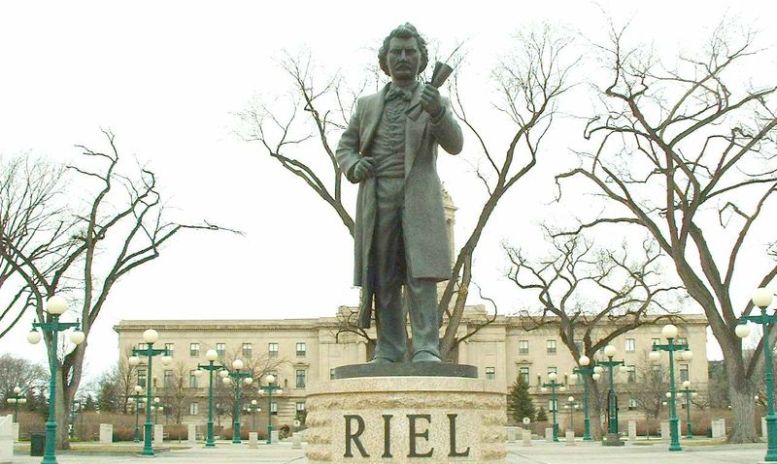
Louis Riel has been transformed from a traitor to a hero. The Louis Riel Act was passed in the Manitoba legislature in 2023, giving Riel the honorary title of “First Premier of Manitoba.” Premier Kinew called this a “historic correction.” This is a far cry from his vilification as a rebel and traitor, depictions long disputed by Manitoba’s Métis community.
Just three years after confederation, the first military action of new Canadian state was against Canadians, to suppress the Métis in the Red River Resistance (1870) and again in the Northwest Resistance of 1885. This was the first of many incidents in which the Canadian state used the police and army to defend the interests of capitalism against Indigenous people. Engels wrote about the “armed bodies of men,” which keep class antagonism “within the bounds of order” but at the end of the day defend the interests of the ruling class.
Riel led resistance movements
The Red River Resistance of 1869–1870 lasted for 416 days. Red River’s population was 12,000, 85 percent of whom were Métis people of mixed First Nations-European descent. It was part of Rupert’s Land, owned by the Hudson’s Bay Company, until it was sold to the Canadian government.
The Red River Resistance was an assertion of Métis land rights and culture. Riel established a provisional government, which negotiated the terms under which Manitoba entered the Canadian Confederation in 1870. During the resistance Thomas Scott, a Canadian nationalist, was executed after he was found guilty of charges against him in a Métis trial conducted by the provisional government. The Canadian government under John A Macdonald sought retribution, led a campaign of terror against both the provisional government and Riel, who fled to the US to escape prosecution.
The North-West Resistance of 1884-85 took place after a delegation of Saskatchewan Métis leaders, led by Gabriel Dumont, persuaded Riel to return from exile to help address grievances with the Canadian government. At the Battle of Batoche, the Métis and First Nations fighting the Canadian militia were defeated. Riel was imprisoned in Regina and convicted of high treason. Despite protests, popular appeals and calls for clemency, on November 16, 1885, the Métis leader was hanged.
Riel as founder of Manitoba
In recent years, Riel has been transformed. He is now celebrated as a leader and true founder of Manitoba. This is largely due to the determination of the national government of the Red River Métis Nation, the Manitoba Métis Federation (MMF). He has been brought into everyday life with Manitoba’s declaration of Louis Riel Day in 2008. The province officially recognized Riel as Manitoba’s first leader, setting the stage for the MMF’s goal of proving that Riel’s government in 1869–70 was the first legitimate government of the province.
Lenin warned of the tendency of the ruling class to canonize historical figures after their death who led significant movements that challenged the status quo. A sanitized version of such figures is presented that separates them from the radical ideas they fought for, to present a sense of unity. On November 16, Mark Carney spoke of Riel as “a foundational figure in the histories of Manitoba and Canada. One hundred and forty years ago, Louis Riel helped unite our young nation.”
The Métis Nation has rejected calls for a pardon or exoneration as Métis Nation legal scholar, Paul Chartrand, put it, “The hanging of Louis Riel is a stain on the honour of Canada. Let the stain remain.”
In his last days, Riel said, “In a little while it will be over. We may fail. But the rights for which we contend will not die.” Future generations are now learning about Riel not as a rebel, but as the leader who defended the Métis’ rights, built Manitoba, and fought for a diverse province.
Additional Reading:
- Chester Brown, Louis Riel: A Comic-Strip Biography, 2011
- David Doyle, Louis Riel: Let Justice Be Done, 2017
- Jean Teillet, The North-West is our Mother, 2019
- George Woodcock, Gabriel Dumont, 1975