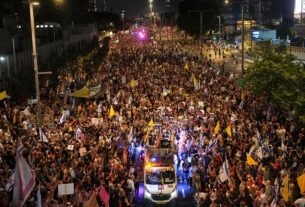
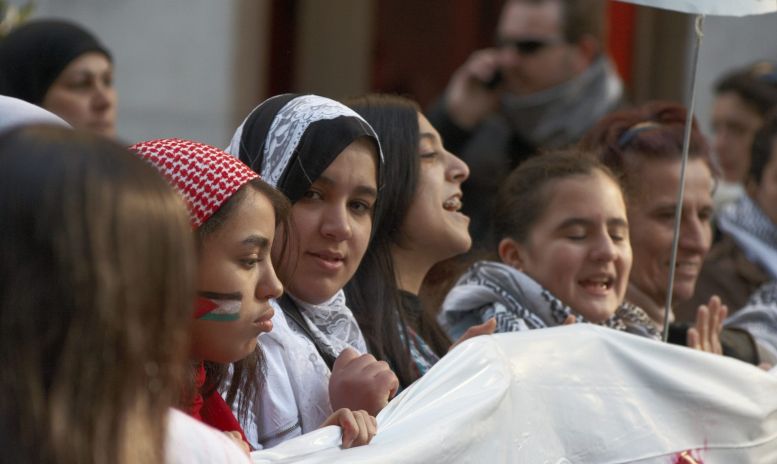
On Thursday, January 22nd, tens of thousands of Palestinians within Israel went on a general strike to protest surging violence and police discrimination and neglect.
State of Crisis in the Arab-Palestinian Community
The crisis of organized crime and gang violence has existed for a long time, with appeals to the authorities being ignored for years. Over 20 Palestinians have been murdered in 2026 so far, following a record number in 2025, with a murder taking place almost every day on average.
Residents in several cities report being terrorized by organized crime, primarily around extortions and shootings, putting many small shop owners and residents under constant threat. This activity is ripe in areas already suffering from disproportionate levels of poverty and systematic under-development.
Only 8% of murders taking place in Palestinian towns and cities end with prosecution, compared with 65% in the Jewish-majority areas. The Israeli police very publicly refuse to act within Palestinian cities with the ridiculous claim of fear for their lives.
Police neglect and discrimination against Palestinian citizens of Israel is directly tied to the general racist national oppression of Palestinians by the far-right Israeli government, as well as all other Israeli governments predating it. These routinely include lack of funding for Palestinian regions, quality jobs, and lack of housing permits, leading to regular home demolitions.
The same police force, under the leadership of proto-fascist Itamar Ben-Gvir, did not hesitate to harass, arrest, and brutalize Palestinians over years, with the height of oppression taking place against those who demonstrated against the recent genocidal war in Gaza.
The police are also directly tied to state terror in annexed East Jerusalem on behalf of far-right settlers taking over the homes of Palestinians, as well as in raids in the Negev region against the Bedouin population living in what the state considers “unrecognized” villages. These attacks and others are part of a decades-old policy aimed at land theft in order to expand areas with a Jewish majority. Socialists stand in principle against this divide-and-rule strategy and for equal rights to all working people regardless of nationality, ethnicity, or religion.
Mass Protests and the General Strike
Seeing no response from the state, shop owners in the northern city of Sakhnin, shut down their businesses in protest against organized crime and against the state. The committee of the parents of school children followed by calling for a school shutdown. Mounting pressure from below forced the city council, who initially opposed the strike, to join it. This then inspired Palestinian authorities across Israel and the national committee of parents of children in Palestinian schools to announce joining the strike.
Two days into the strike in Sakhnin, the High Follow-Up Committee – the main establishment organization representing Palestinian citizens of Israel – announced a national general strike for Thursday, January 22. The strike was accompanied by a mass protest in Sakhnin, estimated at 100,000 – three-times the size of the city’s population.
The strike included professionals such as lawyers and academics, as well as public transit workers and construction workers. Hundreds of doctors and pharmacists, many of them working in primarily Jewish cities and towns, self-organized without support from their union leadership.
Quoted in The Times of Israel, member of Knesset (Israeli parliament) Aida Touma-Sliman from the Hadash party explained that the large size of the protests was possible due to the official end of the war in Gaza. This made Palestinians feel more confident in raising “internal” issues. Importantly, she added that organized crime is essentially functioning as a subcontractor for Ben-Gvir’s political agenda by controlling and oppressing the lives of ordinary Palestinians.
The Need for a Political Alternative
The protest in Sakhnin ended with a meeting of the High Follow-Up Committee, the three main Arab-Palestinian political parties, and the Communist Party-led Hadash. Under pressure from below to run on a united list for the upcoming elections to the Knesset, the four parties signed an initial agreement.
This move should raise alarm bells about the right-wing organizations within the Palestinian forces, particularly the Ra’am party. Under Mansour Abbas’s leadership, Ra’am joined the Israeli coalition government in 2021. That government was led by establishment and far-right forces such as Yair Lapid and Naftali Bennet. Genuine working-class and left-wing forces should only unite under the clear banner of fighting national oppression, racism, and the anti-worker agenda of the establishment party, whether they are positioned in the coalition or the opposition. A new political formation needs to center the fight against privatizations, for social housing, free high-quality education and healthcare for all.
Expand the Strike
In the immediate sense, the strike needs to be expanded. As workers in Sakhnin explained, a full general strike by Palestinian workers in Israel will have a decisive impact on the Israeli economy and will gain support from many of their Jewish co-workers, which can open doors for them to join as well. Democratic strike committees should be set up to link the struggle across the country. This will need to be accompanied by a struggle within the unions to join and organize the strike. The struggle has to be coupled with a call for the union leaderships to break from the murderous far-right government and take a clear stand against oppression and systematic discrimination.
There is a need for a working-class political alternative to all reactionary and pro-business forces. We call for a mass working class party rooted in the struggle against oppression, war, occupation, profits, and the capitalist system which is its basis. And for the struggle for socialist change in the region and the world based on solidarity, peace, and freedom for all.