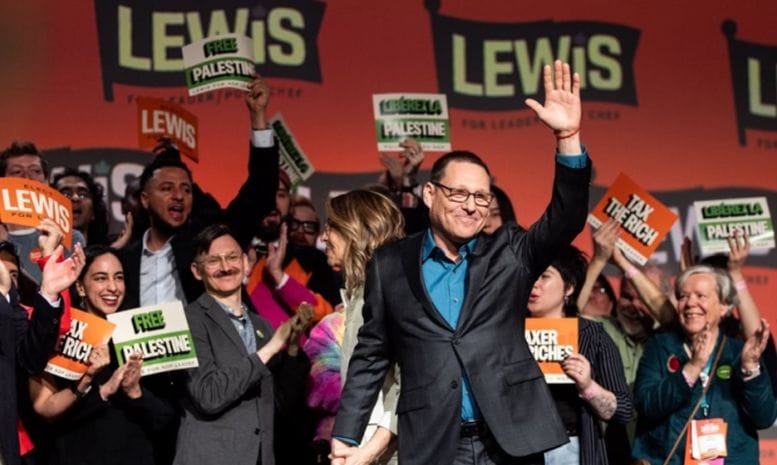
“In the chaos that is headed our way, more voters may be willing to give the NDP a look than is presently accounted for.” Prominent conservative commentator, Andrew Coyne, wrote this after Avi Lewis clearly won the NDP leadership. Coyne has a better understanding of the turmoil ahead than many NDP bureaucrats.
For now, Carney is popular, but he will face mounting problems and growing unpopularity as the reality of higher inflation, growing job losses and cuts to public services sink in. He has shifted the Liberals towards the Conservatives, including welcoming Marilyn Gladu, formerly on the right-wing of Poilievre’s party. There is huge space in Canada for a bold campaigning party.
Lewis’s program faces fierce resistance from the NDP establishment, including Naheed Nenshi and Carla Beck, leaders of Alberta’s and Saskatchewan’s NDP. Others simply defected to the Liberals, as their politics are really “orange” Liberals. Lori Idlout, MP for Nunavut, crossed the floor. Ontario NDP’s former deputy leader, Doly Begum, switched to the Liberals and won the Scarborough Southwest byelection. These actions make it harder for the federal NDP to rebuild.
The Lewis critics ignore the party’s membership who voted decisively for him. Lewis gained 39,734 votes, 56 percent of the total, on the first ballot — a higher percentage than either Jagmeet Singh or Jack Layton received. Lewis’s campaign raised $1.23 million, more than the other four candidates combined.
Lewis’s Platform
Lewis’s platform is a sharp break with the present and past failed policies of the NDP. He talked of an NDP “that works for the many, not the money,” in sharp contrast to the Liberals and Conservatives. His campaign understood that an NDP that is only fractionally more pro-worker than the Liberals doesn’t have much point.
His campaign demands focused on building public homes, protecting tenants, creating one million good green jobs, and providing free transit. Lewis wants “the unmatched power of public ownership” in groceries, postal banking and pharmaceutical manufacture, while taxing the rich and ending corporate handouts. He opposes further fossil fuel industry expansion, including LNG, to truly combat climate change, and pledged that “no one who works in the industry will be left behind.” Tackling climate change is a good way to provide rewarding jobs.
NDP’s long decline
The federal NDP’s long decline from winning 103 seats in 2011 reached its worst ever result in 2025 with only seven MPs. This rock bottom was partly a reaction to Trump, as people “voted strategically” for the Liberals to avoid a Trumpish Poilievre victory. The NDP’s confidence agreement with Justin Trudeau, while helping to win a partial, but flawed, national dental care plan and Pharmacare Act, meant that many voters saw the NDP as Trudeau’s crutch.
For years the NDP has not built national, working-class movements for change, much less talk to people in the streets. Yet this is how Tommy Douglas won the Medical Care Act in 1966! Instead, the party focussed on trying to chase centrist voters, hoping that maybe the next election might be the game changer.
The way ahead
Avi Lewis faces an uphill struggle to make the NDP relevant. He will have to mobilize his 40,000 supporters to resist inevitable sabotage. The clash of his policies and his supporters against the NDP machine will likely open a debate about what sort of party the working class needs.
The NDP’s March conference decisions to campaign year-round and to empower the local parties are important steps to rebuild the party. The new NDP executive members of Niall Ricardo, Libby Davies and Kiera Gunn gives Lewis support within the machine.
Lewis’s priority is rebuilding the party with rallies in cities and towns across Canada. If the NDP does not recover, voters face a grim choice between Carney’s conservative Liberals with massive military spending, or Poilievre with his fake anger.
Standing up to the billionaire class on behalf of the working class requires principles based on class analysis, serious movement building, and democratic structures in the NDP. If this movement is built, it will write a new chapter in working-class struggle.