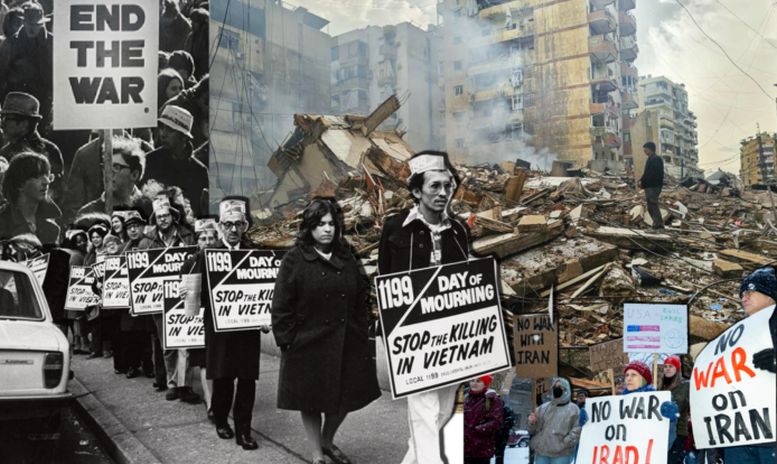
As the threat of continued war with Iran grows, working people are once again being told to prepare for sacrifice while corporations and military contractors prepare for profit. The Trump administration’s war on Iran is against the interests of ordinary working people.
Workers in Iran face the constant threat of renewed bombing campaigns and economic devastation. Workers in the United States and worldwide pay the price of war too — through rising costs, cuts to public services, attacks on democratic rights, and the expansion of militarism at home. Meanwhile, the same political establishment that claims there is no money for healthcare, education, or decent wages somehow always finds billions for bombs and weapons contracts. Even if Trump pulls out from Iran, the militaristic interests of US imperialism are far from over — so workers need to build real opposition to war.
For the labor movement, opposition to war cannot remain a symbolic or purely moral position. It is a fundamental class issue. War strengthens the power of the ruling class while weakening workers’ ability to organize and fight back. Historically, wartime nationalism has been used to pressure unions into accepting wage freezes, no-strike clauses, and tighter labor discipline “for the national interest,” while the capitalist class enjoys massive war profits.
Some unions have already spoken out. National Nurses United has warned about the humanitarian consequences of this war, and the AFL-CIO has criticized military escalation. But statements alone are not enough. Labor needs a concrete, militant anti-war strategy rooted in rank-and-file organizing and workplace action.
Pro-War Means Anti-Worker
Imperialist war has always been incompatible with the interests of the working class. During major conflicts, workers are told to tighten their belts for the sake of “national unity,” even as corporations profit through military contracts, energy speculation, and wartime production. Public resources are diverted away from social needs and redirected toward militarism. Inflation rises while employers insist workers accept concessions. Anti-war dissent is stigmatized as unpatriotic, and governments expand repression in the name of security.
Imperialist war also undermines the international solidarity workers need to resist exploitation. Workers in different countries do not benefit from killing each other on behalf of competing governments and corporations. The same multinational companies exploiting workers in the US also exploit workers abroad. The same politicians demanding military escalation are also attacking unions, privatizing public goods, and slashing social spending at home.
Historically, labor movements are weakened when they abandon internationalism in favor of nationalism. During World War I, many social democratic and labor leaders sided with their own ruling classes despite years of pledges to oppose war. The result was catastrophic: millions of workers were sent to slaughter each other while the wealthy preserved their power. But history also shows another possibility. Mass worker resistance, strikes, and mutinies played a decisive role in ending World War I.
That history matters today because the labor movement still possesses enormous potential power. Workers make society function. From ports and factories to hospitals and schools, the entire system depends on labor. If workers organize collectively, they can not only protest war, but disrupt the machinery that sustains it.
Labor Must Act
What can unions and rank-and-file workers do concretely?
One starting point is introducing anti-war resolutions in local unions, labor councils, and national organizations. Resolutions can demand an end to military escalation and oppose US intervention abroad. They can call on unions to organize educational meetings, protests, and workplace actions against war.
Workers should also push unions to move beyond statements and toward action. In recent years, workers have demonstrated the potential of labor struggle to shape broader political fights. Unions and community organizations mobilized against ICE raids and deportations, with the January 23 general strike in Minneapolis putting an end to “Operation Metro Surge.” It is this kind of militant action that is needed to challenge militarism.
Rank-and-file pressure is essential to drive action because many union leaderships remain tied politically to pro-war Democrats. These leaders’ main role is to secure workplace contracts, while they timidly lay low on most broader political issues, except to occasionally support Democratic initiatives. The labor movement desperately needs political independence—to form a new workers’ party we can use as a vehicle for militant struggle, on all issues that affect our class. This means breaking with the corporate-backed Democratic Party.
Workers in all industries must be a part of building an anti-war opposition, but those directly connected to military production and transportation have a particularly important role. If unionized workers are used to manufacture weapons, transport military equipment, or maintain war infrastructure, they have leverage to organize resistance. Historically, dockworkers and logistics workers have sometimes refused to handle cargo tied to war and occupation. Similar actions could become decisive in opposing an accelerated war drive.
At the same time, labor’s anti-war struggle must be connected to the fight against austerity, racism, authoritarianism, and capitalist exploitation. Militarism abroad is inseparable from attacks on workers at home. The drive towards war is part of a wider reactionary agenda rooted in the needs of capitalism — one that targets immigrants, public education, labor rights, and social programs.
The labor movement faces a clear choice. It can remain passive while politicians and corporations push society toward deeper crisis, or it can revive the tradition of militant working-class internationalism. To defend workers’ interests, unions must fight not only for better contracts, but against war, against authoritarianism, and against the capitalist system that profits from both.