
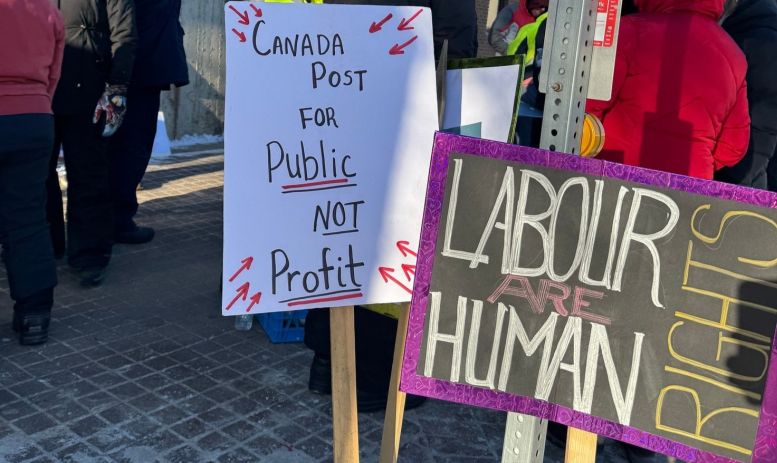
It’s been more than twenty years since Canada Post’s bosses set out to undermine the service — a public service that for most people in Canada is much valued and loved. Mike Palecek, a former letter carrier and former national president of the Canadian Union of Postal Workers (CUPW), recalls that although he was proud of being a “mail man: an iconic part of Canadian society,” the supervisors were “assholes and treated us like the enemy. Upper management was too busy fighting the class war to worry about anything else. It was surreal . . . It was like getting the mail out was a secondary task — something they had to do so they could get back to the real work: sticking it to those union guys.”
So, it is no surprise that CUPW finds itself in a weakened position today. It has been fighting this class war for decades. The Canadian government is now out to destroy Canada Post as a public service. Canada Post’s management is out to weaken CUPW.
The government announced on September 25 major cuts to the postal service. These were based on the Kaplan report, a report of the Industrial Inquiry Commission on Canada Post, which in turn had simply taken and repeated Canada Post ‘s management plans. The government did not discuss with the union or give it any advance warning of its proposals to slash the postal service. Canada Post’s management, Kaplan and the government all ignored the union’s well-researched alternatives to massive cuts.
The attacks on the postal service include ending all home deliveries (reneging on the Liberal’s 2015 election promise), allowing the closure of rural post offices and reducing delivery standards including delivery frequency so letters and parcels take longer to arrive. The minister in charge of Canada Post, Lightbound, has stated that jobs will go. Various analysts have estimated between 10,000 and 20,000 jobs would be cut. The excuse for the cuts is that Canada Post is losing money. However, expanding the postal service’s activities is a positive alternative.
In response to these attacks postal workers immediately walked off the job and a national strike restarted. But on October 11 the union scaled back its actions to rolling local strikes. The management of Canada Post is happy to let the service bleed money to justify cuts and eventually partial or total privatization. The bosses also want to weaken the union and so is refusing to seriously negotiate.
The latest proposal from Canada Post in the negotiations, on October 3, was worse than the previous one as it removed job protection language and withdrew the signing bonus of $1,000. CUPW rightly said that this proposal was a “major steps backwards.”
What is Canada Post’s problem?
While letter deliveries are down, parcel deliveries have soared with the growth in online shopping. However, Canada Post’s share of parcel delivery has declined, with for-profit companies such as UPS (unionized by Teamsters), Purolator (unionized by Teamsters and largely owned by Canada Post!) and FedEx (mostly non-union) taking a growing share.
Their expansion is not due to price as Canada Post is less expensive. Also, the private delivery companies do not pay the full cost of all deliveries. They do not deliver to small, remote, and northern communities, instead they use Canada Post to deliver the last leg of the journey. They take the profitable section between cities and get Canada Post to do the unprofitable part. Canada Post subsidizes the companies that are hoping to drive it out business.
Canada Post owns 91 percent of Purolator and seems to be using it as for-profit alternative to the postal service. In 2018 Purolator delivered 25 million packages, now it claims to deliver 250 million parcels a year. It made $294 million in profits in 2024. Is Purolator Canada Post’s road to privatization?
Amazon in particular has a terrible record of low pay, gig work, union busting and high rates of injury. This is the yardstick that Canada Post wants to apply to its workforce. If the Liberals were a real “Team Canada” government, they would require Amazon to employ all its workers — no gig jobs, and enforce health and safety regulations as well as defend union rights.
The union points out that management is the cause of Canada Post’s problems. In 2022, they told Amazon that Canada Post did not have the capacity to handle their parcels, so Amazon took their business away. During COVID, delivery of parcels surged. In response, Canada Post decided to spend $4 billion over 5 years ($800 million a year) on new infrastructure, almost the same as the annual loss of $748 million in 2023. Inevitably, the number of parcels dropped once COVID receded, yet management did not reconsider its plans. Some of the spending has been on robots and electric vehicles while lacking charging facilities, and $470 million on a new sorting facility in Scarborough.
Negotiations for a new contract started in November 2023, but throughout the last two years Canada Post has not put forward realistic proposals. All along, the government supported their stonewalling.
The ongoing dispute between the workers and management has disrupted deliveries, pushing small businesses and individuals to rely on private companies, even though it costs them more. The dispute has increased the losses as the bosses prefer to bleed Canada Post rather than negotiate. Perhaps some of them hope to see it privatized and they can pick up fatter salaries.
As the cuts bite, fewer people will use Canada Post and the bosses’ answer will be further cuts. This is a death spiral for Canada Post. It is more clear than ever: this is a deliberate strategy aimed at weakening the union’s power and numbers.
A public service
Canada Post is a public service. It provides a universal service for all Canadians regardless of where they live. A few months ago, politicians were talking of “Team Canada” and “we are all in this together.” The government’s cuts will undermine the universal service.
People with mobility issues cannot walk to a community box. People in rural, northern and Indigenous communities rely on Canada Post’s deliveries for many of their needs including medicines. Some people do not have or choose not to do all their businesses online.
Four out of five small businesses used Canada Post to deliver to their customers, sending invoices, cheques and parcels. They valued its convenience and relatively low cost. Many were horrified at the prices charged by private-sector delivery companies. A rural Ontario woman was told that sending a Christmas card to her son in Vancouver through these services would cost $57 to $62 (in contrast to a Canada Post-delivered card at $1.40). A privatized Post would only be interested in profits and so would charge more than Canada Post and cherry pick some areas to deliver to and leave rural and remote communities to suffer. Canadians need a universal national postal service. Only a public service can deliver this.
The Mayor of McNab/Braeside, Lori Hoddinott, argued that many in her rural community, west of Ottawa, rely on home delivery. Seniors will not be willing to drive kilometres on wintery roads to collect their medicines from a community box. The local post office is a social hub for the community.
Community boxes are much easier to steal from than people’s homes. Across Canda there are multiple reports of theft, even of the entire box being taken. Canada Post is unconcerned.
No one, except a few wild reactionaries, would argue that the sewage system, firefighting or elementary schools should make a profit. What if the military had to turn a profit every year! There is no reason why profits are the yardstick that is applied to Canada Post.
Canada Post has the largest fleet of vehicles of any organization in Canada. It has nearly 6,000 post offices (more than Tim Hortons’ branches) and an extensive network of depots and other facilities. This huge public asset should be used to serve Canadians.
CUPW’s Delivering Community Power is an imaginative and forward looking way to make better use of the Canada Post’s resources. This comprehensive strategy was developed by CUPW to counter management’s aims of privatization and service cuts. The management want none of it, as they only want to slash and cut. Among the Community Power proposals are for postal workers to check on elders (they often already do this); fully use post offices as community hubs that could include electric charging stations; deliver food, medicines, etc. in remote and northern communities; and postal banking.
Canada had postal banking until 1969. It was closed as a gift to the big banks. Postal banking is a success in other countries such as Italy, New Zealand, France and Brazil. Many rural areas and lower-income parts of big cities have no local bank. Nearly two million people a year use predatory payday lenders. Canadian banks are super profitable with high fees and aggressive marketing. The big six had profits of $59 billion in 2024. Both the Liberals and Conservatives are close to the banks and Bay Street so are opposed to anything that will hurt their profits, such as a national postal bank.
The urban areas are filled with delivery vehicles from the different companies (UPS, Purolator, Fed Ex, Canpar, Amazon, etc.) and Canada Post all criss-crossing the cities on overlapping routes, which adds to congestion and pollution. If Canada Post delivered more parcels this would be much better for the environment.
The good news for CUPW is that there is large reservoir of public support to defend Canada Post. A 2025 Angus Reid survey found that most Canadians (59 percent) oppose selling off Canada Post and want it to remain publicly owned (64 percent) and 72 percent would support it providing new services, such as postal banking and secure parcel lockers.
CUPW needs a reset
Postal workers have shown determination to defend Canada Post and good paying jobs. In October 2024 they voted 96 percent in favour of a strike and started picketing on November 15. The strike was solid. The government, using Section 107 of the Labour Code, directed them back to work on December 17. There followed months of pointless talks during the government ordered “cooling off” period. The next offer from Canada Post, in August 2025, was rejected by 69 percent of the members. When the government announced it will slash Canada Post in September 2025, CUPW members spontaneously walked off the job in Atlantic Canada, and the strike was then reinstated across Canada.
However, as the management are happy to bleed Canada Post to death, striking has limited impact. Clearly, postal workers want to defend the service to communities and their jobs, however, there seems to be no plan to win and the mood on many picket lines has been low.
The union needs a reset. It needs to develop a strategy to win and rebuild the members confidence in the possibility of victory. The flight attendants’ determination and clear strategy are an example of how to win.
Building a plan will take time, including discussions and meetings of CUPW members — they will have ideas of how to win. Once a strategy is developed there will need to be a program of mass meetings of members to discuss it and mobilize the membership as well as to involve supporters in the public and in other unions.
This fight to save Canada Post will take a determined membership and a clear plan of action.
How to fight and win
Postal workers will have many excellent ideas of how to win. Socialist Alternative offers some suggestions including mobilizing the wider labour movement and public opinion, as striking on its own has limited impact on a management that wants to cut Canada Post.
It is important to emphasize to Canadians that the postal service belongs to all Canadians, and it exists for our benefit, not for the inflated pay of the senior management.
The public’s support needs to be mobilized. Postal workers should be out in shopping streets in cities, towns and smaller communities talking to the public. The union should hold rallies across the land.
The Canadian labour movement owes CUPW a lot. It was the CUPW “wildcat” strike of 1965 that won the right to collective bargaining for federal employees. The strike of 1981 won paid maternity leave, which now has spread to paid parental leave for all Canadians. A defeat for CUPW today would be a defeat for the entire labour movement. Canadian unions must give full support to postal workers.
The fight to defend Canada Post is a crucial struggle for the working class. Victory is possible. To win CUPW will need a strong membership, a bold strategy, and solidarity from society and the working class.