At 12:58 a.m. Eastern Time on Saturday, August 16, flight attendants, members of the Canadian Union of Public Employees (CUPE) and employees of Air Canada, commenced the biggest labour battle of the year so far.
Barely 12 hours later, federal Liberal minister Patty Hajdu intervened in support of the bosses, using the government’s favourite anti-worker weapon of the past two years: Section 107 of the Canada Labour Code. Hajdu ordered the 10,000 workers back onto the job and appointed a “neutral” arbitrator to impose a collective agreement.
But in a major and welcome escalation, the workers have refused to bow. They remain on strike. The union president, Mark Hancock, stated on Monday August 19, that “We will not be returning to the skies.” This could turn into a pivotal moment in Canadian labour history.
The flight attendants had voted with a 99.7 percent mandate in July to strike against the country’s oldest and biggest airline, and their continued strike stopped the government from making the vote an empty gesture. This alone is a victory for workers’ rights in Canada and could have a huge influence on future strikers by standing strong in this strike. Now the focus is on continuing and winning this strike.
More than 70 percent of Air Canada flight attendants are women. A number of women at a rally in Vancouver talked to members of Socialist Alternative. One, a flight attendant for over 40 years, spoke to us about the significance of a union with a huge majority of women standing up to the company. This was the first union to do so, and she said she was so proud of the young women who have stood up to Air Canada and the government, refusing to obey the back-to-work order. This sentiment was echoed by others. One said that “this feels like the beginning of a revolution.” There was palpable resolve among the workers — not just in their chants, but in their determination to not go back until their demands are met. Another said that the strike started with their own demands for fair pay but has developed into a much more significant issue — protecting the right to strike for all workers.
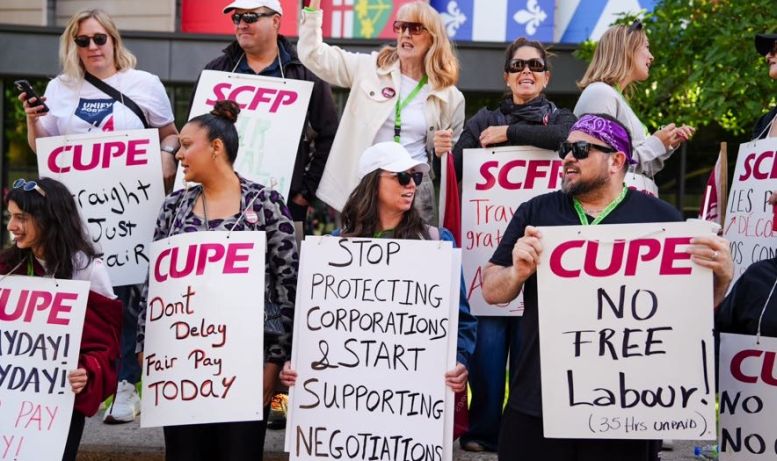
The workers’ top demand is a simple and very popular one: they want to be paid for the full time they’re working. Currently they are only paid when the airplane door is closed, and the brakes are released. Their paid work ends when the brakes are applied after landing. Flight attendants work an average of 35 hours a month without pay. Other North American airlines such as Delta, American, United and Porter in Canada do pay workers for their full shift.
They are required to help travellers with everything from putting heavy luggage into the overhead compartment to leading an escape if the plane catches on fire, but don’t get paid a dime until “the wheels leave the ground,” as one flight attendant put it. Technically this time is not work time, so workers are not compensated for any injuries. Flight attendants have had serious injuries due to turbulence and not had any company compensation. They are calming screaming children (and perhaps more often, screaming adults) on their own time, if the plane happens to be stationary.
Other and less-reported demands include higher staffing levels (Lufthansa flights can have nearly double the number of attendants on the same capacity of flight as Air Canada) and to catch up on pay as the last contract lasted 10 years.
Air Canada has the money to settle — its profits over the two years of 2023 and 2024 were over $3 billion. Instead, it is attacking the workforce, with crews stranded in other countries as the strike started. The union provided a written plan to ensure customers were not stranded but Air Canada refused to implement it.
Air Canada’s strategy all along has been to count on the federal government to come to its rescue. CEO Michael Rousseau (paid over $12 million in 2024) admitted as much in an interview with BNN Bloomberg, saying he expected Section 107 would be enforced. This was his rationale for not having a contingency plan in place. He also said he was “amazed” that the workers are disregarding the back-to-work order. This refusal has forced Air Canada back to the bargaining table, showing the power of workers who are determined to fight.
Based on recent precedents, Air Canada’s reasoning was sound. In the final year of Justin Trudeau’s regime, the federal government successfully utilized Section 107 against striking dockers in Montreal (members of CUPE) and Vancouver (members of ILWU), 9,300 CN and CP Teamsters rail workers and CUPW postal workers. Unfortunately, the leadership of those unions chose to bend, which increased the government’s confidence that this would be successful again.
Air Canada’s 5,200 pilots reached an agreement under the threat of Section 107. The government also tried to use it against 680 WestJet mechanics, members of AMFA, in 2024, but they stayed on strike and won major improvements in their contract.
Employers increasingly refuse to have genuine negotiations with unions. Instead, they stonewall and wait for the government to come running to their side. Canadian unions have the right to strike but the government’s actions are making this “right” meaningless.
Earlier this year, in response to Trump’s tariffs, the Liberals claimed that “We are all in this together.” Yet again, the reality is that the Liberals are on the side of the bosses and not the workers. The actions of the Liberals in blocking strike actions should convince all labour leaders that they cannot have any illusions that the Liberals are friends of workers. They, and Pierre Poilievre and the Conservatives, will attack union rights. The Liberals are a party of big business no less than the Conservatives, but to attract progressive votes, they dole out limited concessions to workers every now and then. But when in power, Canada’s “natural governing party” — whose MPs and other leaders are disproportionately well-off lawyers, bankers, landlords, and other assorted capitalist luminaries — is just as hostile to workers’ rights as the last, and future, Conservative government. The Liberals under Carney are even more allies of big business than they were under Trudeau. Carney was a banker, and he remains their best friend.
CUPE’s members must keep up the pressure on the leadership to stand firm. On Monday, August 19, the Canada Industrial Relations Board (CIRB), a supposedly impartial body, declared the strike illegal and ordered the flight attendants back to work. The CIRB’s chair, Maryse Tremblay, had previously been legal counsel for … Air Canada! The strikers laughed at her ruling.
Defying CIRB orders can be punished by fines or prison. But if the unions stand together these anti-democratic actions can be defeated. Doug Ford in 2022 introduced back to work legislation against Ontario’s education workers who were members of CUPE. The Ontario federation of Labour threatened a general strike and Ford backed down.
It is no surprise that the ruling class loves Section 107, as it allows the state to block effective union action. So far, the coercive use of Section 107 has not worked on CUPE, but more direct threats may soon follow. To stand strong against attacks from the government and the courts, the members’ energy must be fully mobilized through democratic decision-making on picket lines.
Any decision on the strike and any agreement must be taken by the membership through mass meetings and democratic discussions. Importantly, the union has stated the strike will not end without a guarantee that no workers will be terminated or punished for going on strike. This is a vital step and must include probationary workers. All workers standing together gives workers more power.
The courts may be used to impose fines and prison and grant injunctions against picketing. The police could be unleashed on picket lines to enforce any injunctions, which would escalate the dispute. In response, the union movement should have plans for mass action in defence of picket lines.
The flight attendants have public support with 88 percent of Canadians saying they should be paid for all their work. This support needs to be mobilized with rallies organized across the country. Support from other unions may well be crucial. General messages, presidents’ speeches or ripping up of governmental decrees — at rowdy picket lines — will not be enough. Workplaces should mobilize visits to the strikers to strengthen their lines and resolve, and to discuss further means of escalation and defence against capitalist attack. Any threat of fines or prison against CUPE and its members should be met by a strike of all airline workers — air traffic control, baggage handlers, mechanics, pilots, flight attendants and more. If that is not enough to make the government back down, the entire union movement needs to unite in action— including organizing a 24-hour strike. Unity is strength.
Air Canada Jazz was expected to operate as normal as its workers are from a different bargaining unit. A worker on the picket line reported that Air Canada Jazz workers stopped providing services to customers on their flights in solidarity with the Air Canada flight attendants.
A victory for the CUPE members would be a victory for all workers. It would push back the government’s policy of backing the bosses. If corporations can no longer rely on the government coming to their aid, they will be forced to honestly negotiate. A victory for CUPE members would help build working-class power. Every worker should support this strike.
Socialist Alternative is in full support of the flight attendants; we will do all we can to help win a major victory including utilizing our links in other countries through International Socialist Alternative. We say:
- CUPE to oppose any Air Canada retaliation against striking workers, including probationary workers.
- The strike continues until a contract is approved by a discussion and vote of members. CUPE members, not the courts or government, decide when the strike is over!
- Solidarity from other unions. Mass action to defend picket lines. Solidarity strikes in the case of fines or prison.
- All unions unite to defend the right to strike without government interference.