Unfortunately Alberta’s unions retreated and now are running a much weaker campaign trying to recall some UCP members of the legislature.
This is a crucial struggle for the Canadian labour movement, to defend the democratic right to strike. Now is a time for unions in Alberta and Canada to act — words will not defeat Danielle Smith.
Alberta’s premier Danielle Smith has hammered down on 51,000 teachers with back-to-work legislation and the imposition of a contract that 90 percent of them had rejected. The teachers’ union response was to end the strike on October 29.
The government’s offensive
Smith and her United Conservative Party (UCP) government passed Bill 2, the Back to School Act, in a few hours on October 27, the first day of the fall session of the provincial legislature, having announced their intention to do so the week before. The bill ordered an end to the Alberta Teachers’ Association (ATA) strike that had kept all 750,000 public school students in the province out of classes since October 6. The ATA launched the strike after the government had stonewalled the negotiations process for over a year and failed to address any of teachers’ genuine concerns. Teachers want to restore their living standards and have class sizes that would allow teachers to teach and students to learn.
The government invoked the infamous “notwithstanding clause,” which allows a law to be passed without regard to its legality under the constitution and so shield the law from any legal challenge.
The Supreme Court of Canada has declared that the right to strike is guaranteed by Canada’s Charter of Rights and Freedoms. Smith is trampling on all workers’ democratic rights.
Bill 2 terminated all negotiations, which the government had never seriously done, and imposed a virtually identical contract rejected by 90 percent of union members in September. The diktat contract is to run until August 31, 2028, and includes a mere three percent a year wage increase. The enforced contract does not address class sizes.
Alberta teachers’ purchasing power fell by around 20 percent since 2011. Teachers need an increase of 7.3 percent per year to get their pay back to what it was 14 years ago. Instead, the government imposed only 3 percent a year.
With the legislation, Smith demonstrates an open display of brute executive force against the labour movement, a more forceful version of the federal Liberals’ reliance on Section 107 of the Canada Labour Code over the past two years.
The UCP is backing up its order with threats. Bill 2 allows daily fines of $500 for individual defiance of the bill, and as much as $500,000 for the union. Smith’s use of legislation, the notwithstanding clause, and the threat of financial sanctions add up to a new level of attacks on workers’ rights.
Organized labour must respond to this assault on Alberta’s teachers and students. If Alberta gets away with this, other provinces will follow. “An injury to one is an injury to all.”
What Alberta’s schools need
Even more than pay, Alberta’s teachers want action on class sizes. With classes of 40 or more students teaching and learning is much more difficult. Large classes hurt the students.
Most provinces have either contract language or legislation limiting class sizes, ranging from 20 to 30 students, and generally lower numbers for the early school years. Of the three provinces that don’t have clear limits, PEI has guidelines and Saskatchewan has partial limits. Only Alberta has no policy. Amazingly since 2019 the Alberta government has not even recorded class sizes!
In addition to the number of students in a class, the composition of the student body has a big impact on teaching. If a class has a high number of students with complex issues it is harder to teach. In these cases, classrooms should have an educational assistant yet many in Alberta do not.
The Alberta government paid out $30 a day, tax free, per child under 12 years old during strike, rather than settle the dispute. The teachers’ union stated that “Instead of doing the very thing that teachers have been asking for — investing in our classrooms — the government paid parents $30 per day per student when teachers were on strike. This amounts to almost twice as much as teachers are paid to teach those same students in their classrooms.”
Alberta’s government does not value education. It gives the fossil fuel companies billions. Two coal companies received $238 million for not digging coal in the Rockies. The Alberta government gave companies in the oil sands $50 million to tidy up the huge poisonous tailing ponds the oil companies built (Can I get money to clean up my house!), $1.2 billion to chase the fantasy of carbon capture and covers the $300 million losses to make abandoned oil wells safe.
While it has money to aid burning carbon it starves education, spending the least per-student of any province.
Alberta needs at least 5,000 additional teachers to have reasonable class sizes as well as more education assistants to help with complexity. ATA president Jason Schilling said that “if [Alberta education was] funded at the national average, we would actually need 2,600 [additional] teachers in Calgary alone.”
The bad contract imposed by the government will make it harder to retain existing teachers, never mind recruit more.
The public supported the teachers
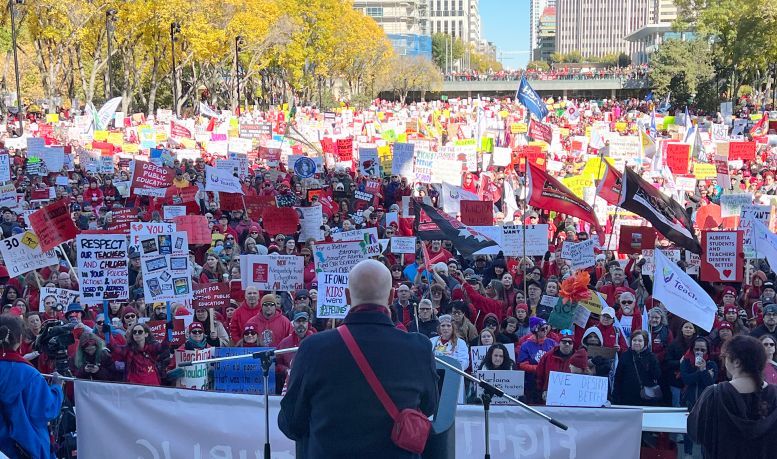
The public strongly supported the teachers’ demands. An Angus Reid poll found that 58 percent of Albertans’ sympathies are with the teachers, compared with 21 percent who side with the government and 84 percent who believe there are “too many kids” in school classes. A rally in support of teachers attracted 18,000 people in Edmonton, with rallies in other cities across the province.
However, the ATA leadership’s decision to not picket schools was a mistake — public and well-attended picket lines are an excellent place to deepen community involvement and understanding of the workers’ goals. Some teachers, without direction from above, took their own initiative. Groups of teachers organized neighbourhood marches and sign-wavings. Students did the same.
Alicia Taylor, a high school chemistry teacher in Calgary, launched a petition for a 2026 referendum question to end the $461 million (in 2025) the province gives private schools. This is the highest subsidy of any province at 70 percent of what the public schools get. Privatization is part of the long-term plan of Alberta’s Conservatives to undermine public schools and boost private schools that select the children they take. The public should not subsidize well-off Albertans who can afford five-figure private school tuition. The petition is a positive development that shows that the funds exist to properly fund public education.
On the day after teachers went back to work, students walked out in over 70 high schools organized by the Alberta Students’ Association. They were clear the teachers were fighting for their students’ future. As one student explained, “Alberta is ridiculous, and we need to show that the teachers aren’t the only ones who need to stand up for themselves. The students need to stand up for the students, and for the teachers. The overcrowding in our schools is terrible. The funding is horrible.”
Labour needs to mobilize
The mood of teachers, students and the public is clear: fight this attack. Air Canada flight attendants showed the way by defying the federal back-to-work order in August, taking the struggle in a powerful direction. In 2022, Doug Ford threatened to use the notwithstanding clause against Ontario educators. But when the Ontario unions threatened a general strike, he backed down.
Solidarity and determination are the way to win.
However, the leadership of the ATA bent the knee to Danielle Smith and ordered a return to work. There is talk of court challenges and wider solidarity. But Smith will not be moved by words.
The ATA leadership repeatedly deferred, before Bill 2 and after, to vague promises of court battles to come, somewhere down the road. This completely sidelines the 51,000 members, their energy, and their initiative. The courts are not the best place to fight for union rights. Power for workers is in the workplace. The BC Teachers took the former Liberal government to court over class sizes — it took 14 years before the Supreme Court ruled that class sizes should be included in negotiations. Fourteen years of overcrowded classrooms, an entire generation of students suffered.
The Alberta government clearly warned what was coming. The Alberta Teachers Association, the Alberta Federation of Labour (AFL) and the Canadian Labour Congress (CLC) should have met as soon as Smith announced her attack, rather than waiting until after the law was passed.
Alberta cannot find 51,000 scab teachers. If the teachers stayed out the government would not be able to open schools. It is certain that the other education unions would not have scabbed.
The government might have started court proceedings to impose fines. If the ATA had stated it refused to pay and appealed to other unions to take solidarity action, then Smith would face a major crisis.
Instead, teachers are now back in classrooms with no real improvements in their conditions.
After Bill 2 was passed Canadian Labour Congress president, Bea Bruske, stated that Canadian unions met in an emergency meeting and voted unanimously to push back against the legislation including a potential general strike. A pre-condition for any generalized strike is the teachers are on strike. Other workers will not strike in support of teachers if they are still working.
Gil McGowan, president of the Alberta Federation of Labour (AFL) and dozens of other union leaders in the Common Front, a union alliance that represents over 350,000 Alberta workers, held a press conference on October 29. Some speculated — and hoped — they would call a province-wide general strike. Instead, McGowan said, “we are not going to pull the pin today, but we are going to start the journey.” Instead, the CLC and AFL is directing the unions’ machinery into much less effective actions such as recall petition campaigns against 12 UCP MLAs and talk of legal challenges. Even the mainstream reporters at this press conference seemed surprised at the tameness of the plans that were laid out.
Is the goal of the Common Front merely to force an early election and campaign to replace the UCP with the Alberta New Democrats? As the right-wing press has been only too happy to point out, in 2017 Rachel Notley’s NDP government collective agreement with the ATA had a wage freeze. The party’s current leader, former Calgary mayor Naheed Nenshi, has given only the most superficial support for teachers and other unionized workers, mostly limited to complaining that Bill 2 was passed through the legislature with debate time limited.
The ranks of Alberta workers need to push for a much bolder approach. Teachers back on strike, mass rallies across the province, solidarity action from other unions and, if fines are imposed, shut down the province.
This is a crossroads for Alberta’s workers and young people. Smith’s attack is against all workers. If not defeated all workers will suffer and hundreds of thousands of students, both today’s and tomorrow’s, are set for worse learning conditions and prospects.
Alberta’s teachers waged a brave battle for nearly a month, one which does not have to end. The working class and young people have the power to defeat Smith, the UCP and big business, who stand behind them. The power of workers is their control of the economy — factories, offices, shops, transport, energy production, schools, etc. Without the workers not a single wheel can turn.