Varun Belur is a member of Socialist Alternative US.
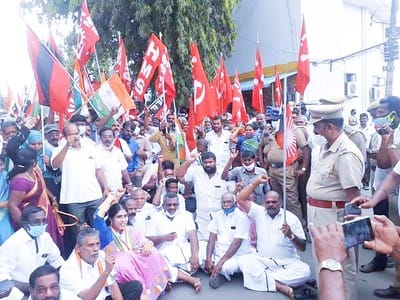
On July 9, 2025, the Indian labor movement fired a warning shot against the Modi government’s onslaught of privatization and austerity. 250 million workers across the country halted entire swathes of the economy in an all-India general strike. Key sectors like mining, transport and construction were entirely shut down and strikers blocked railways and roads, paralyzing nearly all economic activity in parts of the country.
Ten union federations under the banner of the Joint Platform of Central Trade Unions (JPCTU) called the strike in response to the “four labor codes”, Modi’s vicious anti-worker reforms that have been years in the making. These laws would decimate the few legal protections Indian workers enjoy and pave the way for the destruction of the entire organized labor movement. This is in the context of a scorching cost-of-living and unemployment crisis, particularly affecting young, women and oppressed-caste workers.
Indian workers stand on a proud tradition of militancy. Agricultural workers and farmers, alongside the labor movement, organized mass protests and two general strikes in 2020 and 2021 to defeat a package of anti-farmer laws forced through by the Modi regime. It is significant that farmers organizations played a major role in the July 9 strike, demonstrating the solidarity that has deepened between farmers and urban workers in the wake of the 2020-2021 mass movements.
The strike was originally planned for May 20 but was delayed by the JPCTU in a capitulation to the Modi regime’s drive to war with Pakistan, which escalated sharply between May 7 and 10. It was a missed opportunity to fight back against authoritarianism, nationalism and Hindutva, all pillars of Modi’s rule, and assert the independence of the labor movement. Until the labor movement breaks free of the capitalist establishment, which in India includes several “Communist” Stalinist parties, it will be forced to fight with both arms tied behind its back.
Program of the strike
The strike was organized on a seventeen-point program, starting with the demand of repealing the four labor codes. These reforms would lengthen the workday, exclude 75% of factories from labor law protections, expand precarious contract labor and criminalize nearly all strikes. Needless to say, the defeat of these brazen attacks is an existential question for the labor movement.
The program also calls for a national minimum wage of ₹26,000 per month for all workers (just over $300), a significant increase. It demands a halt to privatization of key sectors like steel, energy and railways and stopping a plan to auction off public infrastructure like highways, airports and power grids to private corporations. One of the final, and most crucial, demands is to tax the rich, including by raising corporate taxes and reinstating wealth and inheritance taxes.
The labor movement must fight for these demands, which enjoy mass support, in an ongoing way. The so-called opposition parties, which all operate within the framework of capitalism, do not support these demands. A new party must be built that is capable of transforming this massive demonstration of the strength of the working class into a force that can sweep aside Modi’s attacks and even Modi himself.
If enforced, the four labor codes would represent the harshest attack on the labor movement since the British Raj. In 1928, the British colonial government imposed the “Trade Disputes Act” on the Indian working class in response to a surge of strikes and labor militancy, including the 1927 railway strike. This reactionary law all but banned strikes, especially in key economic sectors for British imperialism, until it was partially repealed after independence in 1947. The Modi government aims to turn back the clock nearly 100 years with its anti-worker crusade.
These broadsides from the Indian ruling class did not materialize out of thin air. Parliament passed all four labour codes in 2019 and 2020, but Modi hesitated to implement them because of the mass anger unleashed by the farmers movements in the following years. Instead of building on the momentum from the victorious farmers’ struggle, the Stalinist leadership of union federations like the CITU and AITUC were focused on negotiations and parliamentary repeal efforts, wasting tremendous energy and courage.
Broader aims of the Indian ruling class
Modi’s ruthless offensive is based on the needs of the Indian ruling class, especially in the context of strengthening imperialist confrontation worldwide. The ultimate aim of Indian capitalists is to replace China as the factory floor of the world against the backdrop of the decisive power struggle between US and Chinese imperialism.
A number of states, including Karnataka, Tamil Nadu and Gujarat, have passed laws lengthening the work day at the behest of corporations like Apple and Foxconn. Despite claiming to be opposed to Modi, the reigning DMK party in Tamil Nadu did not hesitate to carry out his agenda by breaking a strike of 1,200 Samsung factory workers demanding union recognition, higher wages, benefits and a reduction of the work week.
The Indian ruling class is preparing for greater and even more deadly conflicts with Pakistan and China as it seeks to assert itself as a regional imperialist power. The escalatory conflict between nuclear-armed India and Pakistan in April and May, which has not yet been fully resolved, points to a new world order where regional conflicts also involve the main imperialist powers.
In line with this priority, the Indian ruling class aims to align itself with US imperialism. It has taken decisive steps over the past few years to deepen military and economic ties with the US, even as Modi seeks a measure of independence from US imperialism and participates in anti-US alliances like BRICS and the Shanghai Cooperation Organization (SCO). But in the final analysis, Modi and the Indian ruling class are looking west to secure their interests—it is telling that India was the lone abstention on the SCO resolution to condemn Israel’s war on Iran.
Ultimately, any strengthening of the Indian ruling class in the context of the power struggle between the US and China will not benefit Indian workers. The “Big Five” Indian capitalists—Ambani, Adani, Tata, Birla, Mittal—with a combined net worth of $218 billion are the only ones who stand to profit. Only war and poverty are in store for Indian workers unless these leeches and their entire political system are challenged.
Build a party of struggle
The most urgent task for the Indian working class is to assert its independence including building a new party of struggle out of the July 9 strike and the battles to come. The existing capitalist opposition to Modi has proven itself unwilling and unable to mount a serious offensive against Modi’s agenda and has even joined in implementing it when in power. The Stalinist and Maoist left, unfortunately, are not vehicles for working-class struggle. Stalinist parties like the CPI(M) and CPI are members of the capitalist opposition to Modi in the “INDIA” coalition and have consistently held back working-class resistance in favor of maintaining their alliances with the capitalist establishment. The Maoist movement in India is mainly engaged in guerrilla warfare which is disconnected from the working class and aims to overthrow the Indian state through military strength alone. Neither Stalinist parliamentarism nor Maoist guerillaism offer a way forward for the Indian working class, the largest in the world.
Strikes like this have the potential to be a starting point to decisively halt the march towards militarism and war and unite the vast majority of society against attacks that threaten its very existence. The one-day strike should be followed by a plan for extended strikes, mass meetings, mobilisations and organisation. Modi’s assault on Pakistan was a blatant attempt to divert attention from his deeply hated regime and redirect the vast anger against him. Clearly, that anger has not vanished and the Indian working class is ready to fight. This is a lesson for the era in general—class struggle is the only weapon we have against warmongers.
A new party should base itself on the labor movement and fight to win over the workers of every union federation affiliated to parties of the fake opposition to Modi Today, every major union federation is chained to a party of the capitalist status quo, such as the CITU and AITUC to the Stalinist parties and INTUC to Congress. The Bharatiya Mazdoor Sangh (BMS), one of the largest union federations that includes unions from 44 industries, is affiliated with the BJP. Criminally, the BMS did not take part in the July 9 strike and forced its millions of members to cross the picket line. But even the opposition parties are not willing to go beyond a warning shot to a full scale war with Modi and the capitalist system that he rests on. That is why the labor movement must build an independent party of its own in order to further the struggle launched on July 9 to stop Modi’s attacks and topple his entire regime
Such a party would also base itself on firm opposition to all forms of sectarianism and divide-and-rule employed by the Indian capitalists against working people. These include religious divides, misogyny and caste divides. A new party should be democratically organised, with a leadership with no privileges. Fighting trade unions could run genuine candidates of the movement in the upcoming Bihar state elections, an immensely important state and a stronghold of the strike. This could pave the way for a new party running on the seventeen-point program of the strike in the general elections in 2029. If so, such a party will need to learn from the lessons of new left parties internationally, of the risk of capitulation under the pressure from capitalism and its parties. This underlines the need for revolutionary Marxists to organise.
Fundamentally, as long as the capitalist system endures, there will be no end to misery for the Indian masses. Only a mass revolutionary movement, based on the Indian working class and farmers, can bury this system once and for all. We need a mass party that points towards class struggle and working-class action to light the way forward from titanic battles like the July 9 strike to the final fight against capitalism.