Brazil’s Lula government had announced COP30 in Belém, at the mouth of the Amazon River, as a summit of “truth” and “implementation.” It turned out instead to be both an expected and a sad fiasco.
Astoundingly, the UN-led climate negotiations failed to even manage to mention fossil fuels by name as the cause of 75 percent of global warming. Even after 30 years of negotiations, and 10 years since the Paris Agreement brought together 50,000 participants, including tens of thousands of representatives of Indigenous peoples, environmental and social movements, little real progress has been made.
Nor did the roadmap to stop deforestation, which Brazil’s negotiators wanted to see, come to anything. There was not even a mention of the importance of forests in capturing 25 percent of carbon dioxide emissions.
Nor were there any promises of stricter emission reductions in the national climate plans that countries had undertaken to submit. 70 of the 194 countries present did not even bother to submit plans at all.
As the Swedish Society for Nature Conservation notes, the COP30 climate summit in Belém, Brazil, ended without any of the decisions needed to reverse the course toward 3°C of warming.
Another Failure
In a desperate attempt to prevent a total collapse of the COP process, COP30 President, André Corrêa do Lago, managed to write an “appeal” to the 80 or so countries, including the EU, that had argued that they should at least start talking about a roadmap in line with the vague words of the previous COP28 to “transition away from fossil fuels.” It was unclear how this would work, with each country setting its own path and milestones, without a fixed timetable and without any means to enforce them.
Nor did COP30 manage to agree on concrete measures to combat emissions of the greenhouse gas methane, which is 80 times more potent than carbon dioxide. The most achieved was a statement on the sidelines of the summit in which seven countries – the United Kingdom, France, Canada, Germany, Norway, Japan, and Kazakhstan – promised to work toward “near-zero” methane emissions in the fossil fuel sector.
A number of developing countries and civil society organizations demanded a tripling of support for “climate-fair” financing of defensive measures such as mangrove swamps, flood protection, water storage against drought, and other climate adaptation measures by 2030. They succeeded in getting a statement about “efforts to triple” such funding, but not until 2035.
The $120 billion that this is said to involve is a third of what would be required at least. The money will probably be taken from the budget agreed at the last COP summit in Baku, which agreed a framework for public climate financing of $300 billion.
These are stingy and uncertain promises that have nevertheless been hailed as a small success. “Ten years from now is an unimaginably long time for communities facing life-threatening consequences now. Unless developed countries are pushed hard, this decision does little more than lock in climate injustice,” comments Brandon Wu of Action Aid.
Earth system scientist Professor Johan Rockström, director of the Potsdam Institute for Climate Impact Research, also dismissed COP30 as a very serious failure. In response to COP30’s motto, he said that “the truth is that our only chance to ‘keep 1.5°C within reach’ is to bend the global emissions curve downward by 2026 and then reduce emissions by at least 5 percent per year. ‘Implementation’ requires concrete roadmaps to accelerate the phase-out of fossil fuels and the protection of nature. We got neither.”
This threatens billions of people and the entire world with increasing weather extremes and the risk of tipping points being crossed. This includes the Earth’s richest biomes – the Amazon and tropical coral reef systems – and the irreversible melting of the Greenland ice sheet, which in the long term would raise sea levels by 7 meters.
This tone was echoed by UN Secretary-General Antonio Guterres: “I understand that many may feel disappointed – especially young people, indigenous peoples and those living in climate chaos. The reality of overshoot (the new O-word) is a stark warning: we are approaching dangerous and irreversible tipping points.”
“A reality check on how much the global consensus has broken down on what to do about climate change,” was how a BBC report summed up COP30.
Sweden’s beleaguered Liberal climate minister Romina Pourmokhtari tried to defend the role of the EU, Sweden, and herself by placing the blame for the failure on “the Arab oil states and Russia, among others.”
“They have simply listened to the oil countries,” she says, ducking her own responsibility as usual.
But blaming the oil states alone is not enough. The UN-led climate process began in a different world situation than the one today, which is characterized by geopolitical conflict. This takes the form of war, threats of war, and military arms races in a cutthroat economic and political competition between the increasingly authoritarian imperialist rivals of global capitalism.
At the forefront of the active sabotage of climate negotiations is the reactionary and science-denying Trump administration in the US, behind which all oil states can take shelter. And this is done with the support of the US and the world’s leading tech billionaires as well as all the global corporations and banks that see their huge investments in fossil assets threatened by climate change.
Even in the so-called world-leading countries in climate transition, such as Sweden and the EU, there is currently a loosening of previous climate targets, driven by the political right and big business. In Sweden, Pourmokhtari himself is the minister responsible.
In 2023, the EU justified new tariffs on emission-intensive goods imported from countries such as China outside the EU, but none on oil and gas.
Even Brazil’s President Lula, as host of COP30, has given climate hypocrisy a new face by saying yes to exploration by the state oil company Petrobras in the basin outside the mouth of the Amazon River, with the absurd argument that it will pay for the costs of a green transition.
Ultimately, it is the worldwide capitalist system, driven by profit above all, that stands in the way of social development in balance with nature.
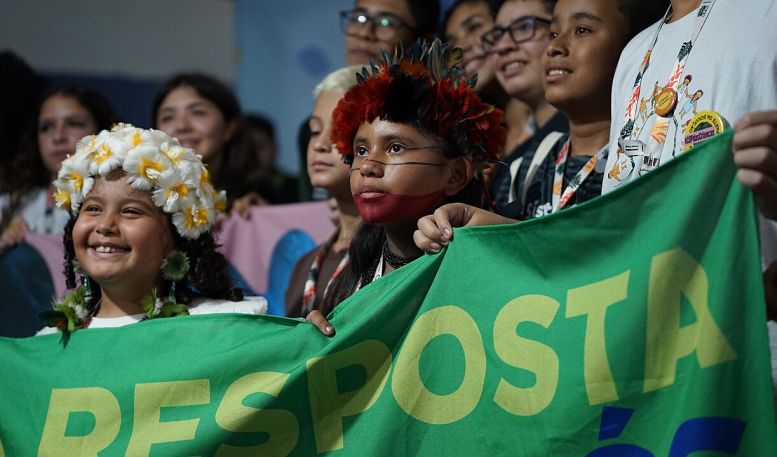
The only small crumbs of positive reports from COP30 were that the two-week meeting on the outskirts of the Amazon, after three previous COP meetings in closed oil states, gave Indigenous peoples, frontline communities, young people, trade union activists, and ordinary people a chance to gather for colorful and energetic actions, debates, and cultural events.
Thousands March for Climate Action
According to 350.org, the People’s March for Climate Justice on November 15 brought together more than 70,000 people. “With dancing, fairs, and a symbolic funeral for fossil fuels – including giant coffins and an inflatable Earth – the march transformed collective grief into powerful, determined resistance. It sent a clear message: real climate leadership comes from the people.”
Another result of the Indigenous peoples’ struggle at COP30 was that, on Indigenous Peoples’ Day on November 17, the Brazilian government granted them rights of control and thus increased protection against deforestation and more for an additional 10 significant territories in the Amazon. This comes in addition to the 11 already granted in 2024, covering a total of 13.8 percent of the country’s land area.
Another result of the COP30 agreement text was a new provision on so-called just transition, called BAM (Belém Action Mechanism). The demand, which was first raised by trade unions in the US, has been embraced by indigenous peoples and contains new wording on indigenous peoples’ rights and support for the communities most affected by extraction. It remains to be seen what this might mean for Oviken and other places concerned about uranium mining in Sweden, if anything.
Emil Gualinga, spokesperson for the Kichwa people of Sarayaku, Ecuador, hopes that the section in the work program for a just transition on the rights of indigenous peoples, “including free, prior, and informed consent (FPIC), self-determination, and the rights of indigenous peoples in voluntary isolation and initial contact,” will serve as a guide for a just transition in every country.
But that is where his praise ends, as COP30, despite the wording in the program for a just transition, kept indigenous peoples “excluded from the negotiations, and in many cases we were not given a voice in the negotiating rooms. Nor have most of our proposals been incorporated. The militarization of COP shows that indigenous peoples are seen as a threat, and the same thing is happening in our territories: militarization occurs when indigenous peoples defend their rights against oil, mining, and other extraction projects.”
COP30 has done nothing to halt the signs that global emissions are accelerating, while the empty negotiation circus now drags on towards next year’s COP31 in Turkey. In the meantime, new catastrophic consequences will inevitably whip up new momentum for the climate and environmental struggle, closely intertwined with new and growing protest movements against war, militarism, imperialism, and capitalist plundering of people and nature.