The CCP-state and the world’s biggest army, the PLA, face their most serious crisis for decades
Since 18 January the CCP’s internal power struggle has entered a critical phase. China’s authoritarian capitalist regime is deeply split, with a raging power struggle that has been largely hidden within the CCP’s internal vault but is now erupting – possibly violently – into view. This is rapidly developing into one of the most serious crises in the CCP-state since the restoration of capitalism more than three decades ago.
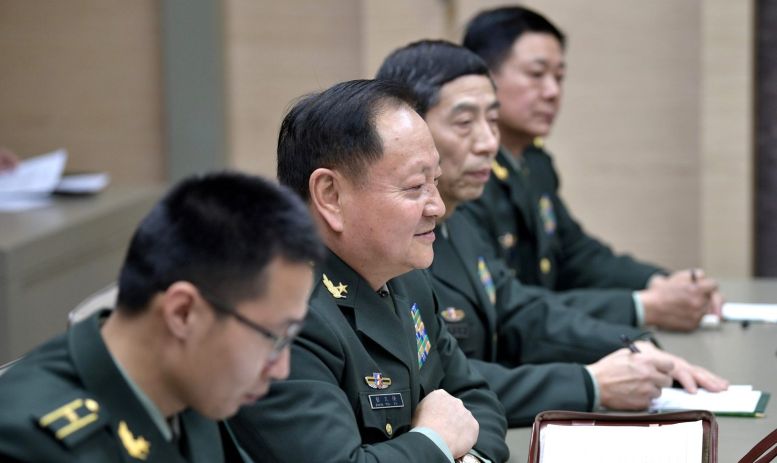
The take down of China’s top general Zhang Youxia, 75, fellow general Liu Zhenli, 61, and a rumoured further 17 generals in the same strike, is not merely the arrest of senior CCP and People’s Liberation Army (PLA) leaders. It’s a coup, or possibly a counter-coup, by Xi Jinping’s faction against rival power blocs inside the CCP dictatorship, a coalition of anti-Xi factional forces within which Zhang Youxia has been the most powerful and problematic figure for Xi.
This is because of Zhang Youxia’s reportedly strong standing in the PLA, which one commentator described as “Godfather-like status,” Zhang, like Xi Jinping, is a princeling, i.e. CCP royalty, which means he has powerful connections throughout the CCP elite beyond his PLA power base. His military career spans 58 years including active service during the ill-fated invasion of Vietnam in 1979. Very few serving PLA generals have actual battle experience.
Zhang’s rank is the equivalent of Chairman of the Joint Chiefs of Staff in the US system, second only to the president. An interesting article by former US Department of Defence official, Drew Thompson, who knows Zhang Youxia, describes him as someone with huge authority and respect among his fellow officers – sharply atypical from the rather robotic norm for senior PLA officers. Thompson confirms that Xi’s purge machine was planning to move against Zhang already in 2023, news he received from South China Morning Post reporter Minnie Chan who went missing that same year.
Clearly, therefore, Xi’s sudden dramatic strike against Zhang Youxia has been a long time in the pipeline. In fact, this was a key factor pushing Zhang to align with other factions against Xi’s concentration of power in the authoritarian system. When Xi Jinping purged the PLA’s Rocket Force in 2023, downing 20 generals, this was a warning to Zhang Youxia that his own position was threatened.
In the period from mid-2024 (the CCP’s 3rd Plenum) until now, the tables appeared to turn, with PLA purges continuing but overwhelmingly targeting Xi’s own supporters – figures like He Weidong and Miao Hua, both Central Military Commission (CMC) members and leading figures in the so-called “Fujian clique,” promoted and cultivated by Xi Jinping to cement his control over the PLA. By late last year, when the fall of He and Miao was officially confirmed, it was clear that the “Fujian clique” had effectively been neutralised – this was Zhang Youxia’s handiwork.
Most foreign media reports blindly stuck to the narrative that Xi Jinping was the architect of these purges – of his own loyalists – which defies logic. To support this idea, these news outlets repeated official CCP talking points that Xi is “serious about corruption.”
Crisis in the CCP-State and PLA
Both Zhang Youxia and Liu Zhenli are members of the CMC, the CCP organ that wields ultimate control over the PLA, which with over two million active-duty personnel is the world’s largest military force. Zhang is CMC vice chairman and second only to Xi in the military power structure. From the seven members appointed to the CMC at the 20th Congress in October 2022, only two remain (and one of them is Xi Jinping, as chairman). Nothing like this has happened before, not even in the 1960s during Mao’s Cultural Revolution.
Zhang Youxia’s increasing opposition to Xi in the CCP power struggle is also a reflection of the severe internal crisis in the PLA, with deep resentment over “political interference” and endless purges throughout Xi’s reign since 2012, which have decimated the PLA’s high command. That in turn is part of a much bigger picture of mass discontent in Chinese society. In no country is the army immune from crises and heightened social pressures in society as a whole. China is mired in a historic crisis as its debt-driven state capitalist economic model has hit a wall, with mass unemployment, falling wages, a collapsing birth rate (which has plummeted back to the level of 300 years ago – not a typo) and a rising curve of protests.
Since 2023, at the start of Xi Jinping’s third term, and prior to Zhang Youxia’s arrest this week, 14 full generals had officially been removed and placed under investigation while a further 23 have disappeared. Only four active-duty full generals now remain – just enough for a game of mahjong.
Stalin Decapitates the Red Army
This has naturally drawn comparisons with Mao’s Cultural Revolution, and the Lin Biao affair of 1971 (Mao’s defense minister who was killed in a mysterious plane crash), but probably a closer comparison is Stalin’s insane destruction of the Red Army’s leadership prior to World War II.
This of course has implications for Taiwan. Military experts in Taiwan conclude that the PLA purges “dilute the experience of China’s top generals, impeding the modernization of its military”, and create “a bottleneck,” according to Taipei Times. This won’t necessarily impact Beijing’s regular military drills designed to intimidate Taiwan and warn the US; these may even become more aggressive. But drills are drills, they are mostly for performative political purposes.
“Most generals with experience have been removed. Taiwan is safe for the moment,” is the verdict of Willy Lam, former chief editor of the South China Morning Post. How could a force in such a state of disarray mount a successful attack on Taiwan, which has better weapons than Ukraine, and as an island 130 kilometers from China’s coast presents a much more difficult military objective than Russia’s land invasion of its neighbour.
This dynamic underlines the fact, which Marxists have always stressed, that the Xi regime’s primary focus is to repress the Chinese masses, to keep control at home, rather than deploy military power overseas, even in respect of “our” Taiwan and in the context of the inter-imperialist conflict with Trump’s US.
Power Struggle – Endgame?
If the Xi faction prevails, and at least on the surface this seems most likely, this will likely result in a sharp political shift, at least a partial reversion to a more combative line by Chinese imperialism against US imperialism. We will develop this point in other articles.
But is the seizure of Zhang Youxia the “endgame” in the CCP power struggle of the past 18 months? Has the Xi faction triumphed already? This is a possibility, perhaps the most likely outcome, but as yet it is too soon to definitely draw this conclusion. We have to be very cautious given the very limited news reports available, the CCP’s systemic disinformation, and the deluge of fascinating but often inaccurate or fake rumours circulating.
There are several eye-catching abnormalities in this case, compared to the past. Most striking is the speed! In the cases of Miao Hua and He Weidong there was a delay of seven to eight months from the time of their disappearance until the official announcement that they were under investigation. In Zhang Youxia’s case the delay was only five days.
This is clearly at odds with the standard procedure for CCP purges, especially for the very top leaders. The snail-like pace is dictated by the need to build a consensus within the elite and neutralise any discontent. Given the powerful almost feudal-style patronage networks within the CCP-state, in rare cases their pressure can succeed in prizing the accused out of the hands of Xi’s Inquisition, mysteriously reappearing as if nothing has happened. Otherwise, victims are broken down (or die) through an extensive process of “peeling the onion” – interrogating family members, secretaries and friends and using them as hostages to force confessions.
Zhang Youxia’s wife, son, and 30 secretaries and staff are also reported to have been arrested. But for what purpose, when the nature of his “crimes” is already known and published? As is the norm, this is done to strike terror in the wider ranks of the CCP and PLA to put down their weapons in the internal struggle, figuratively and perhaps literally in this case.
The unusual haste and urgency in this affair suggests it is anything other than a routine disciplinary investigation. Xi Jinping doesn’t have time to wait; these are shock tactics. He needs to use the demise of Zhang Youxia as a fait accompli to frighten the opposition in the CCP and PLA into submission.
Xi’s aim in capturing Zhang Youxia and Liu Zhenli is clearly to “decapitate” – Maduro-style – the CCP anti-Xi factions, in order to re-establish his full control and prepare for a 4th term as absolute ruler. As with Maduro’s capture (although the Americans posted photos of their captive within two hours, something that has not happened in China) the intended message is “game over” and that resistance is futile.
Mass Purge?
But for Xi’s power move to succeed a much bigger purge will be needed. Some commentators compare this with Hitler’s 1934 ‘Night of the Long Knives’. In this case it will not be confined to the PLA, although that is the immediate focus, but will also presumably be aimed against several key princelings, some of “the elders,” and leading figures of the tuanpai faction and other factions, including significant profiles such as Wang Yang and Hu Chunhua – previously demoted or retired by Xi – whose names have been linked as possible successors to Xi Jinping. If these prominent figures in the anti-Xi camp don’t push back in the immediate term – and nobody should have any illusions about their heroism – Xi Jinping’s history suggests they will not be spared.
There are reports that PLA bases across the country have been ordered into “lockdown,” with orders to remain on base and to undertake study sessions.” All leave has been cancelled. Xi has sent investigation teams to military bases especially those considered to be controlled by Zhang Youxia’s allies. Officers have been ordered to surrender their cellphones.
This is clearly preparation for a mass cull within the PLA, exceeding even the huge purges to date. However, in the current information vacuum, there are few open signs that the PLA is immediately falling into line with Zhang’s ouster. It seems that few of the PLA’s regiment and group commanders have sworn their “allegiance” to Xi’s campaign against Zhang Youxia. Videos and images on social media show troop movements, military convoys, and other activity in apparent defiance of Xi’s orders. None of these reports are yet confirmed.
Xi Jinping has now staked everything on bringing down Zhang Youxia. But this may have been a desperate gamble borne of fear that the anti-Xi factions’ pressure and counter-purges were closing in. As such it could backfire. Having committed, however, Xi has no line of retreat. What happens next is impossible to foretell at this stage given the black box nature of the CCP dictatorship.
After the initial announcements of Zhang Youxia’s capture, CCP media has relegated this news story to its inside pages, which again is highly abnormal in such cases especially given the staggering significance and status of the arrested generals. Zhang and Liu have not yet even been formally removed from their posts in the CMC at this stage, another oddity.
Zhang Youxia, even if already dead, which cannot be discounted, will be a very tough nut for Xi to crack, because of the fraught relations between the PLA and Xi. His calculation is that by conducting such a daring strike and announcing that Zhang and his allies are guilty of heinous crimes – “serious violations of discipline and law” and even “treason” (passing nuclear secrets to the US) – he can use this as a Trump-style shock and awe tactic to suppress any backlash, including a possible military rebellion or acts of non compliance. However, Xi may find he is the snake that swallowed an elephant – good luck with your digestion!
Xi Jinping’s camp, through his Chief of Staff Cai Xi, controls the propaganda machine and the media. So, this part of the struggle is not so difficult for him. But this doesn’t actually mean it is “game over.” Xi’s power is widely misrepresented, ironically even more in the Western “free press” than at home; described as “unassailable” and the “strongest leader since Mao.” Marxists and ISA certainly don’t underestimate the authoritarian character of the Xi regime, yet still these are exaggerations. Xi’s achilles heel has been the economic collapse, the slide into “Japanifaction,” which has weakened him within the CCP regime just as it has undermined Beijing in the global imperialist conflict.
“Soft Landing” Theory
As mentioned, more recently i.e. since mid-2024 it is the anti-Xi factions that have also used purges against Xi Jinping’s allies to try to limit his power and probably to pressure him to step down peacefully at the end of his term in 2027. All the CCP factions – which are all without exception bourgeois and authoritarian – fear the masses and fear the political fallout if the internal power struggle becomes visible to the masses.
They understand this will damage their authority, possibly fatally, undermine their aura of cohesion and power, and thereby give a green light to mass demands for change. The 1989 mass struggle against autocracy broke out after the splits within the CCP regime became evident following the dismissal of Hu Yaobang.
Xi is more prepared to gamble despite these fears. He is more concerned that if he does not act now, the anti-Xi factions will dismantle and purge his support bases one by one until, like the crab in the heating pot, he cannot react. This puts the onus on anti-Xi factions and Zhang Youxia’s military supporters to violate the CCP’s taboos about secrecy, a development that their entire past conduct speaks against, at least in the case of the former grouping.
Various “insider” leaks that cannot be verified suggest that Hu Jintao and the CCP elders favoured a “soft landing” for Xi Jinping. According to this scenario, they hoped to constrain him through various new arrangements such as the Central Decision-making and Coordination body, which was suddenly announced after a Politburo meeting last May, but likely existed as an unofficial body even before this. What we know for sure is that this committee exists and it would hardly have been Xi’s initiative. Its role is to monitor Xi’s actions and restrict his power. Some unverified reports speak of an internal “agreement” between all CCP factions that Xi would step down in 2027. If this is true, he may have played along with this in order to buy time, with no intention of keeping his end of the bargain.
Such a so-called strategy would in that case have been dictated 100 percent by the anti-Xi factions’ fear of a public showdown. But now a public showdown is looming or is a real possibility.
The Role of Zhang Youxia
Zhang Youxia is portrayed as a military hero in some circles, perhaps this is understandable. But in political terms he has been an integral part of the reactionary bourgeois authoritarian state power that is the CCP. Zhang was pivotal in promoting and keeping Xi Jinping in power.
This includes the maneuvers against Hu Jintao and the CCP elders in the run up to the 20th Congress (2022), with the purging of all the other factions from the Politburo and Politburo Standing Committee, which led to the spectacle of the aged Hu being manhandled off the congress podium in front of the television cameras. The Xi-Zhang alliance seems to have broken down abruptly after the 20th Congress, as explained above.
The internal CCP struggle is a conflict between rival corrupt capitalist factions that fear for the fate of the dictatorship, which is what protects their vast wealth and power. That Zhang should be corrupt is not newsworthy or shocking. Xi Jinping’s purges have never been about corruption.
The Wall Street Journal reported on a briefing of senior CCP officials held in Beijing on 24 January, the same day Zhang Youxia’s arrest was confirmed, saying that at this meeting the officials were told that Zhang had leaked nuclear secrets to the US. This would be treason, of course, and punishable by death. Almost nobody believes this charge. WSJ is known to be a mouthpiece for the Xi faction, allowing it to plant its talking points in overseas media.
The “nuclear” allegation smells like a frame-up in the same mold as Maduro being a “drug lord,” which the Trump regime completely dropped after his abduction. This fits neatly into the Xi camp’s overall shock and awe campaign to try to hammer the PLA officer caste into line.
The real reason for Zhang Youxia’s take down is the life-and-death CCP power struggle and Xi’s desperation to stay in power. It is not only about Xi, but his camp loyalists such as Cai Xi and others. They naturally fear that if Xi is sidelined they will face vengeful action – a valid fear.
What Next?
A number of developments are now possible in the next few weeks and further into the future. We can only discuss perspectives very tentatively because we do not know enough at this stage. One is a Xi victory and full re-consolidation, which would most likely be brutal and bloody. This seems to be the most likely. But it would be a mistake to believe this will produce a strengthened or reinvigorated dictatorship. Xi could well prevail, but the cost of his victory could be so high in terms of self-inflicted political harm to the regime that it emerges weaker and more crisis prone.
Another possibility is that the attack on Zhang Youxia and the anti-Xi factions forces them to mount a counterstrike. Are the reports and videos of troop movements in many regions authentic? Symbolic protests, defying the orders from Xi to stand down, don’t in themselves add up to a rebellion, much less the mass resignations of officers that has also been claimed in some overseas reports. But if the PLA begins to show signs of internal collapse, that will increase the pressure on Xi within the regime and could force him to step back.
A further possibility is a stand-off, which in that case could be quite messy and chaotic. All this is very dangerous for the CCP dictatorship – we have clearly entered an explosive and decisive period.
Whatever happens next, the attack on Zhang Youxia is a political earthquake. It makes January 2026 a truly historic, world-changing month: Venezuela, Iran, Greenland, the NATO “rupture,” and the shocks emerging from Trump’s imperial project. The events in Beijing of the past week are of the same calibre, historic.