Arne Johansson is a member of Socialistisk Alternative (ISA in Sweden)
At the same time, according to a new UN report, more than 90 million people in eastern and southern Africa are suffering from extreme hunger after record droughts with widespread crop failures and livestock deaths.
While the world’s capitalist rulers focus on war, military buildup, and superpower rivalry over trade and natural resources, nature is striking back with deadly reminders of how the single greatest threat to human existence on Earth is being almost completely ignored.
At the same time, Trump is following a murderous climate policy, and the EU is toning down its climate goals. Perhaps, despite all the dominant warmongering, a series of disasters like these can breathe new life into the fight against climate change?
After 2024, the first full year with a global temperature rise above the Paris target of a maximum of 1.5 degrees, this summer began with a deadly heatwave, with the inland town of Mora in Portugal topping the records with 46.6 degrees and the Spanish village of El Granado in Andalusia measuring 46 degrees. Extreme temperatures above 40 degrees have also been recorded in France, Germany, and several other countries.
So far, “only” eight deaths have been reported in Spain, France, and Italy as direct victims of the heat and fires, although several hundred people have been forced to go to hospital. However, the excess mortality caused by the heat can only be measured once the statistics are reported retrospectively.
According to Dagens Medicin, excess mortality was estimated at up to 70,000 across Europe during the hot summer of 2003. Perhaps the significantly higher number of households with air conditioning and tree planting in many cities since then may contribute to a slightly lower death toll.
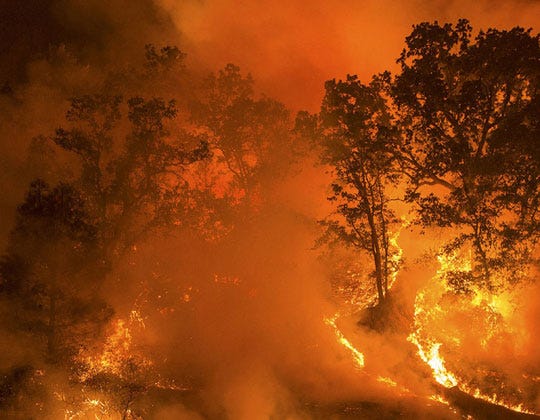
The heat, combined with drought and strong winds, has also caused thousands of small and large fires. Turkey has been the worst affected country in Europe, with fires forcing the evacuation of 50,000 people. Even worse, the Syrian province of Latakia, near the border with Turkey, is currently being ravaged by devastating fires that are out of control. According to the authorities, 100 square kilometers of forest, olive groves, and farms in 28 locations have already been “reduced to ashes.” The Syrian drought and heatwave have been described by the UN as the worst in at least 60 years.
The Greek tourist island of Crete has also been hit by spectacular fires, forcing the evacuation of a thousand people. In Spain, a fire broke out in Torrefeta, Catalonia, killing two farm workers, destroying several farms, and affecting a 40 km long belt.
All of these climate disasters are hitting jobs and production hard, not least in the food sector.
In Switzerland, a reactor at the Beznau nuclear power plant was shut down and production at another was halved due to high water temperatures in rivers.
In France, nearly 2,000 schools were closed last week, with temperatures reaching 40-41 degrees Celsius in some areas.
Some Italian regions banned outdoor work during the day after Italy issued red alerts for deadly heat waves in 18 cities, including Milan and Rome. Frequent power outages occurred due to overloading and overheating of the power grid and cables, causing traffic lights to stop working and elevators to stop.
According to the EU’s climate change service Copernicus, Europe is warming twice as fast as the global average. Nevertheless, it is of course the world’s poor who are hardest hit when drought, sometimes interrupted by devastating downpours that simply wash away the top layers of soil, drives tens of millions of people to the brink of starvation. In regions across the world, drought and poor water management are leading to shortages that are affecting food supplies, energy, and public health.
In southern Africa, according to the aforementioned UN report, one-sixth of the population needed emergency food aid in August last year. In Zimbabwe, last year’s maize harvest was 70 percent lower than the previous year, and 9,000 cattle died.
By early 2024, Morocco had experienced six consecutive years of drought, leading to a 57 percent water deficit. In Spain, drought caused a 50 percent drop in olive production and doubled prices, while land degradation in Turkey has left 88 percent of the country at risk of desertification, and agricultural demand has depleted groundwater reserves.
The report also describes how drought has disrupted production and supply chains for important crops such as rice, coffee, and sugar, which, as we know, has also led to sharp increases in world market prices.
“The struggles that Spain, Morocco, and Turkey have experienced to secure water, food, and energy during prolonged droughts provide a preview of the water future under uncontrolled global warming… This is not a dry spell. This is a slowly advancing global catastrophe, the worst I have ever seen,” summarizes one of the report’s co-authors.
As nature strikes back, the climate crisis is being further exacerbated by the global political reaction in the wake of Trump, warmongering superpower rivalry, and a radical rightward shift in politics in several countries. Despite increasingly violent weather events around the world, the UN-led Paris Agreement is also on the verge of collapse. This refers to the 2015 agreement that states that global net zero emissions of carbon dioxide and other greenhouse gases by 2050 are necessary if global temperatures are to be limited to below 2 degrees Celsius, and preferably 1.5 degrees Celsius, compared to pre-industrial levels.
After the catastrophic flooding in Texas, criticism has been directed at the National Weather Service (NWS) for failing to predict the extent of the flooding and the force of the deadly flash floods. This is a capability that has hardly been improved by the Trump administration’s deep budget and staff cuts at the NWS and insane proposals to cut climate research funding to zero by 2026.
Nonsensical blows are also being directed at the US agency NOAA (National Oceanic and Atmospheric Administration), which is responsible for a large part of the world’s infrastructure for measuring climate change and manages key time series and reference values for global average temperatures and sea level rises. Three of NOAA’s satellites that collect data to track the structure and intensity of hurricanes were also suddenly shut down on Monday this week.
In addition to a 17 percent reduction in NOAA’s workforce, with 2,000 jobs cut, the most spectacular move is the complete abolition of the Office of Oceanic and Atmospheric Research, which conducts climate research. This OAR has long contributed to important improvements in computer modeling and dual-polarization radar for microphysical information on heavy precipitation systems and early warning systems.
With current trends, where emissions rose again in 2024, the world is heading for a catastrophic 2.7-3 degrees of global warming. According to researchers, out of the so-called carbon budget that could limit the temperature increase to an average of 1.5 degrees over a few years, only two years of emissions at current levels remain, and nine years to limit it to below two degrees.
There are still no signs of the transition from fossil fuels that world governments promised at the COP28 climate summit in Dubai in December 2023.
Ahead of this year’s major climate summit, COP30, in Belém, Brazil, in November, ten years after the Paris Agreement, only five of the 20 countries in the G20, which account for 80 percent of global emissions, have submitted the increased national commitments (albeit completely inadequate) that should have been submitted in February. These are Brazil, Canada, Japan, the UK, and those submitted by Biden in the US before they were scrapped by Trump.
The European Commission is proposing a 90 percent reduction in EU emissions by 2040 compared to 1990 as a new interim target, while at the same time taking steps to postpone the measures needed to achieve the less ambitious interim target of 55 percent by 2030.
The EU Commission’s 90 percent proposal is also a target without planning tools, relying on inefficient market trading in emission allowances. The collapse of Northvolt’s battery production and the crisis in the Swedish industry’s green transition are telling warnings.
The EU’s climate policy also includes the purchase of emission allowances, which is based on financing various controversial and “cheaper” projects in poor countries instead of reducing its own emissions. One such project is the Swedish government’s plan to offset emissions in Sweden by purchasing 48,000 electric mopeds in Ghana!
But if the whole world is to achieve net zero by 2050, more developed countries such as those in the EU should have net zero as their target before 2040. Like the Swedish government, the EU as a whole is already well on its way to missing the less ambitious interim target of a 55 percent reduction in emissions by 2030 compared to the base year 1990.
It is not only extreme right-wing parties such as Sweden’s Sweden Democrats and capitalists heavily invested in fossil-dependent industries that are increasing pressure to loosen or completely abandon the transition to renewable production.
In the UK, former Prime Minister and Labour leader Tony Blair has made headlines with statements that “net zero” is losing popular support. According to Blair, a strategy that focuses on renewable energy and limits fossil fuels in the short term or encourages people to limit consumption is “doomed to fail.”
What remains is business as usual and vague hopes for other dangerous and false or completely inadequate solutions such as capturing and burying carbon dioxide emissions. However, as new reports show, the various carbon capture technologies that have been discussed for many years without any practical implementation may, at best, have a limited effect.
As the transition is delayed and new climate failures continue to emerge, nature will respond with more and worse environmental disasters, creating increased public pressure that will radicalize the climate movement on a massive scale.
We are therefore in a race against time, as global warming continues to rise steadily. The rate of warming between 2012 and 2024 has doubled from the levels of the 1970s and 1980s, leading to increasing sea level rises and ocean warming, and thus to ice loss and permafrost thawing, which further accelerates the rate and threatens to make it irreversible.
To break this trend, new mass movements are needed for a rapid, globally planned, and democratically socialist transformation of power and ownership.
In order to restore the metabolic rift between humans and nature, which has widened to breaking point under capitalism, and to establish what is today called a sustainable society, a higher, socialist society is required, as Karl Marx already wrote in Capital. In such a society, “private ownership of the earth will appear as absurd as private ownership of other human beings. Not even a whole society, a nation, or all societies existing at the same time, are the owners of the earth. They are simply its administrators, its beneficiaries, and must leave it in an improved state for future generations.”