Calling the government’s push toward resource extraction without genuine engagement short-sighted, Temagami First Nation Chief Shelly Moore-Frappier said, “This is not economic reconciliation. This is economic coercion.”
The federal government, provincial governments and industry are increasingly using the mantra of “economic reconciliation” but what they really mean is development in the interests of big business, not necessarily in the interests of Indigenous communities.
This new era of trade wars, nationalism and inter-imperialist rivalries comes with the pressure to develop domestic industries and promote national sovereignty. How to survive Trump’s trade war is a key concern. The ruling class’s answer is strengthening Canadian capitalism by dismantling “barriers” to economic development such as environmental assessments and the need for “free and informed consent” of Indigenous people prior to the approval of projects affecting their lands or territories, as per the United Nations Declaration on the Rights of Indigenous Peoples (UNDRIP).
The solution from above
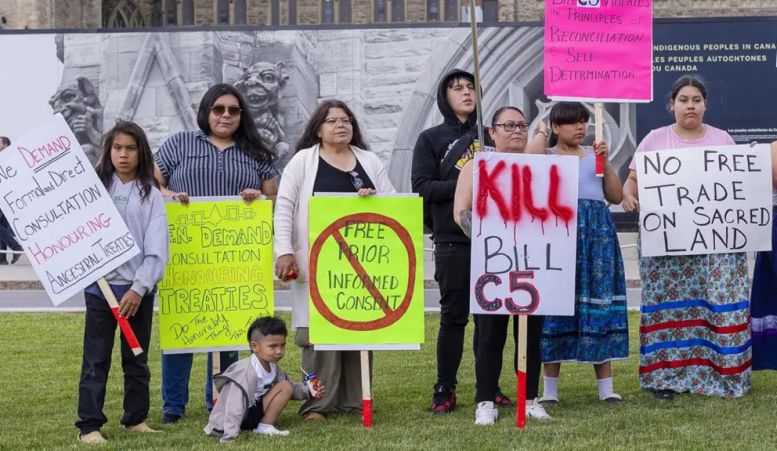
Governments — federal and provincial — have responded in unison. The Carney government’s One Canadian Economy Act (Bill C-5), the Ontario government’s Bill 5 and BC’s Bills 14 and 15 all have a similar intent: to speed up and push through developments without proper scrutiny. This means foregoing or shortening environmental assessments, weakening oversight and trampling on Indigenous and Labour rights.
Bill C-5 aims to shift power to provincial governments for environmental assessments. But several provincial governments have gutted their own environmental protection standards — bypassing environmental assessments and public consultations. Ontario’s Bill 5 includes provisions to overrule local government regulations, to suspend laws to protect labour rights, and health and safety. The rationale for BC’s Bills 14 and 15 is to speed up the approval and development of so-called clean energy projects.
The Chiefs of Ontario hosted a Community Wellness Conference recently where serious concerns about Bill C-5 and Bill 5 were raised: Indigenous groups are being asked to support Canada’s national development priorities while many of their communities still lack basic infrastructure like clean water and safe housing. There are still 38 active long-term water advisories, 27 of them in Ontario.
Economic reconciliation will be used to divide communities. After years of government starving Indigenous communities of resources, these communities are being asked to sign onto despoiling their lands. They will get 10 – 20 years of income and seven generations of poisoned land, water and life.
Mining companies and the Ontario government are pushing to develop the Ring of Fire —a vast mineral deposit covering 5,000 square kilometers in northern Ontario’s Treaty 9 territory — citing the need for critical minerals for the green energy transition. The area also contains one of the world’s largest and most significant peatlands, storing a massive amount of carbon. First Nations are mobilizing to protect their land and rights, asserting UNDRIP’s provisions for Free, Prior and Informed Consent.
Government hypocrisy
Speaking out of both sides of his mouth, Carney has referred to “the fundamental role of First Nations, Inuit and Metis,” by which he means getting them on side to help “build, baby, build.” Indigenous groups are not blind to government’s hypocrisy or to the rhetoric of economic reconciliation but face pressure to bring their communities out of crushing poverty.
First Nations in Ontario are fiercely resisting Bill 5. Several First Nations are taking legal action with talk of injunctions against government projects. Given that Canadian courts only grant First Nations injunctions against the government 18.5 percent of the time, it seems likely that there will be a renewed wave of Indigenous and environmental activism to defend people and planet.
Kyra Willoughby, a member of White Sand First Nation and representative of the Ontario First Nations Young Peoples Council, said “As youth, we refuse to accept a future where our voices are excluded from decisions that shape our lives.”
True reconciliation cannot happen under capitalism. A new society will rise out of the ashes of the old. This means dismantling the chains of oppression and the scourge of capitalism. We can create a new world — one where respect for people and nature is more important than profit.