Trump “told us the Kurds must choose a side in this battle — either with America and Israel or with Iran”, according to the Washington Post on 5 March. Almost a week into the war on Iran, the US president is increasing pressure on the Kurds to offer him ground troops, since he is very unwilling to use US soldiers.
Trump is setting a deadly trap for the Kurds. He wants cannon fodder, not Kurdish liberation. This is most recently shown in his support for the islamist al-Shaara regime in Syria demolishing the autonomous Rojava region under Kurdish rule.
Trump’s appeal, and hasty reports that Kurds were mobilising, was immediately met by Iranian missiles into northern Iraq, directed at Kurdish camps and headquarters. This escalation, in a war that is constantly expanding, can lead to increased bombings, missile attacks and also land battles in Kurdistan, both in Northwestern Iran and Northern Iraq. If Kurdish troops get involved, so could Turkish troops against them.
After a week of war and extreme levels of bombardment, it is clear that Trump has not been able to declare a quick victory as with the June 2025 “12 day war” (the previous bombing campaign of US and Israel against Iran), Venezuela or his other misnamed “peace deals.” The US’s huge military superiority has not stopped Iran’s retaliation having an effect.
Trump has admitted he hoped to carry out a more limited regime change, based on parts of the Iranian dictatorship. This plan was to avoid the alternative of chaos, civil wars and mass movements from below. That scenario was also the reason for different US administrations resisting Netanyahu’s long campaign for a war on Iran.
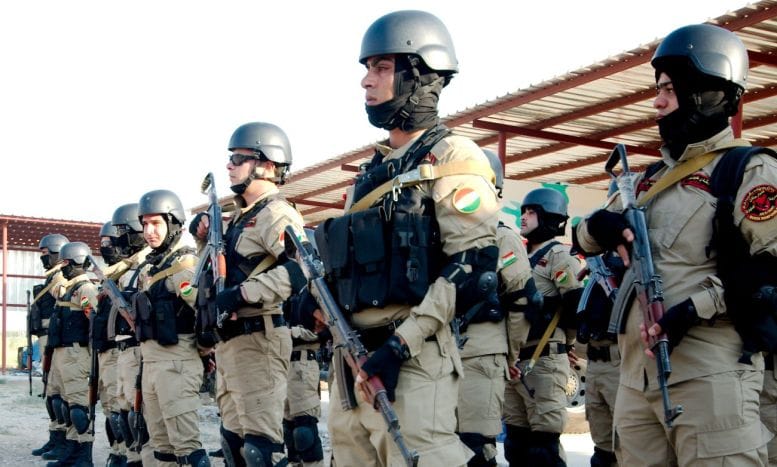
Trump is gradually realising the need for ground troops in addition to the bombing to achieve regime change. Because of public opinion in the US, after Vietnam, Afghanistan and Iraq, he has not seriously considered deploying large numbers of US troops. That is the reason for him now putting pressure on the Kurds as well as the Balochis in the South, hoping action from them will trigger others to go on the offensive. This is not a real plan, only a gamble that puts more lives in danger. In the Iraq war, the US alliance prepared over months and mobilised close to 300,000 troops. Now Trump is urging Kurdish militias estimated to number a couple of thousand under arms to attack at very short notice.
According to these very loose plans, Kurdish forces should take control of areas in Iran, with Trump offering air cover.
Autonomous KRG
Trump made his ultimatums in phone calls with Masoud Barzani and Bafel Talabani, party leaders of KDP and PUK respectively, the two parties which have dominated Southern Kurdistan/Northern Iraq for decades. They rule the Kurdistan Regional Government (KRG) that was established as a semi-autonomous region of Iraq in 1992. Both parties also play an important role in Iraqi politics.
Kurdish troops enthusiastically participated in the first Gulf War in 1991, hoping for liberation from the extremely oppressive Iraqi regime under Saddam Hussein. However, US imperialism at that time allowed Saddam and his army to stay in power and did not intervene when he took revenge with massacres of Kurds after the war. The KRG was then established to keep the Kurds under control, as a regional government that both cooperated with and was in opposition to Saddam’s regime.
US imperialism has a close relationship with the KRG government, including military bases, the main one outside the capital Erbil, not far from the Iranian border. The KRG government, claiming to stand as defender of all Kurds, has allowed Iranian and Turkish Kurdish groups to have camps within its borders. For the Iranian groups, this has been on the condition that they not use these bases for military attacks on Iran. In this way the KRG was able to have a peaceful relationship with Tehran. This also assisted its dealings with the Iraqi government in Baghdad, where Iran has been very influential.
The response to Trump’s call was quite cold. “Iraq’s Foreign Ministry said in a statement Thursday that Baghdad would ‘not allow its land to be used as a launching point for any hostile actions against neighboring countries’.” And KRG stated they “are not part of any campaign to expand the war and tensions in the region.” (Washington Post, 5 February). It seems that Trump is requiring them not to block Iranian Kurdish forces from using their bases in KRG areas to prepare and launch attacks. But both governments fear retaliation from Iran and armed militias in Iraq allied with Tehran, especially when the outcome of the war is unclear. On the other hand, they also want to avoid upsetting Trump, like all other governments.
A week before the war started, five Iranian parties in exile in Iraq formed a coalition to overthrow the regime in Tehran. They most likely knew or felt that war was close. What forces they control is not clear, but some Kurdish groups seem to be prepared to engage. “Hana Yazdanpana, spokesperson for the Kurdistan Freedom Party (PAK), which has been in touch with US officials, said its forces were on standby and prepared to cross the border but no operation had been approved.” (Financial Times, 5 March).
If any attack involves PJAK, the Kurdish organisation in KRG closest to PKK, it will most likely lead to Turkish involvement against such a force.
Kurdish Struggles
10 million Kurds live in Iran, one of the largest ethnic minorities in the country and the one most known for its struggles. Kurds played a key role in the 1979 workers’ revolution that was later hijacked by the mullahs, but also in subsequent mass movements and in the organisation of independent trade unions. The huge Women, Life, Freedom movement all over Iran in 2022 originated from Kurdistan, where Jina Masha Amini was killed by the morality police.
For more than a century, Kurdish proxy forces have many times been exploited by different imperialist forces for their own purposes. In Syria, the Kurdish PYD was decisive in defeating the Islamic State, IS, in the war 2015-2019. For a period, US imperialism supplied arms and accepted establishing Rojava’s autonomy. The Assad regime fell in December 2024 and was replaced by al-Sharaa’s islamist forces, who turned to the US, Türkiye and Gulf states for support. Trump then withdrew his support of the Kurdish-led SDF army and al-Shaara got the green light to attack Rojava. The Kurdish-led forces retreated from large areas while their IS prisoners were freed when al-Shaara’s troops arrived.
This is also done in alliance with Türkiye, whose army is occupying parts of northern Syria in its war against the Kurds. Leaders of the Kurds in Syria have signed deals with the government about abolishing self-rule and integrating its armed forces into the army. This is the kind of capitulation that no Kurds, workers or oppressed people will benefit from. In reality, these deals will not be implemented and the fighting will continue.
The history of Kurdish struggles shows their only real allies are workers and youth internationally. Appealing to governments and the UN has always led to new defeats and setbacks. It is not betrayal, as some say, since they were never really on the side of the Kurds.
The Present War
US imperialism, the Israeli government and their supporters in the Gulf state regimes have diametrically different interests to Kurds, workers and all oppressed in Iran. Their war is not for liberation but for imperialist power.
Socialists support the Kurdish national struggle, up to and including the right to establish their own state. In order to achieve this, appeals to and cooperation with workers all over Iran and internationally is necessary. In defence against the dictatorship and imperialism, arms will be necessary. But they should be democratically controlled, by workers and locally. A limited military force under US command will not be enough to overthrow the regime in Tehran and will have no democratic structures.
The struggle of Kurds and all oppressed people is a struggle against the present islamist and capitalist regime as well as a struggle against imperialism and the capitalist system.