The working class must enter the stage, against the war on Iran and for revolutionary change
Within hours of Trump and Netanyahu beginning their new war of imperialist aggression against Iran, the conflict had spread throughout the region. As of 3 March, death and destruction have already been visited on a dozen countries. The situation is now out of control, with no quick end in sight.
The human costs of this new war are still becoming clear. The first Israeli strikes, which took out Iranian dictator Khamenei and other regime leaders, also murdered at least 165 schoolgirls beginning their day in Minab. More than one thousand Iranians have been killed in the conflict’s opening salvos.
US generals claimed on 4 March that 2,000 sites had been hit, roughly double the scale of the “shock and awe” bombings which opened the 2003 invasion of Iraq. And according to Trump, “We haven’t even started hitting them hard. The big wave hasn’t even happened. The big one is coming soon.” Trump has pivoted from talk of a rapid victory, to speculating about a war of five weeks or more.
On 3 March, Israel extended the war of aggression into Lebanon, killing 31 in a single strike on Beirut and dozens more across the country. Statements from the Israeli war machine indicate that another ground invasion of the country is underway, the beginning of “many prolonged days of combat.”
Meanwhile, Netanyahu has again completely cut off all routes in and out of the Gaza strip, risking a new wave of even more severe starvation. In the West Bank, settler violence and raids by the Israeli state have also been ramped up even further since the start of this war.
The severely weakened Iranian regime’s campaign of retaliation has been unprecedented and stretched throughout the region. At least six US bases – in Bahrain, Qatar, Kuwait, UAE, and Iraq – and US embassies in Saudi Arabia and Kuwait were hit in the first waves, as well as targets within the Israeli state. As of 3 March, six US troops and ten Israeli civilians were confirmed dead. Civilian deaths and injuries were also reported in Oman, UAE, Qatar, Iraq, Bahrain and Kuwait. In Pakistan, 23 protestors were killed after hundreds stormed the US embassy during an antiwar protest.
The UK’s Akrotiri air force base in Cyprus was hit by a combat drone, and installations housing Australian and Italian troops in the region have also come under fire. With the exception of the Spanish government, Western powers, many of whom have spent the last few months posturing as “pushing back” against Trump, quickly lined up with the warmonger-in-chief in defence of their imperialist interests. France and Britain are sending warships to the region. Trump’s rage against Spain for not giving US bombers access to bases, even threatening to “cut off” all trade, shows how far he is prepared to go against those opposing his war, and also reflects his frustration at not having achieved a rapid “victory.”
The Saudi dictatorship, which encouraged Trump to launch this war while publicly counselling “caution,” is reportedly weighing up direct entry into the fighting, which would likely also draw in other Gulf states. This would see the Israeli state and Gulf dictatorships fighting on the same side in a major regional war, a development of huge significance in the region.
Pro-Iranian militias in Iraq and Lebanon are already involved in the fighting, with the Yemen-based Houthis likely to follow. The impact on the world economy is also just beginning, with stock markets plummeting on the morning of 4 March.
US imperialism has unleashed a new wave of horror in the Middle East, with unknown consequences. Alongside many more deaths, a new era of wars, civil wars, terrorist movements and failed states beckons under the capitalist system.
Trump campaigned against “forever wars” but in reality, the lessons of Iraq and Afghanistan have escaped him. While the US and Israel appear omnipotent in the region today, they are in reality engaged in an historic and very Trumpian overreach, sowing the seeds of new generations of powerful resistance to their blood-soaked rule.
US imperialist offensive intensifies
This war continues in the same direction as the assault on Venezuela with which US imperialism kicked off the year. Trump is leading an historic imperialist offensive, seeking to knock out “easy targets” among long-term US adversaries. In the process, he is significantly shifting the global balance of power in the US’s favour and to the detriment of its main competitor, Chinese imperialism.
Trump aims to get himself on Mount Rushmore by being the US ruler who presides over the fall of key adversaries of US imperialism in Venezuela, Iran, Cuba and elsewhere. In a world where “energy security” (i.e the plunder of energy resources) is crucial to competing imperialist powers, he is using US military superiority to knock out two of China’s three most important sources of oil (after Venezuela and Iran, only Russia would remain). He is striking out to ensure that in the Middle East, Israel’s utter predominance as a military force is established beyond any question. And, as always, he is looking to make a quick buck for his friends and family in the process.
It is a moment of humiliation for Chinese imperialism, racked by its own economic malaise and leadership crisis. Little over two weeks ago, Iran conducted joint naval drills with China and Russia in the Persian Gulf. What were they drilling for, if not the exact scenario which Iran faces today? But again, China (and Russia) are forced to do nothing more than issue words of protest while their ally is bludgeoned to death. The impotence of Chinese imperialism as a “security partner” for any regime around the world is being put under the spotlight.
Trump has no plan for Iran
At the same time, this war is very different from Trump’s “cheap and easy” (so far!) operation in Venezuela. This is a much more defining moment in history. It is a moment of extreme hubris and has opened up a situation fraught with great danger for Trump’s regime and US imperialism.
Marco Rubio explained to reporters on 2 March that Trump had pulled the trigger on the war when Netanyahu alerted him to IDF plans to take out the Ayatollah. But even if true, this decision merely brought the beginning of the war, which Trump was determined to embark upon, slightly forward. Farcical “negotiations” – another consistent part of Trump and Netanyahu’s playbook – with the Iranian regime were a cover for preparations to move decisively against Tehran, at its weakest moment since 1979. US imperialism needed time to amass the forces deemed necessary.
Crucially, Trump has gone “all in” for regime change, but without any kind of plan for Iran’s future governance. The suggestion that he might have a ‘Venezuela scenario’ – whereby a section of the regime had been lined up to take over and do Washington’s bidding – up his sleeve has been dispelled. Incredibly, he told The Atlantic magazine on 1 March that he had identified “three or four” candidates to take over, but they had all been killed in his airstrikes!
Trump has repeatedly called on the IRGC (the regime’s “revolutionary guards”) to “lay down their arms.” But even if they wanted to, no IRCG member could know to whom exactly they are supposed to surrender.
There is no Delcy Rodriguez (the acting President of Venezuela) figure in sight. While nothing can be ruled out, it appears highly unlikely that in the immediate aftermath of such a powerful assault and the elimination of Khamenei – who was not only a dictator but the highest religious authority for Shia Muslims – any significant wing of the Iranian regime will be prepared to defect.
In addition to having no base from which to organise a new regime within the country, it is crystal clear that neither Trump nor Netanyahu have the will or the ability to put boots on the ground and occupy this vast country. If they plan on attempting to put the reactionary wannabe monarch Reza Pahlavi back in power, he will have great difficulty securing control without an army.
Trump may hope that by simply bombing the hell out of Iran’s state and military institutions, something to his liking will rise from the ashes. Such an act of hubris has few, if any, precedents and certainly no successful ones. The vacuum opened up by US imperialism’s actions could also very plausibly be filled by an even more hardline dictatorship based on remnants of the regime, and/or lead to a prolonged civil war, which could spread throughout a multi-ethnic region.
For the Israeli regime and the Saudi monarchy, a chaotic failed state in Iran may well be preferable to the existence of a powerful and heavily-armed adversary. But for US imperialism, the destabilisation of the entire region would open the way for new crises and quagmires over a prolonged period.
This, and the bitter lessons of the ill-fated US wars in the region at the beginning of this century, helps to explain why this war is so unpopular in the United States itself, with only one in four expressing support in opinion polls. A new war, which has already resulted in US troops being sent home in body bags, could be a decisive turning point in Trump’s domestic problems, after he was forced to retreat from the Battle of Minneapolis earlier this year by the working class.
Perspectives for the war
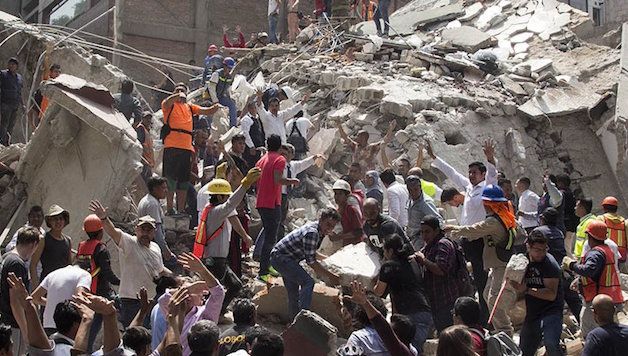
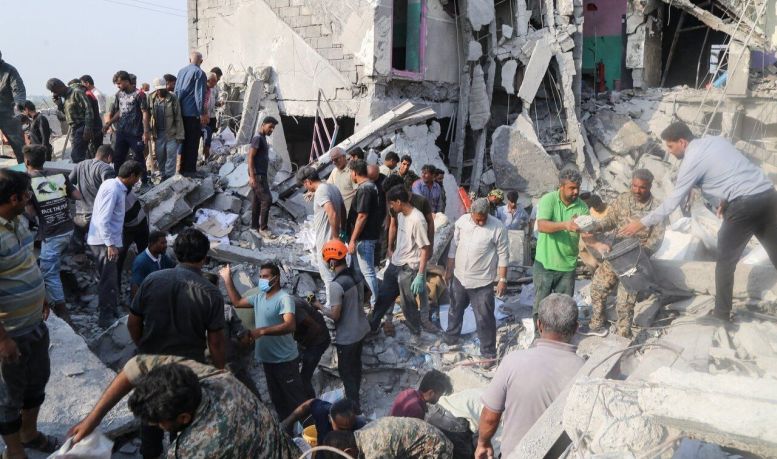
The brutality of US and Israeli attacks is extreme. As well as two murderous confirmed bombings of schools, nine hospitals have reportedly been attacked. Downtown areas are mercilessly flattened in Iran and Lebanon, as the methods of Israel’s Gaza genocide are employed.
The ease with which Khamenei was killed, in his own compound and having recklessly gathered key regime figures together to be slaughtered, is another demonstration of the extreme weakness of the Iranian dictatorship. As in June 2025, there has been no indication that effective air defences are in place in the country. The three US jets that have been shot down so far, were hit by “friendly fire” from Kuwait, not the Iranian military.
Nonetheless, the Tehran regime appears to have learned some lessons from the 12 day war last year. It is firing smaller, but more regular missile and drone salvos, thus increasing its chances of evading air defences.
Realistically, Iran cannot defeat the US and Israel militarily. However, its retaliation is being calibrated to inflict the maximum damage, both militarily and economically, hoping to provoke crises which can force Trump back. If Trump and Netanyahu’s predictions of a long war are confirmed, the impact of Iran’s campaign is likely to get progressively worse.
Trump’s top General, ‘Razin’ Caine, reportedly warned that a new war with Iran risked dangerously depleting US stockpiles of anti-missile munitions which are extremely expensive and slow to produce. During the 12 day war, the impact rate of Iranian missiles significantly increased as the war went on and Israeli air defences began to falter. This time, it appears that Tehran is therefore rationing its missiles, expending lower-quality stocks first and reserving its more powerful ballistic missiles to have a greater impact down the line.
Iran has also consciously targeted the energy industry, which is crucial to the region. It has effectively closed the Strait of Hormuz, through which 20% of the world’s oil and gas is shipped, and its Houthi allies could move to do the same in the Red Sea. Already, Qatar has been forced to stop the production of LNG (Liquefied Natural Gas) and prices have spiked. Iranian drone attacks also shut down one of Saudi Arabia’s largest oil fields.
Tehran hopes that in the scenario of a prolonged conflict, damage to the world economy alongside a bigger death toll, both among the US military and civilians in Israel and throughout the region, will build pressure to end the war. To this end, it has also targeted civilian infrastructure, hotels and airports across the Gulf. For now, however, this appears to have backfired, with Gulf states instead mulling more active participation in the war on Trump’s side.
The working class must enter the stage
Nothing good can be expected of any wing of any capitalist power involved in this war. Neither Iran nor its allies can defeat US and Israeli imperialism militarily. No regime in the region, including in Tehran, is a friend of the Iranian, Lebanese or Palestinian people. There exists no “friendlier” imperialist power that will step in to stay Trump and Netanyahu’s hand. Nor, of course, will the pro-imperialist political opposition in the US or Israel.
The only force with a real interest and the power to turn the situation around is the working class. It exists in its many millions throughout the region, has a proud history of struggle and in several countries is still armed with powerful trade union organisations. New traditions of struggle are being built among new generations and working-class tactics like the strike rediscovered. This power must be mobilised urgently.
Workers across the Middle East should coordinate strike action against the war. A regional general strike should be prepared. Workers in Egypt, Saudi Arabia, Jordan and elsewhere should rise up against their oppressive governments of collaboration with imperialism and genocide.
In the United States, another imperialist war for regime change must spur a new escalation in the working-class fightback against the Trump regime, continuing down the path of the general strike which forced ICE out of Minnesota. In Britain, Europe and Canada, the workers’ movement should organise to stop arms sales to Israel and bring down governments who are lining up with Trump’s new war.
For a revolutionary socialist alternative to the Iranian dictatorship
“Death to the dictator” was the main slogan of many heroic uprisings of Iranian workers, women youth and oppressed nationalities over recent years. The most recent, and maybe the biggest, of these revolts was subdued by the massacring of thousands of people only weeks before this war began. The regime which Ayatollah Khamenei led is drenched from head to toe in blood.
However, the Iranian people did not get the justice they deserve when Khamenei was eliminated by Israeli bombs. Removing the regime and holding its leaders accountable is their task, their right and responsibility. And this task is not only, or primarily, about punishment. It is about building a future which is better. That will not come from imperialist war or invasion, but only by the working-class taking power into its own hands.
Trump and Netanyahu nauseatingly refer to Iranian protests, but are no friend to protestors in their own counties and have wielded brutal state repression against them, including the deaths at the hands of Trump’s repressive ICE forces this year. Their bombs do not assist mass protests. In fact, this war put a halt to another wave of mass protests that started in Iranian universities last week. The hypocrisy of Western leaders talking about democracy is also exposed by their alliance with the Gulf dictatorships, in which protest movements would be attacked in the same way as in Iran.
The streets of Iran are currently and understandably not filled with protestors. Nevertheless, workers’ and the oppressed can still make preparations for a struggle to shape the country’s future. Existing movements must be linked up, and coordinated via democratic working-class organisations. A revolutionary socialist struggle must be prepared to oppose not only Khamenei’s potential successors, but any reactionary government which attempts to replace the regime.
The idea of Reza Pahlavi representing any kind of lesser evil should be determinedly opposed. Instead, the ideas of public ownership of resources and key industries, of women’s and LGBTQ liberation, and national self-determination can inspire the necessary movement for revolutionary socialist change.