
Eric Jenkins
This article was produced as part of the work of Socialist Alternative’s Black Caucus in the US. Follow us on Instagram for more analysis on the fight for racial justice and against capitalism!
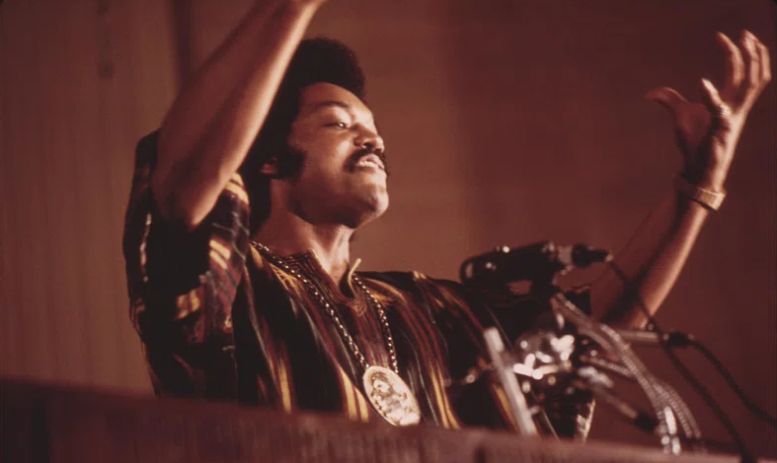
Jesse Jackson has passed away at the age of 84. Jackson was a pioneer in the struggle for Black liberation and a towering figure in the Civil Rights Movement.
Jackson was a crucial leader in the Southern Christian Leadership Conference (SCLC) alongside Martin Luther King Jr. and other gigantic fighters for justice. He led boycotts, sit-ins, and marches, advocating not just for the elimination of Jim/Jane Crow, but for raising wages and providing housing for working people.
He also fought for justice across the world. He was one of the few leading civil rights activists to advocate for Palestinian liberation. Jackson organized alongside Nelson Mandela against the horrific system of Apartheid.
Rainbow Coalition
Jackson would become founder of the Rainbow Coalition (later Rainbow/PUSH), a civil rights organization that fought for demands aimed at improving the lives of ordinary people by expanding social programs. The essence of this trailblazing organization is well captured by a poem by civil rights leader William Holmes Borders Sr. that Jackson often recited, “I Am – Somebody”:
“I am Somebody!
I may be poor,
But I am Somebody.
I may be young,
But I am Somebody.
I may be on welfare,
But I am Somebody.”
Before Bernie Sanders’ presidential campaigns in 2016 and 2020, there were Jesse Jackson’s presidential campaigns in 1984 and 1988, which inspired tens of thousands of young people to fight for his demands. He called for a 40% increase in minimum wage, national free health care, and a 15% corporate tax.
Despite running in the Democratic Party, he primarily built his 1984 campaign around his emerging Rainbow Coalition that for a time represented a serious threat for the two-party system, and could have been the start of a new party for working people, the poor, and oppressed.
In his first campaign, he unapologetically fought for the end of US and Israeli imperialism’s repression of Palestinians, for higher wages, union jobs, and economic justice. The ruling class launched a relentless assault against him, but despite this, Jackson won five Democratic primaries and caucuses in 1984, during the height of the Reagan era.
1988 Presidential Run
Undoubtedly Jesse Jackson’s early successes in his presidential run in the 1988 Democratic primaries were an enormous shock to the Democratic Party establishment and big business. Here was a Black man winning states like Alaska with almost no Black population. He won the industrial heartland of Michigan and notched 11 primary and caucus victories in total. Workers of all races, including white workers, were drawn to his economic demands and to his speeches that echoed their experiences of being on the receiving end of class warfare.
Seven years into the neoliberal agenda of Ronald Reagan, the Democrats were failing to offer any serious alternative to Reagan’s war against unions and his implicit racism. Jackson had increasingly voiced the feelings of workers as he moved across states in increasingly bigger rallies. No other candidate was firing workers up like Jesse Jackson with his economic demands, his willingness to point the finger at the rich, and his anti-military messaging.
Jackson was not only gaining support but he was increasing workers’ expectations for the next government, something the leaders of the Democratic Party, also committed to neoliberalism, did not want to have happen. Finally, he was convinced to step back, to change his message and to almost apologize at the Democratic National Convention that decided the candidate for the 1988 election. Jackson, instead of going after the policies of the right, he argued the Democratic Party needed both left wing and a right wing and that “it takes two wings to fly.” This capitulation scarred Jackson for years to come, somewhat similar to Bernie Sanders’ decision to abandon his campaign early during 2020.
Limitations
Despite his convictions, Jackson began to moderate his approach. Within a few short years he became the personal spiritual advisor of Bill Clinton—the same man who led the way in destroying welfare and building the mass incarceration system that destroyed Black communities across the country.
He was once against legalized abortion and even started an anti-abortion campaign in his organization Operation PUSH in the 1970s. He pulled punches in the debate on Palestinian liberation on the floor of the 1988 Democratic National Convention, and during his second presidential campaign he even went so far to suggest that the struggle against racism was over, to secure more votes. Decades later during the Ferguson rebellion, many BLM activists rightfully challenged Jesse Jackson on his incrementalist approach.
This was connected to Jesse Jackson’s commitment to the Democratic Party, which is a graveyard for social movements because their role is to co-opt radical movements and their leaders to prevent further radicalization. We see their rotten role today as they act tough against Trump, yet refuse to call for abolishing ICE. This is why we urgently call for a new party of the working class that refuses any connection with billionaires and uses mass movements based on class struggle methods to win demands both in and outside of the halls of power.
Jackson was not a socialist. He was supportive of capitalism, often arguing that racism and sexism are bad for capitalists and bad for growth. But capitalism and racism go hand in hand. The ruling class needs racism and sexism to divide working people to keep control, and to force oppressed sections of society to work precarious jobs.
Fight For Liberation
However, what is clear is that Jesse Jackson truly fought for justice for the oppressed, and was pushed by working people, particularly student activists, to adopt more radical stances. But the liberation Jackson fought for is unrealizable under capitalism.
He would soon change his position on abortion, with his first presidential campaign calling for legalized abortion to be covered by Medicare! He said BLM and Occupy were the “modern continuation of the Civil Rights Movement.” In 2024, despite tremendous health issues, Jackson went to City Hall in Chicago to publicly back a resolution for a ceasefire in Gaza.
The Black Caucus of Socialist Alternative honors his legacy by committing themselves to the struggle for Black Liberation. Black activists and working people must continue the modern-day Civil Rights Movement, represented by BLM, #MeToo, the struggle to abolish ICE, and to finally finish the ultimate task for liberation for all working people by fighting for a socialist world.