Trump sides with the Syrian regime
With a military offensive that began on 5 January, the Syrian army has taken control of large parts of the long-autonomous region of Rojava, which has a largely Kurdish population. As in 2015, the city of Kobane is now threatened with invasion, and as then, a strong international solidarity movement is needed.
US imperialism under Trump supports this threat to end Rojava’s autonomy. The attack makes the situation in Syria even more uncertain and could also pave the way for a return of the Islamic State.
Eleven years ago, Kobane was threatened by the Islamic State, IS. Today it is the Syrian army, led by the Islamist Ahmed al-Sharaa, the country’s leader for just over a year, that is approaching. During the fighting in January, the army quickly captured three Kurdish districts in Aleppo, followed by the regions of Raqqa and Deir ez-Zor. The Kurdish-led Syrian Democratic Forces (SDF) have been forced to leave all areas west of the Euphrates River. Despite a peace agreement on 20 January, the army has continued its attacks.
Revolution and Rojava
Rojava’s self-government was established in 2012, at a time of upheaval in the Middle East. The revolutions in Egypt and Tunisia were followed by mass protests throughout the region. Youth protests against the Assad regime in Syria developed into a revolution. But with massive arms deliveries from Turkey and the Gulf states, a brutal civil war quickly developed between Islamic armed forces and the regime. The revolt of young people and workers was crushed. 13 million people were forced to flee the war, half of them abroad.
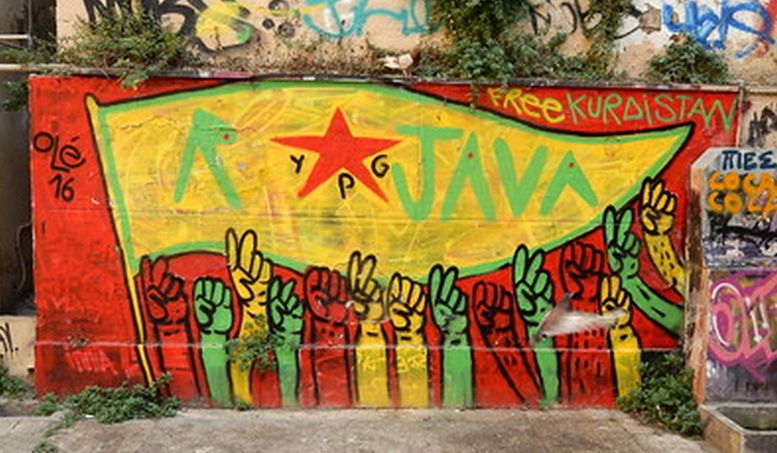
The Kurdish party PYD, linked to the PKK in Turkey, and its armed wing, the YPG, were able to take de facto power in large parts of northern Syria, from Afrin in the west via Kobane in the centre to the north-eastern region. Rojava (referring to the western part of Kurdistan) was proclaimed a secular and multi-ethnic self-governing region. In a Middle East filled with dictatorships and hardship, Rojava was seen internationally as an important democratic advance.
During the siege of Kobane in 2015, the Kurds were offered air support by the US to fight back against IS. This far-right Islamist organisation, which originated from al-Qaeda, was formed after the US war against Iraq in 2003. IS was able to exploit the vacuum that had arisen in a region ravaged by war and discontent. In a short time, large areas of Iraq and Syria were conquered. US imperialism saw this threat and needed the Kurds as its ground forces against IS. A new army, the SDF, was formed, with Kurdish YPG soldiers at its core. Only in this way could IS be defeated. Over 10,000 of the SDF’s 60,000 soldiers lost their lives in this war.
Erdoğan’s war against the Kurds
Erdoğan’s regime in Turkey, which gave full support to the Islamists during the civil war in Syria, has consistently sought to crush the Kurdish government. For decades, the Turkish state has waged war against the PKK, killing and imprisoning tens of thousands, and banning pro-Kurdish parties and organisations.
Even after the Assad regime was able to repel the Islamists, with the support of the Russian air force, Hezbollah and Iran, Turkey has repeatedly invaded northern Syria/Rojava. As early as 2018, they captured Afrin in the northwest. In nearby Idlib, al-Sharaa’s HTS formed an Islamist-controlled region with the support of Turkey. The Turkish army also invaded Syria in 2022 and 2025.
When Assad’s dictatorship collapsed in December 2024 and HTS under al-Sharaa was able to take power, the situation changed dramatically. The new regime moved its government from Idlib to Damascus. Assad’s fall was also a major and unexpected success for the leaders of Turkey, Israel and the United States in the regional conflict with Iran.
Trump and al-Sharaa
Donald Trump immediately embraced al-Sharaa’s new regime, lifted sanctions against the country and encouraged both Turkey and Saudi Arabia to invest and provide financial support to the regime. Netanyahu in Israel was more sceptical, immediately bombing Syrian military installations and occupying areas in the south of the country. For all these foreign regimes, Syria is merely a source of profit and regional power. Other states have established links with the new regime: Sweden for example, has promised millions in extra aid if the regime agrees to receive deported refugees.
Since coming to power, al-Sharaa’s regime has sought to take control of the whole of Syria. In March 2025, this led to fighting between parts of the old regime and HTS forces and massacres in the coastal region. In July, al-Sharaa’s armed forces failed to take control of Suwayda in the south in fighting with Druze armed groups.
Agreement with the Kurds in 2025
The largest region outside Damascus’ control has always been Rojava. The SDF has ruled over nearly a third of the country, controlled oil fields and also run camps with thousands of IS prisoners. On 10 March 2025, al-Sharaa and the SDF’s Mazloum Abdi signed an agreement on the governance of northern Syria.
In Offensiv (the paper published by Socialistisk Alternativ, ISA in Sweden), we commented that “The general plan is for the SDF and the civil institutions in Rojava to be integrated into the new Syrian state apparatus and army, including the oil and gas fields in the region.
The agreement is to be implemented “before the end of the year”. A number of unresolved issues that have been discussed between Damascus and Rojava remain. Kurdish leaders have demanded that their forces be separate units within the army. Nothing is said about which force will be responsible for the al-Hol camp with its 50,000 IS prisoners, which is currently controlled by the SDF. Attacks on Kurdish areas by Turkey and its Syrian National Army continued even on the day the agreement was signed.
Why are Kurdish leaders signing an agreement with the new Islamist government? One reason is PKK leader Abdullah Öcalan’s call for the PKK to end its armed struggle in Turkey. The leading Kurdish force in Rojava, the PYD, has close ties to the PKK and is likely to follow the same path. The decision to enter into an agreement is also likely based on signals from Washington.”
At that point, it was unclear whether Ankara had made any promises of concessions to Öcalan, except possibly to release him from prison. However, no prisoners have been released. It is unclear whether the PKK has actually laid down its arms, and the PYD has definitely not done so yet.
However, the change in the US’s line has been fully confirmed. Trump’s envoy in the region, Tom Barrack, has now commented that cooperation with the SDF has ‘largely lapsed’. Trump is putting the interests of Turkey and al-Sharaa first, and with these loyal partners, the Kurds are no longer needed.
Military attack
This meant a green light for HTS’s offensive against Rojava. In January, new negotiations began on how Damascus would take over power in the region, including the SDF being absorbed into the army. Rojava’s negotiators were urged to respond immediately. It was clear that the regime’s control would be total.
The integration of military forces is, of course, almost always impossible, especially when the respective forces represent different interests. For Rojava’s leadership to give up its military strength would be a form of capitulation, giving up the stated goals of an autonomous region.
After only a few days of negotiations, the regime’s military attack began.
In a short time, the SDF lost control of 80 percent of the territory it had controlled for over a decade. These setbacks are now occurring against similar Islamist forces that the Kurds fought against more than 10 years ago.
Ceasefire?
On 18 January, both parties signed a ceasefire agreement. Now al-Sharaa’s regime had tightened its demands even further. Previously, it was said that three SDF battalions could join the army, but now SDF soldiers were offered to join as individuals. Previous offers of a ministerial post for SDF leader Abdi were withdrawn. The agreement also states that al-Sharaa’s regime will have full power over Raqqa and Deir ez-Zor, as well as over all oil and gas fields in the region. The Syrian state will also take over the prison camps holding IS soldiers. How this will be done is unclear, and during the fighting in January, prisoners managed to escape. In 2025, IS carried out 200 attacks in north-eastern Syria.
The areas that Damascus has now taken control of were mainly Arab and had mostly Arab SDF soldiers. However, the agreement of 18 January also covers the Kurdish-dominated areas of Kobane and al-Hasakah in the north-east.
It states that SDF armed forces must leave Kobane, where a new police force will take over, and that Kurdish leaders who are not Syrian citizens must leave the country. All authorities must be integrated with the Syrian state.
The Kurdish leaders and population know that giving up self-rule does not mean peace. Turkey will want to go further and completely wipe out the PYD as an organisation. Promises from Damascus regarding the right to the Kurdish language and culture are just words on paper. There is no plan for the future of the SDF’s tens of thousands of soldiers.
The most likely scenario is new fighting, not the peaceful implementation of any agreement. The Kurds have experience of being pushed back in Kobane. Many will be prepared to fight, while the Damascus regime wants to quickly take over the Kurdish areas, which are also rich in oil.
The regime in Damascus is not strong, but survives because of the country’s deep crisis following civil war and economic collapse, as well as the support of imperialism. For the population, this offers no way forward.
How can Rojava survive?
The current situation is that Rojava is fighting for its survival against armed forces from the Syrian central government, which has the support of Turkey and the United States. There may be opportunities for new agreements and compromises, but these will be temporary (on January 30 a new agreement was announced). The Kurds’ only real allies are the working class in the region and internationally.
Socialists defend the Kurds’ right to autonomy and to their own state, in Syria and the rest of Kurdistan. Workers and oppressed people in Syria have nothing to gain from the regime’s efforts to take over and crush Rojava. It is by standing up for national rights that trust in a common struggle is established, within the country and internationally. Imperialism and the rulers of Syria, Turkey, Israel and the entire region are not on the side of the workers and the oppressed. US imperialism has not ‘betrayed’ the Kurds – they were never on the same side.
The national liberation struggle is a struggle against imperialism and capitalism. It cannot stop halfway or rely on support from the state within or outside the country’s borders. The struggle for democratic rights, to abolish capitalist exploitation and to share land and wealth, can win support and set an example for workers throughout the world. For socialist struggle and social change in Syria and the Middle East, for a socialist Kurdistan!