On June 18, Vancouver dockworkers and their allies commemorated the 90th anniversary of the Battle of Ballantyne Pier (1935).
This so-called battle was actually a vicious attack by police, who were armed with machine guns and tear gas, on unarmed workers who were trying to provide for their families in the midst of the Great Depression. Many of these workers were veterans of the war and had been decorated for acts of valour.
This brutal, tax-funded, state-directed assault was in service of the employers, who had previously destroyed the dockworkers’ union and replaced it with a company union that they controlled. But when the workers, over the course of a decade, managed to start transforming this company union into one that actually represented their interests, the employers set out to destroy the union once again.
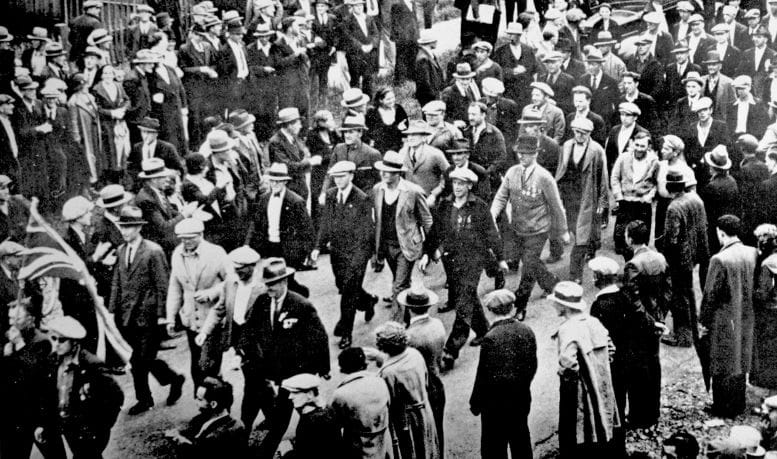
To do this they provoked a strike by locking out 50 dockworkers in Powell River and replacing them with strike breakers. When dockworkers in Vancouver refused to unload ships loaded by these scabs, the employers locked out all 900 Vancouver workers, too. On June 18, when the workers marched down Hastings Street to the docks to confront the strike breakers who the employers brought in to replace them, they were attacked by police.
The police continued to chase down, beat, trample, tear gas, and shoot people — including bystanders — for three hours. Over 100 people were injured, many of whom could not afford to be treated in hospital. In the aftermath, 15 workers and bystanders were charged and found guilty of various offences, receiving prison sentences of between 6 and 12 months. Hundreds of workers were barred from ever returning to work on the docks.
Despite this, the strike continued until December, when it was finally called off in defeat.
But even then, the Vancouver dockworkers did not give up. They may have lost a battle, but not the war. In 1944 they joined the International Longshore Workers’ Union, a democratic and determined union organized all along the west coast of Canada and the US. A union born of the San Francisco general strike of 1934.
The Battle of Ballantyne Pier
Harland Bird
On June 18, Vancouver dockworkers and their allies will commemorate the 90th anniversary of the Battle of Ballantyne Pier (1935).
This so-called battle was actually a vicious attack by police, who were armed with machine guns and tear gas, on unarmed workers who were trying to provide for their families in the midst of the Great Depression. Many of these workers were veterans of the war and had been decorated for acts of valour.
This brutal, tax-funded, state-directed assault was in service of the employers, who had previously destroyed the dockworkers’ union and replaced it with a company union that they controlled. But when the workers, over the course of a decade, managed to start transforming this company union into one that actually represented their interests, the employers set out to destroy the union once again.
To do this they provoked a strike by locking out 50 dockworkers in Powell River and replacing them with strike breakers. When dockworkers in Vancouver refused to unload ships loaded by these scabs, the employers locked out all 900 Vancouver workers, too. On June 18, when the workers marched down Hastings Street to the docks to confront the strike breakers who the employers brought in to replace them, they were attacked by police.
The police continued to chase down, beat, trample, tear gas, and shoot people — including bystanders — for three hours. Over 100 people were injured, many of whom could not afford to be treated in hospital. In the aftermath, 15 workers and bystanders were charged and found guilty of various offences, receiving prison sentences of between 6 and 12 months. Hundreds of workers were barred from ever returning to work on the docks.
Despite this, the strike continued until December, when it was finally called off in defeat.
But even then, the Vancouver dockworkers did not give up. They may have lost a battle, but not the war. In 1944 they joined the International Longshore Workers’ Union, a democratic and determined union organized all along the west coast of Canada and the US. A union born of the San Francisco general strike of 1934.