Zuhair Al-Anhar
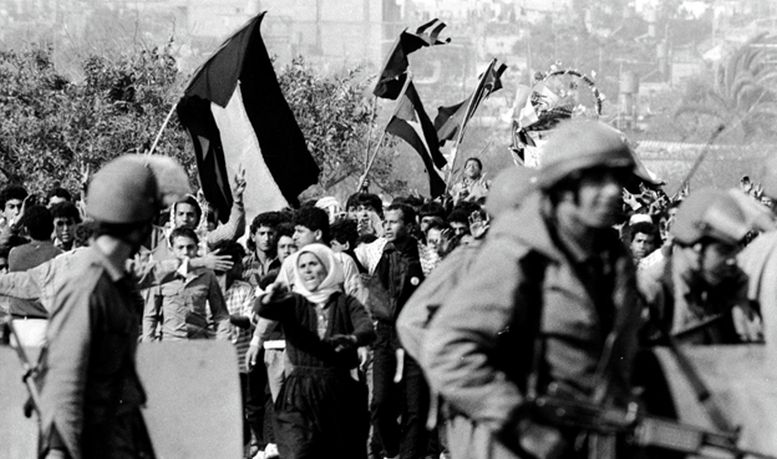
In December 1987, after 20 years of horrific occupation, the movement for Palestinian liberation was set ablaze. An escalating protest movement erupted into a national uprising when four Palestinian laborers were killed by a truck driver at an IDF checkpoint. What followed was a six-year rebellion that would live forever in the imagination of fighters against oppression: The First Intifada — “shaking off.”
After two years of monstrous genocide in Gaza, the present looks grim. While the ceasefire agreement is a needed relief, it does not address any of the fundamental questions of national oppression. The First Intifada brings valuable lessons to all fighters against oppression of the type of mass struggle that can bring about national liberation.
The Seeds of Rebellion In the Soil of Occupation
At that time, Palestinians had been living under military repression for decades, subjected to deportations, surveillance, home demolitions, curfews, political and educational suppression, brutality, and murder. Workers had mobilized for a year after two Birzeit University students were killed by IDF soldiers in 1986. The regime cracked down with summary arrests and beatings. Leaders of the ruling Likud party called for the “transfer” of Palestinians from their homes.
The experience of those four workers whose killing sparked the protests, moving between Israel and Gaza through military checkpoints, was widespread in Jabalia and other refugee camps. In 1967, when Israel seized Gaza, the West Bank, East Jerusalem and other lands, the Palestinian workforce for Israeli capitalism numbered 146,600; by 1974, it had reached 254,800. Besides confiscating land, the occupation became a source of cheap labor.
The slain workers’ funerals, held in Jabalia—the largest Palestinian refugee camp—quickly became a mass demonstration, spreading into an ongoing movement throughout the immiserated region. The IDF opened fire on protesters. But such authoritarian acts did not quell the uprising — it only grew.
A Fighting, Organized Working Class
The grassroots organization steering the Intifada was forerun by the student, labor, and feminist movements since the 1970s. Trade unions were highly political considering the connection between national oppression and class exploitation, and they organized workers in whole neighborhoods or towns. Students and youth, about 75% of the population in the occupied territories, organized campuses and were active in political parties. Networks provided essential services like medicine and building repair.
Most important were the “women’s committees” throughout the occupied territories, which collectivized and democratized domestic labor according to “one worker, one vote,” established literacy and political education programs, and organized women workers to fight for better wages and conditions. Most were explicitly socialist, later forming into the Union of Palestinian Women’s Committees.
This infrastructure proved vital in the uprising, as the leadership of the Palestine Liberation Organization had been either exiled in Tunis, imprisoned, or killed. The PLO were caught unaware by the movement and workers’ confidence in them declined, leaving organic workers’ organizations to coordinate and administer the Intifada, forming the Unified National Leadership of the Uprising (UNLU), a broad grassroots coalition.
They launched demonstrations, mass assemblies, and daily strikes. Workers marched every morning and shut down stores every noon. Strikes moved from spontaneity to regularity, led by youth. Units were established for direct action, education, health, and agriculture.
This collective action undercut every Israeli state effort to break the Intifada: school closures, arrests, deportations, and violence. The Prime Minister, Yitzak Rabin, infamously instated a policy of “force, might, and beatings,” ordering soldiers to “break the protesters’ bones.”
Misleadership & Errors
Unfortunately, the mass character of the Intifadawas cut across by the absentee PLO, consisting of parties like the Palestinian Communist Party and Popular and Democratic Fronts for the Liberation of Palestine, and led by the capitalist-nationalist Fatah. The alliance between the self-described socialist parties and the pro-capitalist Fatah included abandoning the program of collective class struggle for socialism in favor of an immediate national independence under capitalist rule. They faxed communiqués opposing mass struggle, instead relying on militia actions that disempowered workers. PLO parties also exerted influence over unions and divided the labor movement between three “general” union networks along sectarian lines.
Further, the Intifada saw the rise of reactionary, anti-worker organizations Hamas and Palestinian Islamic Jihad. Developing from the Muslim Brotherhood, which had been funded and supported by Israel since the 1970s as a counterweight to the secular-nationalist PLO, Hamas situated itself as an anti-communist and anti-left wing armed militia. Until then, political Islamist organizations had not been a big factor in the mostly secular Palestinian liberation movement. Their extreme right-wing ideology of misogyny, queerphobia, and religious fundamentalism is expressed in their terrorizing, kidnapping, torturing and killing both Palestinian and Jewish workers. Hamas remains an imperialist-backed force funded by both Qatar and Iran, allies of US and Chinese imperialism. With the PLO absent, these organizations stepped into the void, spelling disaster for the struggle.
The Revolution Betrayed
This false leadership robbed the movement of its potential. The absentee, pro-capitalist PLO, pretending to represent the Palestinian masses, signed the Oslo Accords in 1993, birthing the myth of the “two state solution” — an unkept promise over 30 years later. It is significant that the Israeli regime was forced to the table, a victory made possible by the mass struggle of Palestinian workers. But the compromises of the Fatah-led PLO — no guarantee of statehood or removal of Israeli settlements, to name a few — hollowed out this victory.
Fatah took over the West Bank and Gaza, leading the collaborationist Palestinian Authority, overseer of the occupation. Hamas pushed them out of Gaza in 2007, beginning their reign of terror. This failure led to the desperate Second Intifada which initially continued the mass character of its predecessor but then rapidly deteriorated, dominated by toxic forces like Hamas and using terror attacks and suicide bombings. These damaging tactics are futile against the IDF, a $36 billion military. Israeli brutality responded with massacres, blockades, land-theft, and the construction of the oppressive separation wall.
Oslo was sold to workers as a peaceful resolution to the protracted bloodshed, settling for two capitalist states to be rid of the colonialist aggression. It was a lie, diffusing the energy of the movement and opening the door to this aggression unabated. Israel and the US have never recognized the Palestinian state, and only after Gaza has been laid waste are states in Europe and Canada performatively recognizing some ambiguous state with unnamed borders.
Which Way Forward?
We desperately need to return to grassroots, worker-led, democratic organizations like the women’s and popular committees. Self-defense, Palestinians’ right against Israeli state aggression, must be democratically managed by these organizations. Militarized forces of right-wing reaction, like Hamas and PIJ, must be unequivocally opposed. The Palestinian General Federation of Trade Unions must play an active role in the struggle. A fight within Israel to replace the conservative leadership of Histadrut, the main network of Israeli unions, will be necessary to build trust and a common struggle to fight firmly against the occupation. The shared interest of Palestinian and Israeli workers against the oppression of the far-right Israeli regime must be frontloaded. There is a need for building workers’ political parties on both sides of the national divide. The heroic example of young Israelis burning draft cards, refusing to commit genocide against Palestinian workers and demonstrating against war must be built upon. The international movement, culminating in the historic Italian general strikes, must keep leading the way. Striking dock workers blocking the flow of weaponry play a key role.
Ultimately all nations of the Middle East, with the guaranteed right to self-determination, must fight for workers’ democracy and a socialist future free from the ravages of imperialism, occupation, and war.