In Alice Through the Looking Glass, Humpty Dumpty states that, “When I use a word, it means just what I choose it to mean—neither more nor less.” While some people do use words just the way they want, this does not make for clear understanding. Scientists try to use words in a clearly defined manner so that others can understand their meanings; Marxism is known as scientific socialism, and thus values precise definitions. This article examines the roots and meaning of a very important word: fascism.
Fascism’s Context: Revolution and Counter-Revolution Between the World Wars
Fascism was a product of capitalism in deep crisis—the ruling class turned to desperate measures to crush the working class. It was a weapon of the capitalist class in the years between World War I and II, a time of revolution and counter revolution.
It was also a time of crisis and reorganization of the workers’ movement. Before World War I, European workers built significant unions and large mass parties united in the “Second” Socialist International. Its deep weaknesses were cruelly exposed in 1914 when most leaders supported “their” national capitalists sending workers into a bloody slaughter. The socialist internationalists, initially a small minority, clearly opposed the war.
The Russian Revolution, which culminated in October 1917 with the working class, supported by the poor peasantry, taking power, gave hope and inspiration to workers around the world. It led to the founding of a new “Third” Communist International, untarnished by betrayal, that pointed a way forward for workers to win socialism. In most countries, there were now two workers’ parties: a communist party of revolution, and a “socialist” or social democratic party, with leaders that defended capitalism.
The Russian Revolution struck fear in the ruling class. Amid the deep crisis of the system, especially in continental Europe, the choice was increasingly between communism or fascism—revolution or counter-revolution. World War I, fundamentally a clash between British and German imperialism, left most of Europe devastated with weak economies and deep class divisions. The Great Depression starting in 1929 added to the economic misery and dislocation.
There were revolutions and general strikes across Europe in the years after the war. The ruling class turned to open repression. In several cases, “strong man” regimes attacked socialists, communists and unions. Pilsudski, a general, seized power in Poland in a coup in 1926. A series of coups in Portugal culminated in 1926 in a dictatorship that lasted until the 1974 Revolution. The Hungarian revolution of 1919 was crushed by invading troops from Romania and right-wing Hungarian forces commanded by Horthy, who became the country‘s reactionary ruler. Coups in 1926 in Lithuania and 1934 in Latvia overthrew elected governments. Bulgaria was ruled by an authoritarian monarchy from 1918.
However, in some countries the working class was too powerful to be defeated by these means and the capitalist class were too weak to rule through bourgeois democracy. In Italy, Germany and Spain the capitalists turned to fascism, a new form of extreme and brutal repression. While fascism in each country had unique features, they all had common characteristics.
Italy
The term fascism derives from the Italian fascists, the first to be given power. Fascio means a bundle of sticks, representing the idea that sticks are stronger together, in a bundle, than individually.
Italy was wracked by economic dislocation, strikes and peasant unrest after World War I. In the November 1919 election, the Socialist Party won the largest share of the vote at 32 percent.
The Italian working class, faced with high inflation and unemployment, organized the Biennio Rosso (Two Red Years) of strikes, occupations and demonstrations in 1919 and 1920. Union membership exploded, reaching nearly 3 million workers. In the industrial north, especially Turin and Milan, workers occupied factories and set up councils (soviets). July 20 and 21, 1919, saw a general strike in solidarity with the Russian Revolution. Peasants went on strike and seized land. By September 3, 1920, 185 of Turin’s metal-working factories were occupied, usually by armed workers. It was a revolutionary situation.
However, the leaders of the unions and the Socialist Party (PSI) did not want a revolution. While the PSI, under pressure from below, had voted to join the Communist International in 1919, its leaders were not revolutionaries. In 1921, the Italian Communist Party (PCI) was founded, leaving the PSI. But by 1921 the tide of struggle had turned.
In the 1921 elections the PSI was still the largest party, with 25 percent of the vote while the Communists had five percent.
Small fascist groups emerged during World War I and a former socialist, Benito Mussolini, founded the Fasci di Combattimento in March 1919. However, it was a fringe group in 1919, failing to elect any representatives and with less than 4,000 members.
It became more reactionary and attacked socialists, communists and union activists. In August 1920, the fascist thugs, “Blackshirts,” attacked a general strike in Milan. Socialists won many local elections in 1920 and fascist thugs responded by attacking union and local government activists.
The Biennio Rosso convinced the industrial capitalists and landowners to give the fascists support. Mussolini’s “Blackshirts” repaid their money very well. The support of big business resulted in an explosion of members. Mussolini reorganized the fascists, now numbering over 300,000 members, into the National Fascist Party in November 1921. But their electoral support remained small, winning only 7 percent of votes in the 1921 elections.
Throughout 1922 the fascists stepped up their violence, attacking strikes and destroying PSI offices. August in Milan saw street fighting between socialists and fascists who burned the PSI headquarters and then, with backing of business, staged a coup against the elected municipal government.
The capitalist class knew they had their saviour. While the revolution of 1919-20 had failed, they feared the workers would recover. Now was the time to act.
In early October 1922, Mussolini met the General Confederation of Italian Industry and consulted the U.S. Ambassador—he got support from both. In the so-called March on Rome, 30,000 fascists gathered in support of Mussolini. The King, Victor Emmanuel III, with the backing of the military and big business, handed power to Mussolini on October 30.
The fascists won 65 percent of the votes in the rigged elections of 1924. Even still, the left won nearly 15 percent of the votes. After that, Mussolini took full dictatorial power and launched waves of repression.
Germany
The German working class, the strongest in the world with a rich Marxist tradition, was betrayed when the Social Democratic Party of Germany (SPD) leaders voted for World War I. A small opposition gathered around Rosa Luxemburg and Karl Liebknecht. As the war’s misery and slaughter mounted, opposition strikes grew. In early 1917, 120,000 SPD members expelled for opposing the war formed the Independent Social Democratic Party (USPD).
In January 1918, the Revolutionary Shop Stewards organized over one million workers on strike. At the start of November 1918, the sailors mutinied, and then the army. On November 9, the Kaiser was gone, and on November 11, the war was over. Sailors’, soldiers’ and workers’ councils sprung up across Germany, in many cases running cities. Power lay in the workers’ hands. To complete the revolution, the councils needed to come together across the country, establishing a workers’ government and disarming the reactionary army officers.
The Spartacist League organized around Luxemburg and Liebknecht was too small to lead this mass revolution. The USPD was too politically weak and incohesive, unlike the Bolsheviks who had years of shared struggle and experience, to give decisive leadership.
The leaders of the SPD—Ebert, Scheidemann and Noske—were then propelled into government by a revolution they hated. Their role was to save German capitalism, not complete the revolution. Noske stated he would be capitalism’s “bloodhound.” In January 1919, Rosa Luxemburg and Karl Liebknecht were murdered on an SPD leader’s orders.
In the first part of 1919, general strikes swept across Germany including a short-lived soviet in Munich. As they were uncoordinated, one by one these upheavals were crushed by the alliance of the German army and the proto-fascist Freikorps. The first of Germany’s postwar revolutions was defeated, by the “socialist” government!
The Communist Party (KPD), founded by the Spartacist League in the heat of 1919, had a few thousand members. It was young, inexperienced and often ultra-left. It was unwilling to “patiently explain,” to win the majority of workers who were still members and supporters of the SPD or USPD, in the manner that Lenin had urged the Bolsheviks during 1917 when they were a minority among the working class.
Lenin struggled to correct the ultra-left attitude in the KPD. He urged a United Front—the KPD would keep its clear program but join with non-communists in working-class struggles and prove in practice the superiority of the Marxist method.
In 1920, the capitalist class tried to regain full control with a coup (the “Kapp putsch”). Noske ordered the army to stop the coup; the officers refused. The workers mobilized and the coup collapsed. In an ultra-left blunder, the KPD was initially neutral on the coup, although this was rapidly reversed under working-class pressure. In the industrial Ruhr region, a “Red Army” of 50,000 armed workers was established. The SPD sent the troops against them—and this time the officers obeyed, happy to kill workers rather than right wing coup leaders.
The failed coup pushed workers further left; the USPD grew rapidly while the SPD lost members. The KPD’s membership exploded to 78,000 by April 1920. However, the USPD and SPD each had a million members. At the end of 1920, the USPD applied to join the Communist International and half its members joined the KPD, now a mass party of half a million.
By 1923 inflation was out of control. Strikes exploded. The KPD gained members. The situation was again revolutionary. But having been burned by its ultra-left approach in 1919-20, this time the KPD leadership was cautious and held back the revolution.
Its defeat allowed German capitalism to regain control. By 1923, the KPD was banned (this was lifted in 1924), and the eight hour day abolished. U.S. imperialism, fearful of revolution, bailed out German capitalism. Between 1925 and 1929, Germany had relative stability and its currency was revalued.
Hitler’s Nazi Party (NSDAP), founded in 1919, was one of many small ultra-reactionary grouplets. Their 1923 attempted coup in Munich was a fiasco. In 1924 and 1928 elections they only gained a handful of votes. In contrast, the SPD and KPD together gained between 33 and 40 percent.
The world depression, starting in 1929, hit Germany hard. Again, the clouds of revolution gathered. In the earlier revolutions, the SPD leaders had saved capitalism, but this would no longer work with a mass KPD in existence. In 1930, the capitalists turned to the Nazis as the best tool to crush the German working class. They poured funds into the party.
With money, the Nazis grew, drawing in the despairing and desperate petit bourgeoisie—ruined shopkeepers and small business owners squeezed by the corporations—as well as desperate small farmers and peasants, and the unemployed. After the years of war, chaos and upheaval, the Nazis promised strong government, stability and to make Germany great again. Their gangs of thugs became better armed and organized, and attacked workers’ rallies, meetings and strikes.
The money and the support of big business also bought votes. In the 1930 election the SPD came first with 24.5 percent of the votes, the Nazis second at 18.3 percent and the KPD third with 13.1 percent.
The crisis in Germany mounted daily. There was no stable government. Nazi thugs roamed the streets. In the July 1932 election, the Nazis finished first with 37.3 percent of the votes, followed by the SPD with 21.6 percent and the KPD with 14.3 percent. The “center” collapsed, with many of its voters switching to the Nazis. The workers’ vote held firm.
With no stable government, new elections came in November. The Nazi vote dropped to 33.1 percent, and the workers’ vote increased to a combined vote higher than the Nazis. The German capitalists feared their opportunity was slipping away. They had to act now!
Hitler was given the chancellorship in January 1933 and called new elections for March. With control of the state, large funds from big business, killings and assaults on Communists and social democrats, and the banning of KPD and SPD meetings, Hitler expected to win a majority.
Even still, the Nazis got only 43.9 percent of the vote. The SPD and KPD—in conditions of near illegality—combined won 30.6 percent, a testament to the enduring strength of the German working class.
The Nazis’ brutal rule was even more murderous than Mussolini. All political parties were banned. The Communists and social democrats were sent to the concentration camps, followed by millions more. The unions were destroyed. Even churches were controlled and policed.
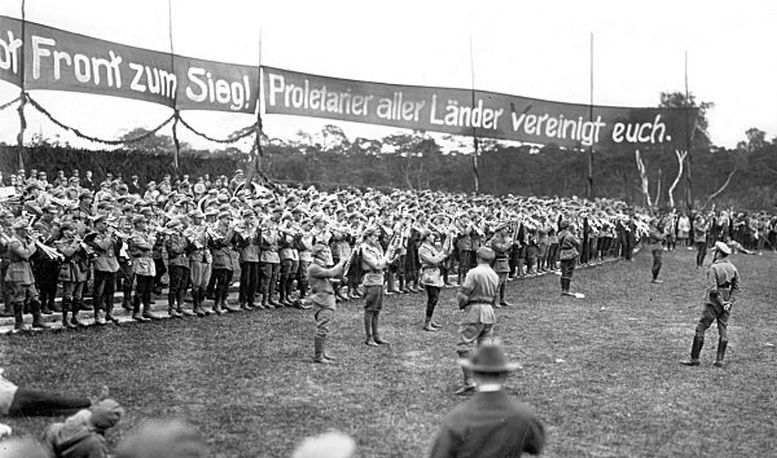
The powerful German working class was crushed without a major struggle. Yet, both the SPD and KPD had armed workers’ militias. The Reichsbanner linked to the SPD, expanded in 1931 as the Iron Front, had over three million members, 400,000 of them militarily trained. The communist linked Rotfrontkämpferbund (Red Front Fighters’ League) had over 130,000 members.
The German workers’ movement was split between the Communists and the social democrats. The KPD leadership did not use a united front approach to build unity in action. Instead of appealing for joint KPD and SPD action against the Nazis, they did everything to increase the divide.
In 1928, increasingly focused on protecting the national interests of the Soviet bureaucracy and zigzagging between an opportunist and ultraleft policy, the Stalinist leadership of the Communist International declared the “Third Period.” Claiming that revolution was on the immediate agenda everywhere, all political parties and organizations that were not communist were the enemy. In Germany, they described the SPD as “social fascists” and set up separate “red” unions. At times, the KDP even worked with Nazis to attack the SPD and argued that the SPD was “the most active factor creating fascism.”
Even after the arrest of thousands of communists, social democrats and union members in March 1933, the Iron Front leaders rejected members’ pleas to resist, stating, “Be calm! Above all no bloodshed.” The KPD leaders made no call to resist Hitler’s seizure of power. Unbelievably, they claimed that the Nazis in power would “speed up Germany’s progress toward the proletarian revolution.”
The mighty German working class was defeated by the abject failure of the leadership.
Spain
Spain’s road to fascism differed from Italy and Germany as the Spanish army, led by the fascist General Franco, was the main force used to crush the working class. In the inter-war years Spain was deeply divided: the reactionary Catholic Church held a grip on most rural areas while the working class, organized in mass socialist and anarchist unions and parties, grew rapidly in the cities.
Spain’s military dictatorship collapsed in 1931, and the socialists and liberals were elected, only to be defeated by the right in 1933. In 1934 an uprising in Asturias, a mining region in the northeast, led to workers holding power for a few weeks before troops crushed it.
The Popular Front (PF), dominated by the Spanish Socialist Workers Party (PSOE) along with Left Republican, left Catalan nationalists and the Communist Party of Spain (PCE), won the February 1936 election. The victory emboldened workers, who took mass actions. Peasants seized land from the reactionary landlords, without waiting for the government.
The army tops then plotted a coup in plain sight while the government refused to mobilize the workers or the ranks of the army against the officers. The coup started in July 1936. Almost immediately, the fierce resistance of workers defeated Franco in the major cities.
While Franco held Morocco (then a Spanish colony) and large parts of rural Spain, the workers held the big cities and most of the coast. When liberating their cities and lands, the working class and poor peasants simultaneously carried out a social revolution, seizing the factories and collectivizing the land. All that was needed to complete a socialist revolution was a revolutionary party to guide the working class to power in a centralized workers’ government. However, this was sorely lacking.
The Communist Party (CP) grew from relative obscurity to play an important role, based on Stalin’s limited supply of arms to the Popular Front government. Stalinism had done a complete political somersault after the disaster of the “third period,” to the “popular front” policy. Now anyone who was not a fascist was a communist’s friend. As this meant appeasing the “progressive” bourgeoisie (a shadow, as the bulk of the bourgeoisie supported Franco) and not upsetting British and French imperialism, the CP opposed peasants seizing land and workers controlling factories. They acted as the main enforcers of capitalist interests against the workers’ revolution.
The revolutionary workers’ organizations—the anarchist CNT, socialist UGT and radical left POUM—did not counterpose a clear policy of revolutionary socialist struggle to the Stalinists’ betrayal. The POUM, especially, failed the test of history. It was led by former Marxists from the Trotskyist Left Opposition, and with tens of thousands of revolutionary members, it could have won the leadership of the movement if it had campaigned for a united front and a clear program for socialist revolution to defeat Franco. Instead, it joined the leaders of the other workers’ organizations, refusing to challenge the Popular Front’s direction until it was too late. As in Germany and Italy, the failure to build a cohesive revolutionary party, with roots in the working class, in advance of revolutionary events, was decisive in the defeat of the working class.
Instead of waging revolutionary war to finish off Franco, the government turned on the workers—crushing workers’ control in revolutionary Barcelona and, to reestablish a bourgeois army, dissolving the anarchist and POUM militias that were fighting Franco.
The Bolshevik-led Red Army in Russia’s 1919-22 civil war defeated the much better armed White Armies with the high morale of a revolutionary political struggle. The defeat of Spain’s revolution turned the war into a purely military conflict and led to the victory of Franco’s army, backed by the weapons and bombers of Italy and Germany’s fascist regimes.
Franco established a bloody regime, which began its decades-long reign with the murder of tens of thousands of workers. The fascist Falange became the party of Franco’s rule. It confiscated the property of all other parties. Genuine trade unions were banned and crushed, replaced by Falangist stooges. Spain’s nationalities and languages were banned and brutally repressed.
Other Countries
There were fascist forces in almost every capitalist country. Although sections of the ruling class supported them, most of the ruling class did not feel the need to hand power to the fascists. However, the capitalists were happy for the fascists to attack the workers’ movement and hoped that Nazis would attack the Soviet Union. They showed no concern for the Jews. When World War II started, the fascists in the allied countries were discredited, as ruling classes pivoted to the banner of “freedom and democracy” against fascism.
Understanding Fascism
Clara Zetkin and Leon Trotsky provided insightful analysis of fascism and how to defeat it. Within months of Mussolini being given power by the bourgeoisie, Zetkin wrote The Struggle Against Fascism and Resolution on Fascism for the Communist International’s conference in March 1923 (both available on www.marxists.org).
Zetkin clearly stated that while fascism uses bloody terror like other military dictators, it is different from regimes such as Horthy in Hungary. The “base of fascism lies not in a small [officer] caste but in broad social layers.” She argued that Mussolini’s regime was “punishment because the proletariat has not … driven forward the revolution.”
She explained that reformists see fascism as “merely a form of bourgeois terror.” Some today call all “bourgeois terror” fascism. The mass base of fascism was middle layers of society who swung between backing the working class and capitalists. When the revolutionary movement failed, they turned to fascism with its promises of a strong state and security and stability. The fascists use populist slogans and phrases against both capital and the unions, giving voice to the “little people.” But once in power, the fascists ruled for capital, setting about the destruction of all working-class organizations.
As well as clear analysis, Zetkin put forward a program of resistance. She argued for workers’ defence forces and a united front of the working class. She recognized that as the Communists were not a majority of the class, they had to stand with social democrats and other working-class activists in common resistance to the fascist threat to the existence of all working-class organizations.
Less than a decade later, as the threat of the Nazis mounted in Germany, Trotsky, in many publications, returned to Zetkin’s analysis of fascism and how to fight it. Tragically, by then the Communist International under Stalin had abandoned all that Zetkin had written.
Trotsky again explained the difference between military dictatorship, however brutal, and fascism. Fascism sets in motion “the masses of the crazed petty bourgeoisie and the bands of declassed and demoralized lumpenproletariat,” the countless humans that capitalism had “brought to desperation and frenzy.”
The united front of the communist and social democratic movements, with their armed workers’ defence forces, could have resisted and then smashed fascism. In joint actions, the Communists could have won SPD members to their ranks.
He warned that the “historic function of fascism is to smash the working class, destroy its organizations.” Fascism means the “workers organizations are annihilated; the proletariat is reduced to an amorphous state.”
The socialist leaders in Italy and Germany called on the state—the courts and police—to act against the fascists, believing the state to be neutral. Yet the state is not neutral—it supports the capitalist class. The danger of illusions of state neutrality was again shown in Chile in 1973, and more recently in calls for the police to act against Golden Dawn fascists in Greece, when it was estimated that half the police were among its supporters.
Neither in Italy nor Germany did the fascists simply seize power; in both cases the ruling class gave them power. The German capitalist class has pushed a narrative of “collective guilt,” claiming all Germans were responsible for Nazis. No! This is a slander of the German working class who never supported the Nazis. A slander to hide that it was the capitalist class that embraced Hitler.
Fascism Today
None of the reactionary regimes of the 2020s are currently fascist. However, many of these governments and the movements they base themselves on, such as Trump, Meloni and Modi, have a fascist or extreme wing.
While the ruling class is absolutely terrified of a future revolution, today they do not face a working class organized to overthrow the system.
In a time of sharp class conflict, the capitalists would willingly use the fascists as they did in Chile in the 1970s against the left-wing Allende government, when fascists sabotaged infrastructure and attacked the workers’ movement. They were an auxiliary force to the U.S.-backed military coup.
Democracy to the capitalists is not a principle, it is the cheapest way to rule in “normal” times. But when their system faces the threat of revolution, they happily abandon it for military dictatorship or fascism, as they did in most of continental Europe in the inter-war period.
To say that the right populist and far right regimes of the 2020s are not fascist, in no way suggests that they are not extremely dangerous to the working class and the planet. The capitalist class is the most ruthless ruling class in history; they will try everything to keep power. The lessons of fascism’s victories—which are ultimately the lessons of failed socialist revolutions—are vital for today’s Marxists.