May the mass struggle in Bolivia serve as an example for the rest of Latin America!
In the popular uprising already of over 6 weeks against the government of Rodrigo Paz and his policies, the people of Bolivia are addressing the most important challenge facing the working class and oppressed in Latin America at this moment: to confront, in the streets through mass action and not merely through electoral processes, the rise of the far right and Trump’s imperialist offensive in the region. The outcome of this battle will determine Bolivia’s future course but will also influence the balance of political and social forces across the region.
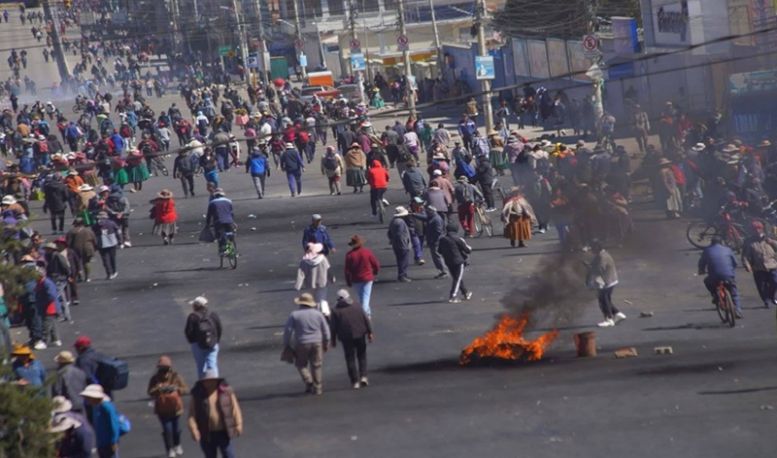
There was no “honeymoon” for the right-wing upon its return to power in Bolivia. Just over six months after taking office as president, Rodrigo Paz Pereira has not had a moment’s peace, and Bolivia is in the throes of a profound social and political crisis. Paz’s resignation is being demanded by the mass movement on the streets of La Paz, in Indigenous and peasant mobilisations, and at the more than 50 roadblocks across various parts of the country which together with a powerful general strike, are causing massive economic disruption.
In the very first days of his term, Paz decided to implement his “package of evils” all at once. He issued a decree abolishing the subsidy on hydrocarbons, triggering an explosive rise in fuel prices (86% for petrol and 160% for diesel). The decree also relaxed legal and environmental controls and authorised the government to enter into confidential contracts with domestic and foreign private investors in strategic sectors such as mining and energy.
The reaction of the mass movement at the start of the year, with a national strike called by the COB and dozens of roadblocks, forced the government to signal a retreat. The original decree was revoked and the government promised to negotiate a new decree with social movements. Although the government remained intent on maintaining its policy of attacks, this led the movement’s leadership to back down as well.
But it was short-lived. In April, Indigenous and peasant communities, mainly from the Amazon region of Bolivia, began to mobilise with roadblocks and a long march towards La Paz demanding the repeal of the so-called Marinkovic Law (Law 1720). The law reverses historic gains made by peasants and indigenous peoples, allowing the reclassification of small rural properties, making them liable for seizure, on the basis of debts and other reasons, thereby serving the interests of large landowners who seek to control these lands.
At the same time, public transport unions and federations denounced the government for selling ‘gasolina basura’ (trash petrol) to users – adulterated or poor-quality petrol that had already damaged thousands of vehicles and caused enormous losses. The campaign for compensation for the damages and losses suffered also helped fuel the broader struggle.
Alongside this, various categories of workers (education, health, miners, factory workers) took up the struggle for compensation and wage increases, which led the COB leadership to hold a national “Cabildo” (assembly) on 1 May, attended by thousands of workers. The Cabildo decided to call an indefinite national strike in support of the demands of the various sectors involved in the struggle.
Also in May, the government announced the first steps towards changing the 2009 Constitution in order to remove what it considers obstacles to foreign investment. In practice, the aim is to roll back social and political gains achieved through mass struggle and to safeguard the interests of big business and imperialism.
The movement grew and became more radicalised as it faced harsh repression by the government, which refused to meet its demands. The protest movement took on the characteristics of a genuine popular uprising.
Harsh repression meted out during the mass march in El Alto on 16 May resulted in at least four deaths. The mobilisation continued to La Paz, where clashes with the police from 18 May onwards took place in the streets and around Plaza Murillo, where the government palace is located. At this point, on the demonstrations in La Paz and at the more than 50 roadblocks which had been erected across at least seven regions, the main demand of the struggle became the resignation of Rodrigo Paz and the fall of the government.
Paz: a Government Serving Big Business and Imperialism
Rodrigo Paz took office last November as the first right-wing president elected in Bolivia after 18 years of MAS (Movement Towards Socialism) governments, led by Evo Morales (2006 to 2019) and Lucho Arce (2020 to 2025). In 2019–20, a far-right government, led by the self-proclaimed president Jeanine Áñez, was established following a coup d’état, but new elections were called in 2020 following pressure from the mass movement which put the MAS back in power.
Rodrigo Paz was elected in 2025, capitalising on the massive erosion of support for Lucho Arce’s government and the MAS in general. The crisis within the MAS that led to the collapse of this political force is a direct result of its inability to deepen the process of transformation demanded by the mass movement since the major struggles with revolutionary potential of the early 2000. These included the “water war” (2000), the “gas war” (2003) and the radicalisation of the mass movement in response to the attempted coup by the far-right “media luna” in 2008.
The political camp considered “progressive,” which for years had organised itself around the MAS, went into the 2025 electoral process completely fragmented and demoralised. The political rift between Evo Morales and the then-president Lucho Arce reflected a struggle for control of the party and the presidential candidacy, but was also fuelled by economic crisis and the austerity policies implemented by the then-president.
Evo Morales, barred from standing, formed his own party (Evo Pueblo) and called for a blank vote in the elections. With other divisions within the MAS also taking place (such as the split by former Senate President Andrónico Rodríguez, who secured 8.5% of the vote in the presidential race), it was virtually decimated in the elections. Its presidential candidate secured just 3% of the vote, and the party lost all the seats it held in the Senate, whilst the number of deputies in the National Assembly fell from 75 to just two.
In the second-round contest between two right-wing candidates, Rodrigo Paz chose to adopt a more pragmatic and moderate stance against former president Jorge “Tuto” Quiroga, who took a line of direct confrontation against everything associated with the policies of MAS, including the social gains won through struggle. Both, however, equally represented the interests of big business, agribusiness and US imperialism in the country.
Having won the election, Rodrigo Paz began to implement the typical recipe of cuts, privatisations, tax breaks for the super-rich, the withdrawal of rights, etc. Faced with a popular and workers’ response far stronger than he had expected, Paz attempted to combine repression with cynical gestures towards dialogue. He sacked the labour minister and made other changes to the government, as well as creating an “economic and social council” supposedly to engage in dialogue with sectors of civil society.
What stands out, however, is the brutal repression in La Paz and other regions, with deaths, injuries, arrests and the persecution of social movements. Arrest warrants have been issued for several movement leaders, including Mario Argollo, executive secretary of the COB, who is currently in hiding. A powerful media campaign is underway to criminalise social movements for causing a “humanitarian crisis” in cities through road blockades and the “disorder” they have caused.
US Imperialism and Latin American Right Rally Behind Paz
This was the tone adopted by a “joint statement on the situation in Bolivia” signed by right-wing and far-right presidents from Latin America in support of Rodrigo Paz. In the statement, the presidents of Argentina, Chile, Costa Rica, Ecuador, Honduras, Panama, Paraguay and Peru condemn the Bolivian social movements, clearly fearing a repeat of a similar situation in their own countries.
This is particularly the case in Chile, where the first days of the far-right José Antonio Kast’s government were also marked by fierce struggles by students and other sectors of the working class against the new government’s repressive measures. The fear of a repeat of the 2019 social upheaval hangs in the air in Chile and elsewhere, and this worries the entire Latin American right and US imperialism.
The US Deputy Secretary of State, Christopher Landau, cynically denounced the movements in Bolivia as an attempted coup d’état. The Secretary of State, Marco Rubio, echoed the position of the so-called “Shield of the Americas”, the clique of sycophants of Donald Trump and US imperialism, which, in addition to the cynical “humanitarian concern” about the blockades, sought to justify the repression by accusing the social movements of being drug traffickers.
Rodrigo Paz is under pressure from the strength of the workers’ and popular movements but also from the dissatisfaction of sectors of the Bolivian right that want an even tougher and firmer stance. Tuto Quiroga has demanded that the government declare a state of siege and impose further repression. Proto-fascist organisations such as the ‘Santa Cruz Civic Committee’ have threatened violent action against the movement if the blockades are not lifted. Vice-President Edman Lara, a former police officer and far-right populist who was already at odds with Rodrigo Paz, is now opportunistically distancing himself even further from the president.
The political crisis and divisions within the ruling elite reflect the strength coming from below. But this strength needs organisation, strategy and a programme commensurate with this historic moment.
Harness the Strength of the Mass Movement with a Socialist Strategy and Program
The right accuses the current mass movement of being orchestrated by Evo Morales, who is currently living in the Chapare region to protect himself from court convictions against him. But the movement is much more than that; it has deeper roots in the Bolivian people’s tradition of struggle, in their grassroots initiatives and organisations, and in the widespread popular dissatisfaction with the current situation and the government of Rodrigo Paz.
The leadership of the COB and the main peasant and Indigenous organisations have already shown that, without pressure from the grassroots, they tend to conduct negotiations and make agreements that end up frustrating those on the front line of the struggle. But this active grassroots movement of workers, peasants and Indigenous peoples has also shown that it is capable of pushing its organisations beyond what the leaders intended.
Recent days have shown that it is possible to bring down the government of Rodrigo Paz and fight for an alternative government of workers and the oppressed.
To this end, it is crucial to intensify the stoppage of production and the distribution of goods, consolidating the indefinite general strike and organising it from the grassroots. Workers’ committees can take responsibility for the democratic organisation of the struggle at the grassroots level, and it is only they, acting independently, which should organise supplies for the needs of working-class communities. We must strangle big capital and build solidarity among the oppressed and exploited.
The focus of the struggle is the overthrow of this government and, with it, its anti-worker and anti-popular policies. Overthrowing Rodrigo Paz must also imply rejecting any solution based on institutional continuity, whether through the vice-president or a solution based on the right-wing-led Legislative Assembly. By organising the struggle from the grassroots up, it is possible to lay the foundations for a political alternative based on the organisations of the working class, peasants, indigenous peoples and all oppressed people.
The movement needs to learn the lessons from the limitations, mistakes and betrayals of previous MAS governments and, based on the mass struggle, put forward an anti-capitalist and socialist program as an alternative to the crisis in Bolivia and across Latin America.
A victory for the workers, peasants, and Indigenous and oppressed peoples in Bolivia against this government will provide an enormous boost to the struggle against the rise of the far right throughout Latin America and all imperialist meddling in the region. This is the basis for defeating US imperialist intervention in Venezuela and the increasingly concrete threats against Cuba. In all these cases, the priority is the mass struggle and a socialist program.