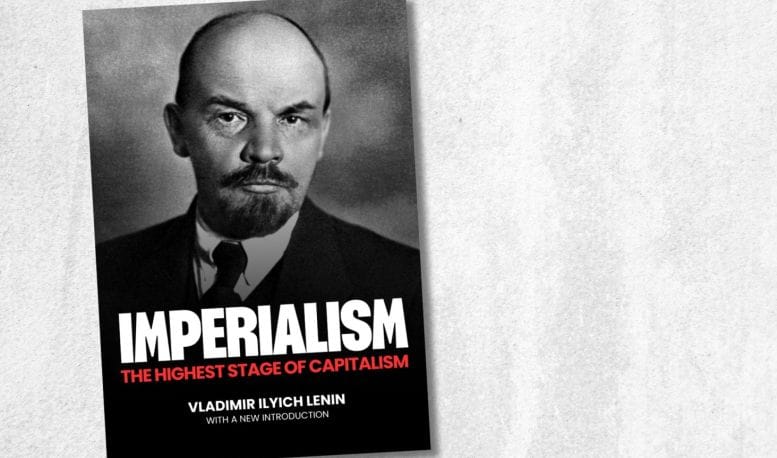
The following article is an introduction to Vladimir Lenin’s Imperialism: The Highest Stage of Capitalism which was republished by Socialist Alternative England, Wales and Scotland in 2025. While there have been a number of significant global developments since this introduction was written – including the current US-Israeli war on Iran and Lebanon and Trump’s offensive in Venezuela – these developments only reinforce the relevance of Lenin’s analysis today.
Imperialism: The Highest Stage of Capitalism, arguably like all great works, was born of a profound understanding of the particular moment in history in which it was written. It was of its time and for its time. It provided a deep theoretical explanation of the forces shaping the world at that moment. But its conclusions were not merely theoretical. Lenin’s intended audience was the workers’ movement internationally. He wrote for the most militant socialist and communist workers in the trade union and political organisations in which they were organised. The book was intended to shape and to guide the work of these fighters on the eve of great revolutionary crises and upheavals. Lenin wrote with a keen sense of purpose. His analysis was designed to arm anti-war and revolutionary workers with a clear political understanding. He explains what connects the seemingly mundane capitalist drive to make a profit with the dramatic, powerful and world-shaping march of imperialism, colonialism and war.
In what can therefore seem like a paradox, Imperialism is a work that is both completely of its time and completely relevant to the world of 2025. Despite more than a century having passed since its publication, it is essential reading for all those organising against war and militarism, battling against colonialism and neo-colonialism, struggling for decent wages, better living standards, and against the capitalist system itself. Our hope is that the re-publication of this book both deepens the understanding of those fighting for socialism today, and inspires others to join that struggle.
Context of Imperialism: The Imperialist Slaughter of World War I
To be truly understood, Imperialism must be seen in the context of its time – it was a book written to understand the processes which had led up to and bred World War I. It was devoted to answering the question of how a catastrophe of this scale could happen, and as a result, how it could be ended. It was written during and published during the war. But it was also, crucially, written in the run-up to an even more important historic event – the 1917 Russian Revolution, where the working class of Russia overthrew capitalism and began building the first workers’ state in history, ending the slaughter of WWI itself in the process. Lenin’s role as a leader of this revolution simply could not have been fulfilled without the understanding laid out in this book.
WWI was fundamentally reactionary in every way. It was a war fought between two blocs of imperialist powers for the right to plunder the world. It was a war over the right to exploit, resolved by sending workers from more than 30 countries to murder one another for profit. But it’s not enough to condemn imperialist wars like this; they have to be understood.
In the words of Carl von Clausewitz, “war is a continuation of politics by other means”. The world war was not at all the product of the assassination of an Archduke – often cited as the trigger for its beginning – but grew out of the growing competition and conflicts between imperialist powers. In particular, it grew out of the end of the period of British imperialism’s unchallenged hegemony, and the rise of new competitors on the world market.
From the 1880s to the 1910s, there was an unprecedented land grab across the globe, whereby imperialist powers competed to gain first dibs on new lands, resources and labour. German imperialism, which arose as the main challenger to Britain, was a relatively late arrival onto this scene, but compensated for this with rapid state-led capitalist development and militarisation.
One effect of inter-imperialist rivalry is that wars between nation-states are less likely to remain isolated, increasingly becoming entangled in the wider web of global conflict. This is exactly what happened in the run up to WWI. From the Spanish-American War (1898), to the Boer War (1899-1902), seemingly local, national wars became increasingly embroiled in conflict between the powers, as each sought to manipulate conflicts in pursuit of their own imperial ambitions. In the Russo-Japanese War (1904-05) Russian and Japanese imperialism came to blows over who would dominate East Asia.
Through this messy and drawn out process came the formation of two blocs. On one side were the Allied Powers – France, Japan, Britain, Russia and the United States (which did not officially enter the war until 1917). On the other side, there were the Central or ‘Axis’ Powers – Germany, Austria-Hungary and the Ottoman (Turkish) Empire. These alliances did not emerge in a neat or straightforward manner, however. As the historian A.L. Morton described it, the process leading up to WWI’s outbreak was a “story of complicated and shameless intrigues, of alliances made and repudiated or undermined by other conflicting alliances” (A People’s History of England).
In the Balkan Wars (1912-13), which acted as the catalyst for WWI, a whole series of complex national wars were drawn into an inter-imperialist scramble for control, with major powers relying on a confusing and changing mix of proxy forces. The Balkans became the spark, the point at which the tectonic plates collided. When a young Serbian nationalist assassinated the Austro-Hungarian Archduke Franz Ferdinand in June 1914, it triggered a geopolitical earthquake. A rapid military conflagration spread across Europe. Austria-Hungary declared war on Serbia. Germany declared war on Russia, and two days later France, invading Belgium in the process. In turn, Britain declared war on Germany.
As is always the case, each side spewed its own propaganda to justify sending people into the slaughter. The British ruling class framed its involvement as a brave and democratic war for the defence of small nations like Belgium against German militarism. Germany did the same, framing it as a war for the defence of Poland against Russia. These were lies, of course – the war was completely predatory and imperialist on all sides.
The Betrayal
Crucial to the context of Lenin’s Imperialism was the struggle to understand what had led to the mass working-class and socialist parties of Europe to capitulate and support their ‘own’ capitalist classes in carrying out the war. It is hard to fully comprehend today the scale of the betrayal which took place when these parties broke their promises and lined up behind the imperialists. It was a betrayal of the working-class unity and internationalism which (at least in theory) was written into the constitution of the international socialist movement. The leaders of the Socialist International at the time couldn’t pretend they didn’t see the war coming – it had long been a topic that had been discussed and planned for within the international workers’ movement. In one motion passed at the International’s 1907 Stuttgart Congress, the socialist movement’s leadership made its stance clear:
“If a war threatens to break out, it is the duty of the working classes and their parliamentary representatives in the countries involved, supported by the coordinating activity of the International Socialist Bureau [the leadership of the Socialist International at the time], to exert every effort in order to prevent the outbreak of war by the means they consider most effective”
Lenin and the Polish-German revolutionary Rosa Luxemburg added to this the following amendment, which was accepted:
“In case war should break out anyway, it is their duty to intervene in favor of its speedy termination and with all their powers to utilize the economic and political crisis created by the war to rouse the masses and thereby to hasten the downfall of capitalist class rule.”
But when it came down to it, the majority of socialist and labour parties with a few exceptions (e.g. the Russian, Bulgarian and Italian workers’ parties) conveniently forgot these words and played their part in shepherding the working class into one of the greatest mass slaughters in human history.
The French Socialist Party leadership, previously champions of anti-militarism, signed up to a “union sacrée” (sacred union) with the French bourgeoisie. On 4 August, the German Social Democratic deputies (members of parliament) lined up to unanimously vote for war credits. The genuine internationalists and radicals within the party like Luxemburg, Clara Zetkin, Franz Mehring and others were blown away. Lenin, at this time still a political exile in Switzerland, upon hearing the news of the Social Democratic Party’s capitulation initially refused to believe it, thinking it must have been a fabrication by the German state.
This acted like a hammer blow to the European socialist movement. The tensions within the movement – an uneasy coalition of reformists and revolutionaries at the best of times – could no longer hold together in the face of war. As Luxemburg commented at the time, the slogan “workers of all countries, unite!” was turned into “workers of all countries, unite in peacetime and cut each other’s throats in war!”
Out of the fragments of the Socialist International, three tendencies went in disparate directions. The “social-chauvinists” – the old right wing who openly sided with the ruling class by backing the war – emerged as the most obvious traitors. Men like Labour leader Arthur Henderson in Britain, Ebert, Noske and Scheidemann in Germany and others became blatant cheerleaders for imperialism. Dropping all pretence of support for class struggle, they toured the front lines, actively recruited workers into the army and saw their role as being to drum up support for militarism within the labour movement.
Diametrically opposed to the social-chauvinists were the revolutionaries. These people – the soon-to-be founders of the Communist International and supporters of the Russian Revolution – were the ones who really took seriously the socialist movement’s earlier anti-militarist positions, and carried them out. This tendency was best represented by Lenin himself and the Bolshevik party in Russia, with the German Spartacus League of Karl Liebknecht and Rosa Luxemburg, and left-wing currents in other socialist parties.
In addition, former leading Marxist Karl Kautsky attempted to occupy a “centre” position between the two – between betrayal and loyalty to the working class. In the first phase of the war he and his followers often remained silent, privately opposing it but doing nothing to fight back. Famously at the outbreak of conflict, Kautsky had advised the German Social Democratic deputies to abstain on war credits, but when the decisive hour struck, he kept silent in the name of “party unity.”
The hypocrisy of their position was paraphrased as such by Rosa Luxemburg:
“Social Democracy is an instrument for peace but not a means of combating war… the only policy befitting socialism during the war is ‘silence’; only when the bells of peace peal out can socialism again begin to function.”
This basically meant sitting out the war instead of resisting it. Like an umbrella full of holes (useless when really needed), these “centrists” preached “class struggle” and “revolution” – but abandoned both as soon as real conflict emerged. Lenin was absolutely scathing towards the ‘centrists’, seeing their indecision as the most dangerous and deadly because they hid their capitulation to imperialism in “left-wing” phrases. However, these forces were, as war dragged on and working-class resentment in the trenches grew, eventually forced by events to begin adopting a somewhat clearer anti-war stance.
Zimmerwald and Struggle of the Left
On 5 September 1915, the first international gathering of anti-war socialists took place in the Swiss village of Zimmerwald. Although it only hosted 38 delegates, the conference would go on to have historic consequences. It was decisive in giving the working class confidence to express its latent and growing opposition to the imperialist war. But it was also full of contradictions. Zimmerwald gave voice to anti-war feeling, but many of its delegates were former betrayers of the working class who had initially backed the imperialist war under pressure, but now felt emboldened to speak out, however cautiously.
Avoiding sectarianism, Lenin took part, but he didn’t do so uncritically. He did so to intervene with his revolutionary anti-war position. By this stage, the isolation of the early days of the war had given way to new opportunities for revolutionary Marxism. Karl Liebknecht had loudly broken ranks with Social Democracy, casting votes in parliament against war credits, making militant speeches and producing leaflets calling on workers to take the war to the German ruling class.
The manifesto draft produced by Lenin, and supported by seven other delegates at the conference – known as the “Zimmerwald Left” – still acts as one of the clearest expositions of a Marxist approach. It began by making clear that, in times of inter-imperialist war, socialists had no business supporting either side:
“With both groups of belligerents, this war is a war of slaveholders, and is designed to preserve and extend slavery. It is a war for the repartitioning of colonies, for the ‘right’ to oppress other nations, for privileges and monopolies for Great-Power capital, and for the perpetuation of wage slavery by splitting up the workers of the different countries and crushing them through reaction.”
In what could act as a rebuttal to those on the left who follow the logic of ‘the enemy of my enemy is my friend’ in the US-China conflict, Lenin followed it by saying clearly:
“It is not the business of socialists to help the younger and stronger robber [Germany] to rob the older and overgorged robbers. Socialists must take advantage of the struggle between the robbers to overthrow them all” (Socialism and War).
He argued that socialists must not only oppose war, but follow through by breaking with the treacherous leaders who had led the working class into it.
Lastly, and in many ways the most controversial position that Lenin fought for was the need for a revolutionary socialist program. Against the majority at Zimmerwald who sought to limit the movement to a pious call for “peace” alone – in essence a call for a return to the capitalist status quo before the war – Lenin sharply contradicted this with a call to end the war through the revolutionary struggle for working-class power and socialism:
“In utilising that [anti-war] temper for their revolutionary agitation, and not shying away in that agitation from considerations of the defeat of their ‘own’ country, the socialists will not deceive the people with the hope that, without the revolutionary overthrow of the present-day governments, a possibility exists of a speedy democratic peace, which will be durable in some degree and will preclude any oppression of nations, a possibility of disarmament, etc. Only the social revolution of the proletariat opens the way towards peace and freedom for the nations… The imperialist war is ushering in the era of the social revolution. All the objective conditions of recent times have put the proletariat’s revolutionary mass struggle on the order of the day. It is the duty of socialists, while making use of every means of the working class’s legal struggle, to subordinate each and every of those means to this immediate and most important task, develop the workers’ revolutionary consciousness, rally them in the international revolutionary struggle, promote and encourage any revolutionary action, and do everything possible to turn the imperialist war between the peoples into a civil war of the oppressed classes against their oppressors, a war for the expropriation of the class of capitalists, for the conquest of political power by the proletariat, and the realisation of socialism” (Draft Resolution of the Left Wing at Zimmerwald).
This position did not win out at the Zimmerwald conference; Lenin didn’t expect it to. But subsequent events dramatically proved him right. The position of “turning the imperialist war into a civil war” – i.e. a class war between workers and the warmongers – was decisive in the victory of the Russian working class in October 1917. Without that perspective, which Lenin fought for even within the Bolshevik party, leading the working class to take power would have been impossible.
The Highest Stage of Capitalism
Lenin’s Imperialism has to be seen as part of this process – of himself and an at-the-time small layer of Marxists preparing for revolutionary events. To change the world, they were trying to understand it. Where had the imperialist war come from in the first place? How exactly did capitalism breed it, and what does that mean for socialists? These are questions which Imperialism answers in a way which is still extremely relevant.
Drawing on a wealth of contemporary written material in the book, Lenin carefully and skilfully draws out how imperialist wars are the inevitable consequence of capitalism itself. The understanding he sketches out is concrete and precise. While acknowledging that colonial policies long predated capitalism (one example he cites is that of the Roman Empire), Lenin refers to a new and unique predatory form of capitalism – imperialism – that was fundamentally different to all preceding forms of colonialism. Of course, Lenin was far from the first Marxist to comment on the rise of imperialist expansion. Marx and Engels themselves for instance had commented on how capitalist production would force the capitalists to go beyond their national borders:
“The need of a constantly expanding market for its products chases the bourgeoisie over the entire surface of the globe. It must nestle everywhere, settle everywhere, establish connections everywhere.” (Communist Manifesto)
Lenin’s Imperialism builds on this accurate and valid prediction, bringing it up to speed with the facts of the modern world. He draws a direct line between capitalist production and imperialism by beginning with the role of monopolies – companies big enough to dominate markets and swallow up smaller companies. Eventually, entire economies came to be dominated by only a handful of conglomerates. While this leads to record profits in the short term, it eventually creates problems, as corporate giants can no longer profitably invest within only a single country. The market outgrows the narrow confines of the national state, and, using the rise of finance capital (the combination/coordination of large banks and corporations into one single entity), they’re compelled to direct their investments abroad.
This process leads to what Lenin calls in the book the “export of capital.” Instead of simply taking direct control of colonies for plunder and loot as in earlier periods, imperialism increasingly relies on exporting investments and loans. Banks and corporations direct their capital (investments) into railways, agriculture, mines and industry in less developed countries as a new source of profitability.
Although it gave a new lease of life to the system, sparking the “Long Boom” from the 1870s to the 1910s, it also created new contradictions. Different national states, acting on behalf of their own monopoly interests, were forced into direct competition with one another. Desperate to shore up their portion of the world market and demonstrate their strength against opponents, states turned to militarisation. At its sharpest expression upon the outbreak of WWI, the division of the world into spheres of influence couldn’t be contained any longer and had to be settled by military means.
Lenin doesn’t just set out an analysis of how imperialism grows from capitalism, but contrasts this Marxist analysis with the approach of others on the left at the time. In particular, he takes aim at Kautsky, who, along with a dominant section of the former Second International’s leadership, described imperialism not as a necessary outgrowth of capitalism, but simply a policy, “favoured” by the ruling class.
The consequence of this position was Kautsky’s theory of “ultra-imperialism,” which proposed that, with the arrival of monopoly capitalism, there could be a new era where imperialist countries peacefully collaborate in the joint running of the world. More than a trace of this theory can be seen today among some proponents of “multipolarity” on the left, who argue that with the rise of Chinese and to a lesser extent Russian imperialism as contenders with US hegemony, there is a basis for peaceful co-existence between the powers. The unspoken assumption of this theory is that the powers will somehow “cancel each other out.”
History demonstrates, however, that this has never been the case. When imperialist powers face a contender, it’s an iron law that they flex their muscles to combat threats to their access to markets and power. Instead of a feel-good but false narrative which feeds workers and youth with false hopes, socialists have to tell the truth – that capitalism means war in every era, and especially so today.
Imperialism and the Class Struggle
Besides cataloguing the steps in the process leading to WWI, Lenin also discusses the effect of imperialism on the working class, as well as relations between workers and capitalists.
Imperialism has historically had a dual purpose for the ruling class, both economic and social. It is a necessary source of profits for capitalism in its monopoly stage, but it also acts as a tool of social control at home. Lenin quotes Cecil Rhodes, a chief architect, ideologue and apologist of British imperialism in Africa, who once commented: “The Empire… is a bread and butter question. If you want to avoid civil war, you must become imperialists.”
By “civil war”, Rhodes meant revolution. Imperialist expansion was used in this era by the British ruling class as a tool in maintaining a temporary “class peace” at home. By feeding British workers the false idea that the Empire was “their Empire,” and handing down some crumbs from the table, a section of workers would be turned away from class solidarity and struggle.
In the process, the ruling class consciously cultivated a narrow “aristocracy” of better paid workers, largely concentrated in skilled trades. This “aristocracy of labour” became one of the main material foundations for the rise of a conservative trade union bureaucracy which based itself on organising workers strictly along “craft” lines (one particular skill or trade).
Rather than fighting for the whole working class through militant unionism, they often took a narrow view, contenting themselves with organising only a small minority of workers. They often adopted an attitude of hostility to strikes, preferring backdoor deals and “partnership” with employers. Socialists like Engels and Eleanor Marx (daughter of Karl) were central figures in the resistance to this model of trade unionism, building up the more militant ‘New Unionism’ of the 1880s.
While extremely valuable, the sections on this “labour aristocracy” in Imperialism must be seen in their full context. In later decades – especially the 1960s – a false and out-of-context reading of Lenin’s position was used by mostly middle-class sections of the left to argue that the majority, even the entirety of the working class in the imperialist countries could no longer play a revolutionary role in fighting for socialism. The thinking went that workers in the advanced countries would no longer enter into struggle due to being “bought off” by imperialism with TVs, cars and fridge freezers.
This is absolutely not what Marx, Engels or Lenin ever argued. Nor did they see the aristocracy of labour as fixed and unchanging. Engels for example explained how the basis for a relatively stable aristocracy was quite specific to a period where Britain enjoyed an unchallenged colonial monopoly. In these circumstances, the bosses would be able to throw down a few crumbs from their table to a section of workers, but this was never going to be permanent. Engels commented:
“…with the breakdown of that [British imperialist] monopoly, the English working-class will lose that privileged position; it will find itself generally — the privileged and leading minority not excepted — on a level with its fellow-workers abroad. And that is the reason why there will be socialism again in England.”
This prediction was sharply born out by future events. In times of recession or slowdown, the capitalists will seek to make the entire working class pay. In 1910, precisely at a time where competition from German and American imperialism were heating up, British capitalism moved to claw back previous concessions made to the workers’ movement. This triggered the so-called “Great Unrest,” where a gigantic strike wave including tens of millions of workers swept Britain and Ireland.
Even better paid sections of workers were not, and in reality almost never are, immune from this process. In the 1926 General Strike for instance, it was the formerly relatively well-paid rail workers, printers and metal workers who were at the forefront of the mass strike in defence of the miners. In France 1968 – the revolutionary general strike which temporarily paralysed French capitalism – relatively “comfortable” workers in the car factories were thrown into confrontation with the French capitalists.
More recently in Britain the strike wave of 2022-23 saw sections of the working class who, while in no way privileged, had in previous decades occupied a relatively secure position (postal workers, teachers, nurses, doctors etc.) pushed to the forefront of struggle against the previous Tory government. Those who had at one stage considered themselves “middle class” have, over decades of capitalist misrule, found themselves pressed into the ranks of the working class, and been forced to adopt the methods of struggle of the workers’ movement.
Imperialism Today
“Peaceful alliances prepare the ground for wars, and in their turn grow out of wars. The one conditions the other, producing alternating forms of peaceful and non-peaceful struggle on one and the same basis of imperialist connections and relations within world economics and world politics”, Lenin writes (p. 157). In other words, under this system, wars are an inevitability. Reading the book in 2025, it would be difficult to argue against this. We are living through a period of history in which the ratcheting up of inter-imperialist rivalry, the proliferation and intensification of bloody conflicts, and the drive towards militarism and war, are defining features.
At the time of writing, the Middle East is ablaze. At least 100,000 people have been killed in Gaza in the 22 months that have passed since 7 October 2023. The majority of those dead have been women and children. Backed to the hilt by the US, Benjamin Netanyahu’s government has conducted a merciless genocidal campaign against the Palestinians. Meanwhile the Israeli government has used the moment to aggressively re-configure the balance of power across the Middle East in its favour. It has invaded Lebanon, been joined by the US in a war with Iran, and bombed Yemen and Syria relentlessly. All the while it has stepped up its campaign of ethnic cleansing in the West Bank.
The genocide in Gaza is a great historic crime now etched into the consciousness of millions upon millions of working-class and young people all around the world. It has sparked an enormous international anti-war movement – by far the biggest since the mass protests against the invasion of Iraq in 2003. Among those demonstrating, there is a clear understanding not just of the murderous role of the Israeli government, but of the way in which the US, along with other major capitalist powers in the so-called Western bloc, provide the ammunition (very literally) for the Israeli military’s rampage across the region.
Lenin describes how in the epoch of imperialism, economic and territorial disputes between rival powers and alliances overlap. This is evident in the world today. For example, in the Middle East, you see the Israeli regime using its might to try and break up the so-called Axis of Resistance, led by the Iranian regime in Tehran. But real and specific as this ‘rivalry’ is, it is also part of a much bigger picture. The shadow of the truly ‘great’ powers, the US in particular, looms over this conflict.
The US has had Israel as its key strategic ally in the Middle East for decades. American imperialism has nonetheless sometimes attempted to put in place “guard rails” against the escalation of conflict in the region, toothlessly chastising Israeli Prime Ministers for settlement expansion, or setting itself up as the broker of “peace” negotiations, for example. A striking characteristic of the current moment in world history however is that, as a rule, the “guard rails” are coming off long-running conflicts. Wars are longer, less contained, more bloody and more prone to escalation. This is not just true in the Middle East.
It is more than three years of the most significant war fought on the continent of Europe since World War II. Putin’s brutal invasion of Ukraine in 2022 decisively broke the rules of the US-led “world order.” The conflict rapidly took on the character of a proxy war between two larger imperialist blocs. As a consequence, guns, tanks, bombs and ballistic missiles poured into Ukraine and helped create the long-running ‘meat grinder’ which continues to claim thousands upon thousands of lives.
New World Order
The world may not yet be living through a period in which, as in Lenin’s time, regional conflicts have proliferated and merged into one single “world war” between two main power blocs. But there are nonetheless strong echoes of the dynamics which led up to the first world war in the situation that exists internationally today.
Lenin points to the fact that “for the first time the world is completely divided up, so that in the future only redivision is possible” (p. 105). He explains how different conjunctural “world orders” rely on the temporary equilibriums which can develop in the balance of forces between different imperialist powers. These equilibriums are inevitably punctured by the crises of capitalism. The transition from one “world order” to another does not occur bloodlessly. Instead, it inevitably involves military build-up, war, revolution and counter-revolution.
Since the end of WWII, the US empire has dominated the capitalist world. Unlike the empires of the old European powers it replaced as top dog, this domination has not been primarily achieved via direct colonial rule. Neo-colonialism, meaning domination through economic, financial, and strategic means, has generally been the main tool through which the US has built its empire, largely through indirect rule, including via institutions like the International Monetary Fund (IMF) and World Bank.
As Lenin puts it, explaining how imperialist domination can work in the absence of formal colonisation:
“It must be observed that finance capital and its foreign policy, which is the struggle of the great powers for the economic and political division of the world, give rise to a number of transitional forms of state dependence. Not only are the two main groups of countries, those owning colonies, and the colonies themselves, but also the diverse forms of dependent countries which, politically, are formally independent, but in fact, are enmeshed in the net of financial and diplomatic dependence, typical of this epoch. We have already referred to one form of dependence – the semi-colony” (p. 115).
That is not to say that the US has not used its military might around the world to assert control. It has done so on many occasions, and has also faced resistance and defeat, such as in Vietnam. But partly because the US became dominant at the same time as millions of people across the neo-colonial world were rising up to throw off their old colonial masters, it was both impractical and unnecessary for it to seek direct rule over much of the world’s surface in the way Britain or France had before.
One factor which contributed to this different approach was the real fear on the part of the ruling class that movements for national liberation in the colonial world might “spill over” into socialist revolutions – something that could ultimately threaten the continuation of capitalism itself.
Like the US, the Soviet Union also emerged strengthened from WWII. The Stalinist bloc did not by any means represent genuine socialism. It was a million miles removed from the profoundly democratic system that Lenin envisioned, argued for and fought to build after the Russian Revolution, where democratic councils (soviets) of workers and peasants collectively managed the economy and society. What Lenin fought for was a genuine democratic workers’ government, with full election of officials, the right of recall and all state officials to receive an average workers’ wage for instance – all fundamental principles trampled underfoot by the Stalinist bureaucracy which emerged following his death. Nonetheless, the planned economy which remained and was extended to many other countries following WWII including China, in spite of all of its bureaucratic distortions, did represent an alternative economic system to capitalism. This meant that, for a unique historical period, one of the two most powerful forces on the planet was not a capitalist one. This fact played an important part in extending the period of “equilibrium” which saw the US unchallenged as the number one imperialist force on the globe.
When Stalinism collapsed under the weight of its own contradictions at the beginning of the 1990s, the era of the unipolar world of US domination took shape. This epoch was expressed in neoliberal globalisation. It was a period in which the working-class movement internationally was pushed back. Meanwhile, the collapse of the Stalinist regimes in the USSR and Eastern Europe had a decisive impact on processes in China, speeding up the steps already being taken towards the Chinese state fully embracing the capitalist market. This, in turn, accelerated the process of capitalist globalisation and neoliberalism on a world scale. The Shanghai and Shenzhen Stock Exchanges were founded in 1990. Today, the Chinese stock market is the biggest outside the US.
The Chinese economy is an estimated 50 times bigger now than it was in 1990. Though it is now plagued by crisis and decline, the dramatic rise of China’s unique form of state capitalism as a challenge to US domination over the past couple of decades, has helped create a new dynamic in world relations. In 2025, these are characterised by a conflict between the world’s biggest capitalist powers: the US and China, and tentative blocs which have been formed around them.
All capitalist blocs are dynamic and contradictory. Not every country will ally itself clearly with one or the other. The lesser powers within an alliance can (often unsuccessfully) seek to assert their own interests even while the greater power remains dominant. The Israeli-US war in Iran is a case in point, with Netanyahu, leading the undisputedly junior partner in the relationship, in the driving seat of the conflict’s dynamic. Such contradictions have also been on full display in the Trump regime’s dynamiting of NATO unity over the war in Ukraine.
Political Crisis
In line with this change of era, the political forces which dominated in the age of neoliberalism have been largely decimated. The financial crash of 2008 revealed the limits of that phase of capitalist development. A series of crises have accelerated the turn away from neoliberalism; in particular the Covid pandemic. Meanwhile, despite huge and sometimes revolutionary movements of the working class sweeping the globe, the disorganisation and disorientation of the workers’ movement which the neoliberal era created has meant that many of these movements have faced setbacks or outright defeat.
This has created the current scenario in which the capitalist politicians with the most momentum internationally now overwhelmingly hail from the authoritarian right and far right. Donald Trump embodies this ‘strongman’ far-right politics. The dominance of such figures is not unusual in periods like this, where inter-imperialist conflict is heating up. Xi Jinping is also a reactionary strongman ruler. Indeed, he presides over one of the most repressive dictatorships in history.
The role of bonapartist leaders like Donald Trump in prosecuting the inter-imperialist struggle adds an extra layer of unpredictability and volatility into the situation. Trump came to power in the US claiming that he would “end the war in Ukraine within 24 hours.” He perhaps had illusions that his previously warm personal relationship with Putin might be enough to force through a rapid deal. But six months into Trump’s presidency, the conflict continues uninterrupted.
Trump’s minerals deal with Ukraine is an echo of some of the punitive peace deals – such as the Versailles Treaty of 1919 – that losing imperialist powers were forced to sign up to. But this deal comes without peace! Meanwhile, Trump is demanding huge new programs of military spending from his European NATO allies, saying they must “pay their way to defend their own back yard.” Obligingly, these governments are planning massive new increases in military spending. In an era where economic growth on the continent of Europe is meagre at best and non-existent at worst, the funds to pay for this will be taken directly from public services, welfare, and other forms of social spending.
Lenin’s Struggle Continues
This underlines the enduring relevance of Lenin’s central political argument: that it is not possible to consistently stand on the side of workers if you make concessions to nationalism, militarism or imperialism. The mistakes of the “socialists” Lenin polemicizes against in this book are not unique to that era. War and its build-up can exercise some of the most extreme ideological pressure faced by the workers’ movement. The temptation to give into that – to capitulate to the logic of imperialism in one form or another – can be very great.
This is already evident in the workers’ movement in many countries today. In Britain, for example, trade unions including Unite and the GMB have adopted policies supporting the drive to militarism on the basis that it will create jobs.
That’s why it’s crucial not to treat reading Imperialism as a purely academic exercise. The warnings it offers and the lessons it urges are about the practical day-to-day work all socialists ought to be engaged in. Unlike when Imperialism was published, we are not in the midst of an actual world war. There remain important obstacles that stand in the way of such a development, not least the potential for revolutionary movements to decisively cut across this. But war is still an increasingly dominant feature of the geopolitical landscape. That’s why understanding what drives these processes, and how to overthrow the system that gives rise to them, is so crucial.
International Socialist Alternative strives to continue and develop the consistent anti-imperialism Lenin pioneered and fought for. We take part in the struggle for Palestinian liberation, and put forward the program of international working-class struggle for socialism we believe is essential for it to win. We campaign to end the war in Ukraine, and stand for its right to self-determination, and full national and democratic rights for minorities within it (including the right to separate). We understand the inherent connection between Lenin’s consistent opposition to imperialism, and his defence of the rights of all nations to self-determination within a united struggle for a socialist world. This was critical to allowing the Bolsheviks to lead workers to power in Russia. Today, we oppose all imperialism, be it US, Chinese, British, or Russian.
We are internationalists because we understand that a great lesson of the 20th century, and the legacy of the Stalinist degeneration which stole the Russian revolution from the workers who made it, is that there is no path to socialism in one country. Despite the apparent veneration of Lenin within the Soviet Union, it was the exiled and reviled revolutionary Leon Trotsky, who led the Russian Revolution alongside him, who represented the real continuation of his ideas.
We stand in this tradition today. We fight for the overthrow of the capitalist system. We see the international working class in all its diversity as the only force capable of achieving that. We look to the example of the Bolsheviks, who led the only successful workers’ revolution in history. And we seek to build the struggle for socialist change around the world today.
If you too see the need to join the struggle against imperialism, and the capitalist system that inevitably gives rise to it, we urge you to join us, get involved and help build that fightback today.