
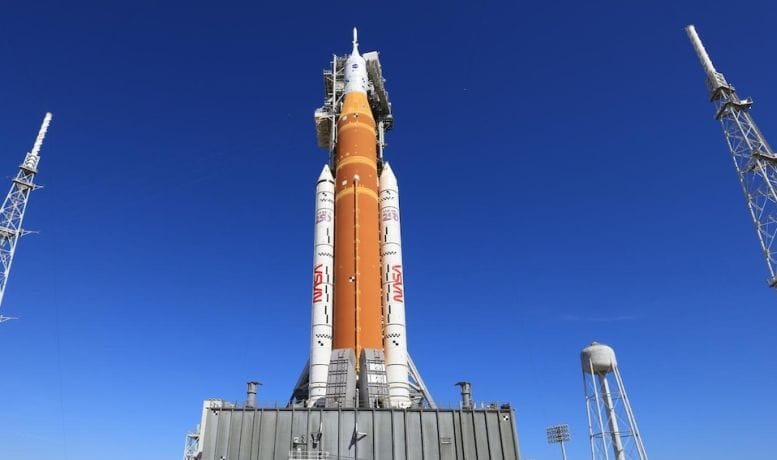
The NASA-led Artemis II mission is not merely a new chapter in “space exploration.” It represents a new phase in the expansion of imperialism beyond Earth.
The Artemis program and its various missions are presented as necessary steps toward establishing a human presence on the Moon and, ultimately, reaching Mars.
But just as “exploration” by the imperialist powers in the past served to divide up the planet among themselves, it now serves to conquer space and the Moon.
The imperialist powers’ operations in space, particularly on the Moon, are not motivated by curiosity or the collective progress of humanity, but by the desire to control resources, open new markets, and ensure strategic dominance.
The New “Race to the Moon”
This new “race to the Moon” is not limited to the United States and its allies. China has developed its own lunar program, with similar ambitions. What is emerging is not a unified human endeavour, but competing blocs, each building its own infrastructure, alliances, and economic spheres of influence.
Recent diplomatic initiatives illustrate this dynamic. French President Emmanuel Macron has just signed a new contract with Astroscale, a Japanese company specializing in satellite services and space debris which underscores how space is increasingly integrated into global strategies combining economic expansion, technological competition, and military planning.
A smokescreen of identity
The mainstream media and political elites are promoting a very different narrative surrounding the Artemis program. The so-called “new space race” is presented as a shared human achievement, a triumph of science and international cooperation. This rhetoric masks the material interests at stake.
Nationalist and identity-based pride is used to legitimize the project. The presence of a Canadian military officer alongside a crew of US military personnel — including, for the first time, a Black astronaut — is celebrated as progress. But these formal representations do not change the underlying logic: inclusion at the top does not transform a system founded on domination and militarism.
The purpose of the Artemis program is not new. It is a continuation of the Apollo program, from which it takes its name, in Greek mythology Artemis was Apollo’s twin sister. The Apollo program unfolded against the backdrop of the Cold War as a geopolitical competition between the United States and the Soviet Union. Going to the Moon has never been merely a scientific objective: it was a battleground for power.
Following in the footsteps of past programs
When the Apollo program was abandoned in the 1970s, it was not because its objectives had been achieved. Rather, it was due to a shift in the political and economic priorities of the American capitalists, who were buckling under pressure from the anti-Vietnam War movement and other domestic social crises.
Since then, successive U.S. attempts to return to the Moon — from the Space Exploration Initiative under George H.W. Bush to the Constellation project under George W. Bush — have reflected the state of the class struggle. The political elites have changed their strategies, but without ever breaking with their fundamental imperialist logic.
In 2017, Donald Trump’s first administration signed Space Policy Directive-1, which directs NASA to return Americans to the Moon and establish a long-term presence there to support future missions to Mars.
Three years later, the Trump administration established the Artemis Accords. Signed by 61 US allies, these accords aim for a “secure, peaceful, and prosperous” future. Contrary to the rhetoric, the Accords are intended to regulate the exploitation of lunar resources, the establishment of activity zones, and data sharing.
These agreements constitute a legal framework dominated by US decisions. Canada, through the Canadian Space Agency, plays an indispensable — albeit subordinate — role in this framework, thanks to the Canadarm 3 robotic system.
The Central Role of the Private Sector
Compared to the Apollo era, the Artemis program presents a crucial difference regarding the central role played by private capital. Since Trump’s return to the White House in 2025, the privatization of NASA’s space policies has forced Canada to adopt American technological and commercial choices.
During the Apollo years, NASA designed and controlled the program, relying on contractors to execute its plans. Today, it increasingly acts as a client, purchasing services from private companies.
Companies like Elon Musk’s SpaceX and Jeff Bezos’s Blue Origin are not merely subcontractors for the next lunar lander. They are key players shaping the direction of space exploration.
By redirecting public funds to private companies, NASA allows them to retain ownership of the technologies and the profits they generate. Thus, the government is sacrificing public control to generate wealth for billionaires.
The fundamental issue is that space is being militarized and privatized for profit. The technologies developed for these missions — propulsion, robotics, communications, surveillance — are inherently dual-use. They serve both civilian and military objectives, reinforcing the power of dominant states.
In the long term, the goal is clear: to exploit lunar resources such as rare earth minerals and water ice, and to establish control over new extraterrestrial territories. This is not exploration — it is the appropriation of what could be worth trillions of dollars.
Cutting Public Services to Fund the Space Giants
All of this is taking place against the backdrop of an economic crisis, in which governments claim there is no money for public services, housing, or public transportation. Yet tens of billions are currently being invested in space programs and funneled to private corporations.
Against the backdrop of a severe global economic downturn, the short-term goal of space programs is to prop up a new military-space economy that is not in the interests of the international working class.
Since capitalist policies are rife with contradictions, even more immediate military objectives may interfere with these programs. Trump has just announced a 23 percent cut to NASA’s budget to redirect funds toward his war in Iran.
As a result, the Artemis program is being unilaterally redefined by the United States. Canada risks suffering project cancellations and job losses as a result.
No to Space Militarism
Space programs are not neutral. They are extensions of militarism, nationalism, and capitalist expansion beyond Earth.
Socialists’ criticism is not directed at the technologies themselves, but at the capitalist context in which they are deployed. Science, technology, and transportation should be used to improve the lives of working people, not to line the pockets of multi-billionaires and fuel rivalry between superpowers.
Space programs, in their current form, should be defunded. For them to truly serve humanity, their resources should be reinvested in healthcare, education, public transportation, and public housing.