The outcome of the NDP leadership race may determine whether the party remains relevant in federal politics. In the 2025 election the NDP only won 7 seats, the worst in its history. Since the federal NDP won 103 seats in the 2011 election, aided by a collapse in both Liberal and Bloc Québécois votes, it has gone downhill. Clearly the program and approach of the leadership in the last decade is a failure.
The NDP, both federally and in the provinces, has put forward moderate policies, with a few mild reforms such as making unionizing easier in BC and pushing the federal Liberals to pass a limited dental program. Yet, its moderation meant that when it became the government in BC it was unwilling to reverse the tax cuts to big business and the rich so it could provide only modest improvements to education, health and housing, and now has a significant budget deficit.
Its pact with the Trudeau government left it blamed for the Liberals’ failings and seen as too closely tied to then in election. In the rush to stop Poilievre, after Trump’s attacks on Canada, the NDP was largely seen as irrelevant.
The party is controlled by a small group controlled from the centre with many local riding (electoral district) associations largely inactive. Rarely does the NDP campaign face to face with the public on the street. The main connection for most members is being asked for money. Former Hamilton MP Matthew Green, defeated by the Liberals in 2025, makes a telling critique of the NDP in an interview with The Breach.
The candidates for leader
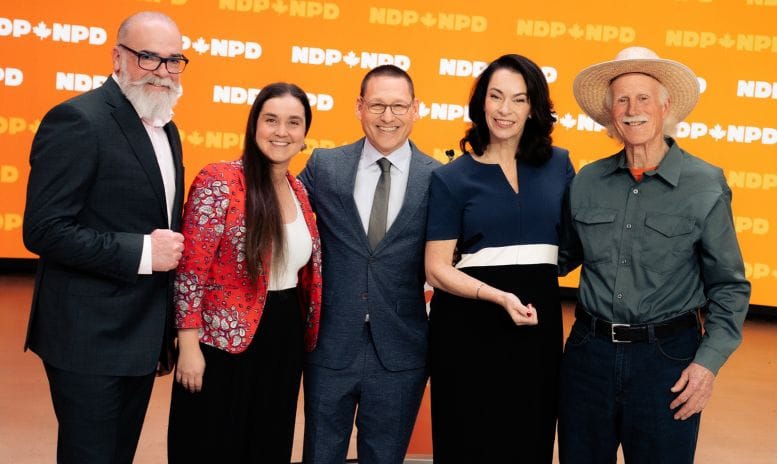
After a three-person panel barred Yves Engler from running, there are five candidates left. Barring Engler was not a surprise but shows the current NDP’s lack of democracy and transparency. The members should decide the leader not three people. Engler had the most radical program, much of it focussed on foreign policy, including demands that Canada withdraw from NATO and stop the export of all weapons.
All the five remaining candidates are talking about the need for a change of direction, with more member involvement in policy making, and stronger riding associations to build the party’s base. They want to diversity the economy beyond resource extraction. Most are critical of Carney’s militarism and his support for the Israeli regime’s genocide.
Heather McPherson, MP for Edmonton Strathcona, is seen as the candidate of the party establishment, but so far is not running away with the election. As the NDP’s foreign affairs critic, she steered a motion in the House of Commons two years ago banning arms sales to Israel (though Global Affairs Canada has constantly wiggled out of this). She says Canadian nation-building projects should be a clean electricity grid, high-speed rail, investment in transit and retrofitting homes.
Rob Ashton, President of the Longshore union (ILWU), talks a lot about the working class and is the only candidate who is explicit about defending and expanding union rights and ending the Temporary Foreign Workers Program. Yet, he does not rule out building a bitumen pipeline to the BC coast because “we’re in a trade war with the US, and we’ve got to look at every option available to protect Canadian jobs and Canadian workers.”
Avi Lewis, filmmaker and journalist, has the most far-reaching platform of the five approved candidates. Along with fully funding healthcare, eldercare, and education with a wealth tax, he wants affordable, public options for groceries, telecom, postal banking and pharmaceuticals. Lewis also wants a Green New Deal for Canada featuring a million green jobs, with no more oil and gas infrastructure and a just transition for oil and gas workers. He argues that the NDP should work more closely with unions and communities in struggle.
Both Tanille Johnston, of the We Wai Kai First Nation, and a City Councillor in Campbell River, BC, and Tony McQuail, an Ontario farmer, are seen as less likely to win. They are open to strategic alliances with the Greens and the Bloc. Johnston’s platform includes free post-secondary education, rural-urban rail, and increased Indigenous participation in government decision making. McQuail focuses on protecting and regenerating nature, taxing the rich and proportional representation.
Four of the five candidates (all except Rob Ashton) participated in a debate on Palestine: all of them clearly supporting the right to self-determination for Palestinian people and opposing Canada’s complicity in exporting weapons to Israel. To that end, they expressed strong support for Jenny Kwan’s private members’ bill (to be voted upon in February) on closing the loopholes that allow weapons and components to end up in the hands of governments accused of war crimes and human rights abuse. The current loopholes allow weapons and components to be exported to the US, where they have been used in conflicts in Gaza and Yemen.
While there is much agreement among all the candidates on many issues, there appear to be some differences in how they view change happening. For example, McPherson has focused more on the role of MPs in making change happen, while Lewis has argued that it is social movements who push parties into action.
NDP must change
Whoever is elected as the new leader, they face an uphill struggle to rebuild the party to become more relevant to workers and young people. Unless the NDP can recover, voters face a grim choice. On the one hand there is Carney’s shift of the Liberals into a conservative party of cutting public services, handouts to big business and massive military spending. The other choice would be Poilievre who continues his Trumpish faux anger, with very few clear policies.
For the NDP to offer a real alternative it must discard the failed approach of recent years. The NDP needs to take a different path from the past, with an active campaigning membership, which has real control over the party’s policies and actions. No more domination of the party by a small clique.
To attract new members the NDP must be bold and inspiring, with unique and sharply different policies than the Liberals and Conservatives.
The party we need
Socialist Alternative Canada believes that the party that is needed — a workers’ party — would have bold campaigns, mobilizing young and working people, for affordable housing, free public transit, quality health care, climate action, and public ownership of key sectors of the economy.
These campaigns would be ongoing, not just in election years, meeting people on the streets, in their neighbourhoods. A new NDP would encourage, empower and help union and community activists in their struggles. It should be normal for the NDP to be on picket lines. Class struggle exists, but today it is the bosses and their politicians who are doing most of the fighting and most of the winning; while working and oppressed people lose that fight most days. Yet, with a party that fights to win, workers and the oppressed can get more than a kinder, gentler capitalism — they can build a better society and system.
Rather than doubling down on resource extraction and exporting raw materials, with very little processing or value added, while ignoring Indigenous concerns and damning the environment (as Carney is doing), the NDP should champion an economy built for both people’s needs and to protect nature.
One clear “nation-building” action is to take the railways into public ownership and then invest in a significant upgrade to re-lay the railway bed, double the track wherever possible and electrify most of the lines. This would allow faster freight and the extensive establishment of passenger travel. Other nation-building projects would include a universal publicly owned telecommunication network, rebuilding rather than destroying Canada Post, a massive home building program concentrating on publicly owned rentals, and a rapid transition to clean energy. All of these would provide millions of good union jobs using tariffed steel, wood and aluminum.
A vital part of a real program for workers is to end the workplace dictatorship of the bosses. Instead, publicly owned sectors would benefit from workers’ democracy in the running of the workplace and management of public housing.
Socialist Alternative’s view
Socialist Alternative Canada’s National Committee agreed that “Avi Lewis has the best program among the official candidates” and “we would welcome a Lewis victory.” His platform most fully speaks to the needs of the working class.
If Lewis is elected leader and seeks to campaign on his platform, he will face fierce resistance from the NDP establishment and many of the elected representatives in the provinces. This will open a sharp struggle for the soul of the NDP. The experience of Corbyn as leader of the British Labour party provides a stark lesson. Corbyn was twice elected by a clear majority of the membership, but a section of MPs and the bureaucracy did everything they could to sabotage his leadership, including helping to lose the 2017 election to the Tories.
Lewis will need to be clear sighted about the resistance he will face. The BC NDP barred Anjali Appadurai from running for leader in 2022 on spurious grounds as they feared she would win with her radical campaign approach. Lewis will have to mobilize his supporters to resist the inevitable sabotage.
Lewis’s platform is a sharp break with present and past (failed) policies both federally and provincially. More than any other candidate, if Lewis wins, we believe that the clash of his policies and his supporters against the NDP machine will “most likely to open a debate both inside and outside the NDP about what sort of party the working class needs.” This is a debate long overdue. Socialist Alternative has stated for years that the current NDP is not the sort of party the working class needs. It cannot win federal elections and does not even fight alongside the working class.
Transform the NDP or …
The best way to challenge the Liberals and Conservatives is to adopt a bold socialist platform and build a mass movement.
Either the NDP is transformed into a different party, or the working class will face the need to build a new party. This is happening in Britain with Your Party after the Labour Party bureaucracy defeated Corbyn and has become an openly racist party reluctant to challenge Trump. If Lewis is elected leader and either fails to overcome the NDP machine or is defeated, he and his supporters should seriously consider the path of Corbyn and Sultana.
While a break with the NDP can seem daunting, there is powerful evidence that bold socialist policies can be much more successful than the NDP has been in recent years. Zohran Mamdani won convincingly in New York, Sean Orr topped the polls in Vancouver.
Whatever it’s called or wherever it comes from, Socialist Alternative will help to build a mass party that is democratic, and consistently campaigns and fights for socialism. Join Socialist Alternative in the fight for socialism!