With a stroke of the pen, Carney illuminated his party’s position on the growing climate disaster. His signature on the MOU erased any illusions (not that Socialist Alternative had any) that the Liberal Party is serious about reducing emissions and averting climate catastrophe. It made clear where its allegiances lie: with big business and big oil.
The Memorandum of Understanding (MOU) that Carney and Alberta premier Danielle Smith signed on November 27 was a sharp break from the Trudeau-era policies, which while inadequate, aimed at slowly reducing the carbon dioxide released in the production (but not the burning) of oil, and gas and methane emissions. Steven Guilbealt, Environment and Climate Change Minister in Trudeau’s government, resigned from his current cabinet position (but not from the government) over his “profound disagreement” with the new direction of the MOU, which declared a new bitumen pipeline to the Pacific coast to be a “Project of National Interest” under the Building Canada Act, thus allowing it to be exempt from environmental laws. In addition, the MOU exempted Alberta from The Clean Electricity Regulation and agreed to a 15-year delay in achieving net-zero emissions from the electricity sector.
In 2016, the Indigenous and environmental movements in Canada won a significant victory when they forced then-Prime Minister Justin Trudeau to officially give up on the proposed Northern Gateway oil pipeline.
In effect, the MOU all but ends the decade-long fiction of the Liberal Party being either pro-environment or “anti-oil,” and could inspire a new generation of resistance to the fossil fuel industry’s assault on the environment. That resistance will need to learn from the past.
Understanding the memorandum
The centrepiece of the agreement is federal government support for “one or more private sector constructed and financed [oil] pipelines, with Indigenous Peoples co-ownership and economic benefits,” to transport one million barrels per day (BPD) across more than a thousand kilometres from the oil sands in northern Alberta to a new export terminal at a yet-to-be-determined location on BC’s coast. This could necessitate an alteration or repeal of the 2019 Oil Tanker Moratorium Act, which bans tankers carrying more than 12,500 metric tonnes of oil from docking, loading or unloading in Hecate Strait, Queen Charlotte Sound or Dixon Entrance —waters stretching from the Alaskan border in the north to top of Vancouver Island in the south. The moratorium excludes Kitimat, which had been slated to be the endpoint of Northern Gateway, from being the terminus of a new pipeline.
Another major part of the deal, likely to be accomplished with far more expediency and less pushback, is a plan to increase the carrying capacity of the federally owned Trans Mountain pipeline, running from Edmonton to Burnaby, by over 40 percent from 890,000 to 1.25 million BPD. This is to be accomplished mostly through construction of additional pumping stations along the existing route and introduction of drag-reducing agents to the pipeline flow, at a total estimated cost of between $4 and $5 billion.
The agreement’s exemption of Alberta from the federal government’s Clean Electricity Regulations (CER) mandate is a giant gift to the natural gas companies that supply three-quarters of Alberta’s electricity. The Alberta Electric System Operator estimated in a previous study that repeal of CER would result in up to $30 billion in extra investments in natural gas infrastructure by 2049. This comes in addition to Smith’s moves in 2024 to massively restrict construction of new wind turbines and solar farms, and in January of this year to reopen the Rocky Mountains to coal mining, even though Alberta’s electricity grid has almost phased out coal use over the past ten years.
Currently only 6 percent of Alberta electricity is for residential use. That number could soon get even smaller, as another insidious and major component of the MOU is a new push for gigantic and massively power-consuming AI data centres in Alberta, to the tune of “thousands of megawatts of AI computing power.” Alberta’s technology minister wants $100 billion in overall AI infrastructure in the province in just the next five years. Tech speculators are flooding Smith’s government with proposals. At least 37 large AI projects are currently being examined, with a total energy use of 200 percent of the province’s current electricity generation. Although only a handful of these would end up being built, even approval of one of the largest proposed data centres would be the equivalent of adding the energy needs of another Calgary or Edmonton onto the grid.
The only environmental fig leaves are a commitment to raise the current industrial carbon price to a maximum of $130 per tonne (carbon taxes being an extremely inefficient means of addressing carbon pollution), and support for the Pathways Project, an industrial endeavour hatched by the big oil companies for “carbon capture, utilization, and storage” (CCUS). This in reality is another concession to Alberta as prior to the MOU, the industrial carbon price, currently at $95/tonne, was to rise $15/tonne/year until it reaches $170/tonne in 2030. The industrial carbon pricing commitment has already been undermined by Smith’s own party and government, with a vote by her United Conservative Party convention condemning that provision of the MOU just two days after it was signed. Seven days after the MOU was signed, Alberta introduced regulatory changes that will flood the province’s industrial carbon pricing market with credits and weaken the system for charging emitters. These changes will make it much harder to reach the $130/tonne that was agreed to in the MOU and raises concerns that Alberta is not negotiating in good faith.
The support for Pathways would put $16.5 billion toward facilities to capture, and pipelines to move, carbon emitted by oil sands facilities and to bury it underground. CCUS technologies so far do not work. They may deserve study and investment, but only alongside sharp reductions in the production and burning of fossil fuels — as wherever they are burned they add to the climate disasters. The fossil fuel companies, however, see CCUS as an alternative to reducing production. It is utterly insufficient to address the massive greenhouse gas emissions from oil and gas, and the transport and storage includes risks such as groundwater contamination.
There are other elements to the MOU including huge new transmission lines through BC and Saskatchewan to help power expanded oil sands development, as well as to “LNG, critical minerals, agricultural, data centres and CCUS industries.” The federal government will “utilize Canada Indigenous Loan Guarantee Corporation to help backstop Indigenous co-ownership of the bitumen pipeline project and, if appropriate, Pathways” — a first indication of direct financial backing, which will likely expand. Alberta will develop a plan “to build and operate competitive nuclear power generation,” while clean renewables are left completely out of the document. Both levels of government are to “streamline” environmental impact assessments.
Smith has an ambition of doubling Alberta’s oil production in the next ten years, even from its projected record-high average of 3.5 million BPD in 2025. Many analysts suggest a goal of 5 million BPD is more realistic. Both numbers are far too high for environmental sanity, but that metric does not enter into Smith’s and Carney’s calculations.
“The answer is no” say First Nations to changes to the Oil Tanker Moratorium Act
The commitment made to modify, if necessary, the Oil Tanker Moratorium Act has aroused great ire among coastal First Nations. Grand Chief Stewart Phillip, president of the Union of BC Indian Chiefs (UBCIC), described the MOU as “nothing less than a high risk and deeply irresponsible agreement that sacrifices Indigenous peoples, coastal communities, and the environment for political convenience.” He said the UBCIC will not stand by while Carney and the Alberta government “attempt to bulldoze our rights … The answer is still no and always will be. We will not stand idly by.” A moratorium on oil tankers in BC’s northern waters was first imposed in 1972 but not legislated as the Oil Tanker Moratorium Act until 2019.
While several Alberta chiefs were present at the MOU signing, Treaty 8 chiefs demanded a pause to the agreement on December 11, threatening court action over lack of consultation. Neither coastal First Nations nor the government of BC, were consulted in advance of the signing of the MOU although Haisla Nation and the District of Kitimat met with the Alberta premier on November 25. Following the meeting, they issued a joint statement saying “Over a decade ago the community of Kitimat voted to oppose the Northern Gateway project. The Haisla Nation, who were firmly against that proposal at that time, still maintain that same position today regarding an oil pipeline and export facility in their territory. This position was articulated clearly to Premier Smith during the meeting.”
Chief Marilyn Slett, Coastal First Nations Great Bear Initiative, said that a tanker ban on the north coast “is not up for negotiation,” and the First Nations “will never tolerate any exemptions or carveouts, period.” She also says the nations have “zero interest” in co-owning or benefiting from a project she says has the potential to destroy their way of life, citing the risk of a catastrophic oil spill.
On December 2, the national Assembly of First Nations voted unanimously to press the federal government to uphold the tanker ban and withdraw the agreement with Alberta for a new oil pipeline to the BC coast.
Why this, why now?
While several commentators have called the signing of the MOU “political theatre,” others have observed that there is no private sector proponent for another pipeline to BC’s coast, a requirement for a pipeline to proceed. As the agreement is “non-binding,” it’s also been described as a kind of fiction or fantasy. Greenpeace Canada’s senior energy strategist Keith Stewart claims that the oil industry doesn’t really want another pipeline but are using the demand for one to eliminate federal climate policies. He says that it “looks like they’re getting what they wished for.”
Trudeau’s predecessor Stephen Harper approved Northern Gateway in 2014, to be built through northern Alberta and British Columbia by Calgary-based pipeline and energy company Enbridge. However, the combined efforts of dozens of First Nations communities and large and sustained environmental protests in bigger cities convinced Trudeau to make a retreat two years later and instead focus on the expansion (and eventual state purchase) of the Trans Mountain pipeline, which was completed last year.
The federal and provincial governments have devised what they hope is a way to overcome Indigenous resistance to the destruction of the land and waters. Today, they are eager to paint major industrial projects as “economic reconciliation,” offering a belated and conditional dealing-in to Canadian capitalism to a limited strata of Indigenous peoples.
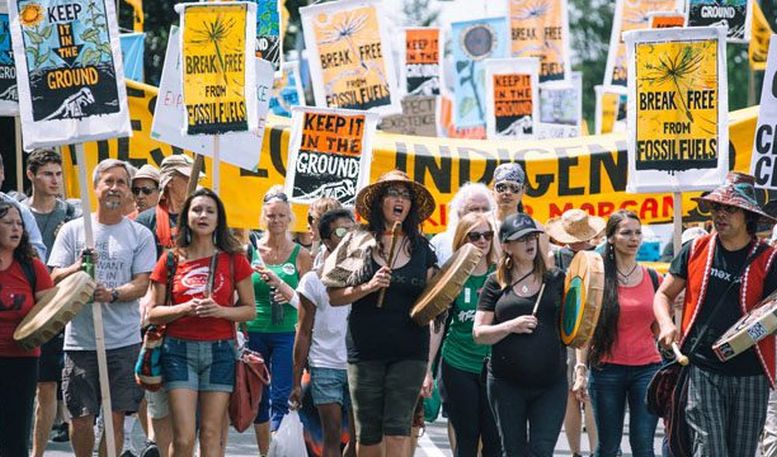
The environmental movement in Canada has been in an almost unprecedented low ebb of more than a half-decade. Such a decline was nearly unthinkable on September 20, 2019, the day of the largest environmental protests in Canadian and world history. Around a million people in Canada marched that day, as part of six or seven million worldwide, disproportionately teenagers both frightened by the increasing damage to the natural world they were growing up in, and energetic to force a change in course.
But the movement’s size was supplemented by political diffuseness and illusions in reformism, exemplified by the fact that the pipeline-purchasing Trudeau was permitted to march at the head of the rally in Montreal, in spite of the loud opposition of a minority of the attendees. That day would prove to be the high point of environmental activism for a long time, though there were also the February 2020 rail blockades in solidarity with the Wet’suwet’en First Nation’s resistance to a natural gas pipeline through their territory. COVID dealt a staggering blow to the movement, but more significant now to its continued doldrums are the West’s burgeoning rivalry with China, continued economic precarity associated with the Trump tariffs, and the rightward shift in politics that accompanies both of these.
How can Carney and Smith be beaten?
It is clearer than ever what a Liberal Party unhindered by significant resistance — and one attuned to the new era of aggression and war — really wants. They want what’s best for big business, not for workers, not for the environment, not for First Nations. With military alliances to strengthen and a working class to discipline, they neither need nor want the sanctimonious greenwashing of the Trudeau era. Carney may soon demonstrate that he is willing and capable of imposing his policies in support of the fossil fuel industry through state coercion.
The leadership of the New Democrats have shown where their interests lie. The NDP — whether federally, in government in BC, or in opposition in Alberta — will not provide a strong alternative to Carney and Smith. Rachel Notley, as Alberta’s NDP premier from 2015 to 2019, was a bellicose supporter of the oil industry and even clashed with John Horgan, BC’s NDP premier from 2017 to 2022, on the Trans Mountain expansion. She needn’t have fought so hard, however, as the BC NDP’s opposition to that project was never deeper than the level of court challenges, to be abandoned at a judge’s say-so. The BC NDP has fully embraced LNG, including with massive subsidies. David Eby bent just three days after the MOU was announced, saying that he could accept a brand-new pipeline just so long as the tanker ban remained in effect, suggesting that another terminal on the south coast could be the route the project takes. The current Alberta NDP leader Naheed Nenshi, who also did plenty of hobnobbing with oil executives in his prior job as mayor of Calgary, has only chastised Smith for allegedly allowing her uncouthness to lessen the pipeline’s chances.
The current contestants for the leadership of the federal party have varying views. Yves Engler’s stance, before he was barred from running by the party bureaucracy, was to “halt new tar sands projects and rapidly wind down existing projects.” Avi Lewis has said, “no more approvals for new pipelines, LNG terminals, offshore oil.” However, Lewis, will need to explain how he would implement such a policy against much of the NDP’s bureaucracy and elected representatives. Both Union leader Rob Ashton and Edmonton MP (and establishment pick) Heather McPherson have stated that it cannot be built without the consent of the Indigenous peoples on the coast.
What to do?
If a pipeline proposal is brought forward, opposition cannot rest on Indigenous people alone. Legal battles will only take things so far, and can be a hindrance to struggle if too much faith is placed in them. Neither the courts nor Indigenous opposition stopped the Trans Mountain pipeline. A fight of this magnitude, against a ruling capitalist class that is largely united in its extractive aims, will not be won in that ruling class’s courts.
Socialist Alternative has long argued that it is mass movements, rather than the courts, that makes real change. To build such a movement needs a program of quality green union jobs, cheaper energy costs, environmental clean-up, and strengthening of not only Indigenous rights, but tangible improvements to Indigenous peoples’ lives. Given the real danger a new pipeline would pose to jobs and livelihoods, the environment and Indigenous rights on the BC coast, it may be necessary to take industrial action to stop it.
It will take a serious coalition of union members, Indigenous peoples, environmental groups, and left-wing political parties to defeat this destructive plan and struggle against elimination of the limited policy tools that exist to fight environmental destruction. The waters are literally and figuratively rising, and for the time being the mainstream political current is unfriendly to socialists. However, there is growing tide of young people who know this system sucks and are looking for a socialist alternative. We’ll have to prove to be strong and adept swimmers, but others will join in time. We must ensure that it’s this MOU that hits the rocks, or else something much nastier will.
Socialist Alternative is committed to the struggle for good jobs and a healthy environment. Join us!