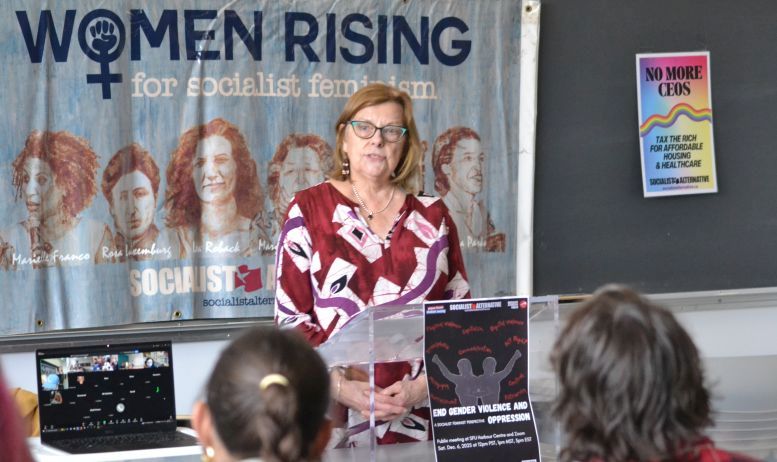
Gender-based violence continues to be a scourge in Canada. On the 36th anniversary of the Montreal massacre, Socialist Alternative Canada’s Socialist Feminist Working Group organized a powerful meeting against gender violence and oppression. About thirty people participated in the meeting, both in-person and connecting through Zoom from cities across Canada, including watch parties in Vancouver, Victoria, and Montréal.
Leslie Kemp, Socialist Alternative Canada Executive member and convener of the Socialist Feminist Working Group, chaired and opened the meeting with introductory remarks. She started by underlining the shock and horror felt by so many people across Canada on December 6, 1989, when a gunman killed 14 students and injured 13 more, specifically targeting feminists.
The oppression of women is the oldest form of oppression, dating back 10,000 years or more to the beginnings of class society, as Friedrich Engels first explained in 1884 in The Origin of the Family, Private Property and the State. As human society has evolved, so has the oppression of women, and it has been perpetuated in various ways to serve the interest of the ruling classes.
With the industrial revolution and the dawn of capitalism, things began to get worse for women. Child labour was common, and women earned far less than men. Women toiled long hours in factories. But women fought back with strikes and street protests. In fact, it was women textile workers who flooded into the streets of Petrograd in the spring of 1917 to begin the process that led to the Russian Revolution later that year. For a period of time after the Second World War, strong movements of the working class demanded expanded legal rights, economic benefits and liberation for women and other oppressed people. The economic boom in the rich capitalist countries meant that the ruling class had the economic capacity to provide these expanded rights and benefits, which it did in the face of mass pressure, in order to prevent further social unrest.
The era of globalization, which claimed that the state would disappear, is over. In the new era of world history inter-imperialist rivalries and conflict between nation states is back. This has boosted the rise of the right and increasing numbers of authoritarian regimes. In this historical context, and reflecting the interests of the imperialist ruling classes, we are also seeing the resurgence of reactionary ideas around gender roles, the family, and the nation.
But the economic benefits of the post-war boom in the capitalist world were not evenly distributed, even within the rich capitalist countries. While women’s movements could win equality before the law, material equality in the workplace was much more difficult to secure. Rosalie Bélanger-Rioux, member of Alternative Socialiste in Québec, spoke of “reproductive labour,” the unpaid care work that women continued to be expected to perform in the home. The capitalist class benefits from not having to pay for this work in producing and training the next generation of workers.
In times of economic downturn when jobs are tight, the struggle of women for liberation and equality was framed by the right wing as a threat to male workers. This was exemplified in the horrific Montreal massacre of 1989. In the context of the ebb of second-wave feminism, there was a recession and oil price collapse leading to a rise in unemployment. The shooter killed 14 women, who were engineering students at L’École Polytechnique, claiming that they were stealing men’s jobs. But it was not women engineering students who were cutting jobs, it was the bosses. This is why socialist feminists argue for the struggle against the oppression of women to be a working-class struggle incorporating economic and material demands, including for jobs, secure public housing, parental leave, reproductive rights, paid parental leave, and free transit. In contrast, a liberal feminist approach focuses on political and legal reforms and on promoting individual women to positions of power and influence. But without a materialist analysis, this means that the feminists are fighting for privileges for a few that capitalists are willing to concede, rather than against the system that creates their oppression. Socialist feminists wage the struggle against gender oppression as a class struggle, which has the potential to unite working-class people of all genders to fight the system that creates the obscene wealth and privilege hoarded by the capitalist class.
Sara Domok from Winnipeg spoke on violence against Indigenous women, who face multiple oppressions, including gender oppression and colonialism. She spoke of the violence of colonialism and capitalism. Indigenous women worldwide face higher levels of sexual violence, domestic violence, trafficking, and murder than women as a whole. In Canada, the homicide rate for Indigenous women is six times higher than that of all women. The 2019 Report of the National Inquiry into Missing and Murdered Women and Girls documented 1,181 missing or murdered Indigenous women and girls in official police databases for the period 1980–2012, and there are likely more unreported cases. The Highway of Tears, in northern BC, is well known as a road corridor in which Indigenous women have been murdered or have gone missing.
Indigenous women are at even higher risk if they live near resource extraction zones, where colonial capitalism sees Indigenous people as a barrier to further exploitation of the land for profit. Companies extract minerals, oil, timber, and water from Indigenous territories, often without consent. This leads to community displacement, poverty, and exposure to dangerous work camps or military forces. Environmental degradation harms women first — through loss of food sources, water contamination, and cultural destruction. Governments fail to investigate or prosecute violence against Indigenous women, as such violence is consciously or otherwise accepted as part of the “normal” operation of colonial capitalism.
The struggle for liberation of Indigenous women is thus clearly tied up in the struggle against capitalism and the struggle for climate action. Indigenous women have been at the forefront of movements against violence and climate justice. Co-existence with capitalism is impossible for Indigenous communities without subjugation and assimilation. A united class struggle against capitalism is needed to secure the liberation and rights of self-determination for Indigenous people.
Ross Kelly of Socialist Alternative Vancouver spoke about how the ruling class is built on the control of working people’s bodies. Being conscripted to fight in imperialist wars is the ultimate violation of bodily autonomy for working-class people. Women have often been expected to contribute in silence and work in factories, while men go to war. The death and destruction of war do not stop at the front lines. Sexual assault and rape are commonly used as a weapon of war. In the conflicts and genocides in Sudan, Palestine, and Ukraine, domestic violence and rape, primarily affecting women, have risen sharply.
Today global capitalism is in crisis, and the only way that imperialist powers can stabilize their economies and societies is through conflict, and ultimately war, with rival imperialist powers. The ruling class is therefore finding it increasingly necessary to suppress dissent and to rekindle nationalism to build political support for the wars that they see coming.
Hannah Fitzgerald, a member of Socialist Alternative in Pittsburgh and member of Laborers’ International Union of North America local 1058, spoke about the killing of Amber Czech, a welder in Minnesota, by a co-worker who said he “didn’t like her.” The trades continue to be workplaces where women workers are not treated as equals and where sexual harassment is unfortunately common.
Hannah experienced harassment at her own workplace and was frustrated to find that her union leadership would not take action, instead directing her to Human Resources. But HR departments do not exist to protect workers, they exist to protect the employer from liability. Sexual harassment trainings sponsored by the employer are largely ineffective, but they do allow the bosses to pretend that they are doing something to address the problem. The root of the problem is not a lack of understanding of what constitutes harassment by reactionary men, but rather a sick system that elevates a wealthy minority, mostly men, into positions of power that perpetuate horrific behaviour with impunity. Solutions to this problem cannot be found within capitalism.
Political polarization is increasing, especially among young people. There is a profound misogyny in the US right now with the rise of Trump, toxic masculinity and the manosphere. Trump is personally implicated in sexual abuse. This polarization has a gendered character, with more men moving to the far right and more women moving to the far left. Socialist feminists recognize that this polarization of young working-class men to the right is neither universal nor permanent. A key part of the role of all socialists is to fight against the divisions within the working class and its movements. A bold socialist program can cut across young men moving to the right – Mamdani recently won the votes of 62 percent to young men in New York City. Ultimately, gender oppression affects everyone negatively, including working-class men. Through collective struggle for a socialist feminist program, against the bosses and against all forms of oppression, workers of all genders can learn to recognize their common interests.
Digital violence is the theme of the 2025 UNITE to End Violence against Women Campaign. This topic was discussed by Natalie Lingren, a member of Socialist Alternative in Vancouver. The internet has opened up new avenues for violence and harassment. From cyberbullying and doxxing to grooming and revenge porn, these forms of violence don’t just happen online. They often lead to offline violence in real life, such as coercion, physical abuse, murder and femicide — killing of women and girls. The harm can be long-lasting and affect survivors over a prolonged period of time.
The ruling class has abandoned woke liberalism, which was mostly window dressing anyway. Now in this era of inter-imperialist conflict, they are dredging up reactionary ideas on race, gender, and nationalism with a particular push on gender and women’s work.
The internet is being used as a tool to spread reactionary misogynist ideas, collectively referred to as the “Manosphere.” Trans people today are particularly under attack. It is no accident that the right wing is targeting trans people: the existence of trans people threatens the ideology of the enforced binary of gender roles, which in turn is critical to justify the oppression of women.
In the face of political polarization, where it feels like the reactionary right is in the ascendancy, socialist feminists argue that what is needed is bold socialist ideas and collective struggle for liberation. There is a trend of liberals that believes that the best way to stop the rise of the right is to compromise and join forces with the centre. But all recent historical experience has proven this idea wrong. The status quo is untenable, and any organizations that defend establishment politics are completely discredited, driving more people into the arms of the right. On the other hand, bold left-wing programs act as a pole of attraction to bring together working-class people and socialist activists in numbers that have not been seen in generations. There are numerous examples of this, from Mamdani in New York City, to Die Linke in Germany, La France Insoumise in France, Your Party in Britain, and Sean Orr and COPE in Vancouver.
Following the panel speakers, there was a lively discussion among attendees with a dozen speakers making contributions. There was a finance appeal to help build the socialist feminist work of Socialist Alternative Canada that raised $203.
Socialist Alternative Canada is committed to the fight against gender-based oppression and to building the struggle for a socialist world. Join us!