
The next step – a workers’ struggle for real change
The parliamentary election in Hungary on April 12 turned into a stinging and historic defeat for the autocratic Prime Minister Viktor Orbán and his party, the ruling far-right Fidesz.
The election dealt a blow to all the world’s Trumpists and resulted in a defeat for both Washington and Moscow.
Although the election was primarily a vote of no confidence in Orbán’s 16-year rule, the outcome has given hope for change. This must now serve as a shot in the arm for the struggle.
In Budapest and other Hungarian cities, Orbán’s defeat was celebrated by jubilant crowds. The desire to oust Orbán was also evident in the record number of voters—turnout was the highest ever, nearing 80 percent.
Fidesz not only lost in the cities but also saw its support decline in rural areas, where the party had traditionally held strongholds.
After 16 years in power, Orbán and Fidesz lost power to the opposition party Tisza (Respect and Freedom), which won not only the election but also a supermajority—two-thirds of the seats in parliament.
Tisza received 53.56 percent of the vote and 138 of the 199 seats. This, in turn, opens the door to amending the constitution that Orbán rewrote to strengthen his authoritarian rule and prevent electoral losses. The election results are not only redrawing Hungary’s political map but are having repercussions far beyond the country’s borders.
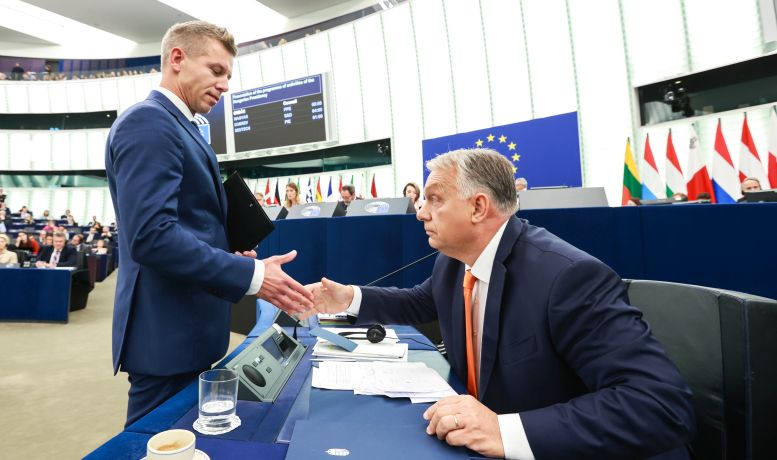
Tisza is a right-wing party, and its leader, Péter Magyar, was a member of Fidesz until 2024 and for many years belonged to the ruling clique around Orbán. It is the lack of a strong left-wing alternative and a strong labor movement that has enabled Tisza to capitalize on the growing discontent with Orbán’s corrupt rule and nepotism, as well as all the injustices and deteriorations that have followed in the wake of the government’s right-wing policies and the stagnant economy. For more than three years, the Hungarian economy has been stagnant, and since discontent exploded on a large scale at the end of 2022 — with teacher and student protests — there have been numerous mass mobilizations against the government.
In 2024, the struggle reached a new level after it was revealed that the president and the government had attempted to cover up abuses that occurred at a state-run children’s home and pardoned the director who had been convicted for protecting the perpetrators. This scandal and others like it fueled the anger against the government. This anger was not lessened by the fact that Orbán’s regime constantly tried to hide its politics of hate and anti-feminism behind phrases about “protecting Christian, Western morality” mixed with the constant lie that they were “protecting children’s interests.”
200,000 people marched in Budapest Pride last June, despite the government’s ban, surveillance cameras, and threats of fines. Magyar, however, did not join the Pride parade.
In this year’s election, Tisza stood as the only alternative to Fidesz and the far-right party Mi Hazánk (Our Homeland), which has roots in Jobbik’s neo-fascist wing. (Jobbik split in 2018). The so-called Socialist Party did not even field candidates but urged voters to support Tisza’s candidates.
It also appears that the majority of Tisza’s voters consider themselves to the left of Magyar.
“Magyar is a conservative, a former Fidesz insider who broke with Orbán in 2024. His party, Tisza, attracts a strikingly diverse voter base: 43 percent of his voters identify as liberals, 22 percent as left-wing supporters, 10 percent as Greens, and only 11 percent as right-wing conservatives. Holding that coalition together while implementing sweeping institutional reforms will be a balancing act in itself,” France24 wrote on April 13, concluding that: “When it comes to the rule of law, migration, and LGBTQ rights, the path forward is neither straight nor guaranteed.”
In the days leading up to the election, U.S. Vice President JD Vance was in Hungary to support Orbán, and six weeks earlier, Secretary of State Marco Rubio visited the country to celebrate the “golden era of cooperation between the U.S. and Hungary.” During his visit, Rubio told Orbán that “a victory for you is a victory for us.” “Your success is our success.” But instead, both ended up sharing in the defeat — Orbán’s election loss is a political defeat for both Trump 2.0 and all the far-right parties that were in Hungary to support Orbán during the campaign.
In March, the far-right international organization, the Conservative Political Action Conference (CPAC), held its annual conference in Budapest to support Orbán. Trump sent a video greeting to the conference, which featured Argentina’s President Javier Milei as “its star,” writes BalkanInsight in its report. When Milei concluded the conference, he said: “Viktor Orbán has become a beacon for all of us who refuse to accept that the West’s destiny is destined to be marked by managed decline” (BalkanInsight, 23 March).
In connection with this White Power conference, one of the European Parliament’s two far-right groups, Patriots for Europe, held its first-ever public rally. At that meeting, Marine Le Pen of the National Rally, Matteo Salvini of the Northern League, and Geert Wilders of the PVV, among others, gave their wholehearted support to Orbán, “who has made Hungary something extraordinary,” according to Wilders.
The Trump administration’s support, along with Orbán’s promise to buy more weapons and natural gas from the U.S., likely contributed to the election defeat. Instead of further strengthening Europe’s far right, Trump 2.0 has resulted in division, and an increasing number of far-right parties — particularly due to the war against Iran — have felt compelled to distance themselves from Washington.
In Brussels, the election has been hailed as a “victory for Europe.” European governments have been trying to outdo one another in praising Magyar and taking credit for Orbán’s crushing defeat. British Prime Minister Keir Starmer called the result “a historic moment, not just for Hungary, but for European democracy.” For Europe’s leaders, much is at stake in increasing and streamlining military and economic support for Ukraine — something Orbán has hindered. Within the EU, Orbán’s government has stood closest to both Moscow and Beijing, and has thus been seen as an obstacle to the expansion of EU imperialists and big business.
Swedish Prime Minister, Ulf Kristersson, for his part, called the election a “historic victory.” All of this is an attempt to hide the fact that the British, Swedish, and other governments have copied Orbán’s inhumane refugee policy and racist division.
“In Budapest, this week I met the country’s minister for the EU, János Bóka, who said Hungary’s approach has been vindicated by the restrictive measures now being put forward in the UK — where the government plans to make it harder for refugees to bring family members to the UK — as well as in countries like Ireland, Denmark, and Sweden (…) now we see most countries are doing what we have been doing for the past 10 years”, (BBC, 3 September 2025).
The election results pave the way for Hungary to begin receiving some of the loans and aid that the EU has frozen since 2022–23. Magyar has said that he “wants better relations with the EU,” and his government will likely be quickly rewarded with aid and loans from Brussels to alleviate the country’s economic crisis, and so that the new Hungarian government will approve new EU loans and weapons for Ukraine, which Orbán opposed.
But it was not the relationship with Brussels that proved decisive in the election, and even Magyar may turn against Brussels to try to deflect domestic discontent.
Rather, it was the perfect storm caused by a series of interacting factors and events: scandals, abuse of power, and corruption combined with constant cuts to welfare, high inflation (Hungary is the EU country where prices have risen the most overall since 2020, and the average annual wage in Hungary has plummeted to the third lowest in the EU), an economy in crisis, and a demographic crisis — the population has shrunk by 500,000 since 2011.
The election result was primarily a gauge of the extent of dissatisfaction rather than an expression of strong support for the right-wing opportunists Magyar and Tisza.
On several issues, the difference between Orbán and Tisza is small. In the European Parliament, Tisza and Fidesz have often shared the same views regarding Ukraine, agriculture, and migration.
Magyar’s election platform contains few concrete promises. He has, however, promised better pensions and tax cuts. “But his position on LGBTQ issues is vague, while his views on immigration are even stricter than Orbán’s, as he has said he would end the government’s guest worker program. He is generally distrustful of the media and often clashes with them. Overall, his promise to voters is: a functioning country with a Western identity and Christian-conservative politics, but without what he calls the corruption of Fidesz” (euronews, 11 April ).
Even if the new government receives EU support, new cuts loom.
“The winner of the Hungarian parliamentary election on April 12 will need to cut social spending to stabilize public finances, as the economic recovery faces strains due to the global energy price shock,” wrote the Reuters news agency on March 24, citing an analysis by S&P Global. “We expect that the incoming government after the 2026 election (regardless of its composition) will need to implement measures that reduce social spending.” Otherwise, Hungary’s credit rating will be downgraded, S&P Global warned.
The fact that Orbán, who was long seen as invincible, is now gone could give the struggle and the working class new confidence. Unless the struggle and the working class’s political self-organization take steps forward in the more favorable situation that has now arisen, there is a risk that the hopes that have been raised will turn into deep demoralization when Magyar’s government proves incapable of implementing lasting improvements.
It is not the interests of the working class that Magyar will serve, but those of capitalism and the elite of which he is a part.
In the struggle for real and lasting improvements, the working class can rely only on its own strength and solidarity. It is by building its own party—a socialist workers’ party—and fighting to abolish capitalism that the welcome end of Orbán’s rule can also be followed by jobs, welfare, and housing for all, as well as an end to oppression and discrimination.