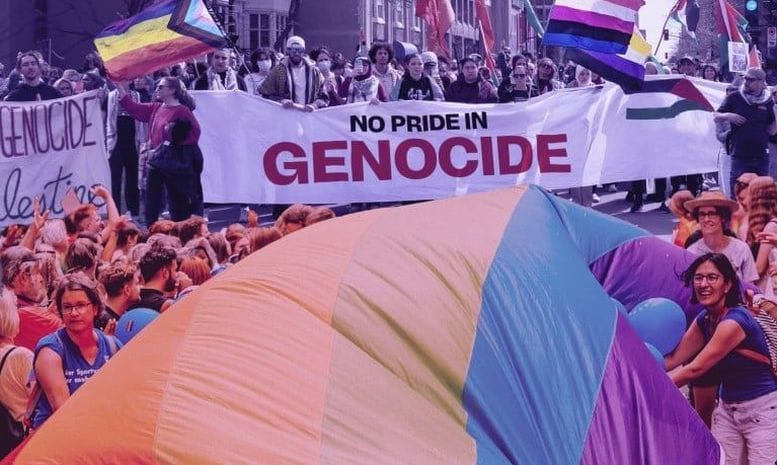
Pride’s rallying cry is struggling to be heard amid overlapping crises. Rising militarism, affordable housing shortages, and economic precarity dominate the attention of working-class queer people who are increasingly struggling to survive. Amid news of another bombardment, another pipeline, another data centre, corporations covertly cancel Pride initiatives and legislators quietly erode hard-won queer rights.
The past three years have seen a stark increase in criminalization of LGBTQ+ people worldwide. Uganda, Mali, Ghana and Burkina Faso have all implemented new laws with harsh punishments for same-sex sexual activity, as well as for the “promotion” of LGBTQ+ identities and practices. The UK Supreme Court defined women as based only on biological sex, excluding trans women from gender-based discrimination protections. In the US, the White House began circulating documents defining a terrorist as anyone with “extreme viewpoints on immigration, radical gender ideology, and anti-American sentiment.” Such language in a time of rising police violence has many LGBTQ+ Americans feeling scared.
Canada has not been immune to this growing trend of restrictive new laws. The past year has seen a flurry of bills seeking to punish, isolate and restrict LGBTQ+ people from living their lives. Alberta has banned gender-affirming care for trans youth, removed sex ed from school curriculums and banned some books from libraries. Québec now prohibits public workers from using inclusive they/them pronouns and has banned schools from building gender-neutral washrooms.
In BC, the far-right OneBC Party recently proposed several anti-trans bills, but they went nowhere. More worrying than OneBC, the BC Conservatives’ new leader, Kerry-Lynne Findlay, is opposed to sexual orientation and gender identity (SOGI) curriculum in schools and gender-affirming care, and has other reactionary views. Given the ruling NDP’s failures and unpopularity, the election of a Conservative government is highly possible, which would be devastating for schools, health care, the environment, and the lives of workers across the province.
This rising hostility from conservatives is an attempt to turn queer people into scapegoats for the crises of the failing capitalist system. The ruling class — the billionaires, corporations, and politicians — manufacture this divide-and-rule hatred, trying to weaken workers’ unity and to deflect blame away from themselves.
There is resistance
The right-wingers are not getting it all their own way. In Hungary, Orbán banned Pride in 2025, but the marches were huge. In 2026 Orbán was soundly defeated in the elections.
New Brunswick’s Conservatives attacked young people’s gender rights. The unpopularity of these policies contributed to their defeat in the 2024 election. The new Liberal government restored these rights.
In BC, attacks on Pride flags, university DEI programs, and anti-discrimination protections have largely failed to find any footing.
The colonial history of queer oppression
LGBTQ+ identities were not criminalized throughout much of recorded history. There are records of queer and gender-nonconforming people living peacefully on every continent. Oppressive anti-gay laws were enacted by a few rulers and monarchs, often using religion as an excuse, but they quickly spread with colonial expansion.
The Ottoman, British, Dutch, Spanish and Portuguese Empires spread discrimination around the globe. In seeking to uphold the tenuous social order that kept them in power, the ruling class was happy to crush the colourful identities of local populations.
Revolutionary periods have offered a reprieve from these oppressive laws. Homosexual activity was first decriminalized in France in 1791, during the revolution. After the workers’ revolution in Russia, gay sex was decriminalized and same sex marriage was recognized. As the Stalinist reaction overturned many of the democratic and social gains of the revolution, same-sex activities were again recriminalized.
Gains through struggle
Social movements like Pride have further power to drive social change. The Stonewall riots took place in 1969 after a violent police raid on the Stonewall Inn in New York City, setting in motion a more radical and organized gay rights movement. Communities in Canada carved out queer safe spaces, such as the well-known 519 in Toronto, or the Turret in Halifax. However, police raids were common until the early 2000s. Toronto’s AIDS Action Now (AAN) network organized a two-year protest movement to win access to life-saving medication. Vancouver’s Little Sister’s Book & Art Emporium fought a 15-year legal battle against the Canadian Border Security Agency that continually seized shipments they deemed “obscene.” The bookstore endured three bombings over the years, but with the support of the local queer community, emerged victorious over this censorship.
It is marches and protests that have changed public opinion and won victories to end the stigmatization of LGBTQ+ identities, and to promote equality under the law. Most politicians and corporations have, at best, followed behind.
Today, the rights of trans- and gender-nonconforming people are being attacked, same-sex attraction is still a crime in much of the world, self-expression is at risk of being suppressed, and the basic needs of the average Canadian worker are not being met. Queer people need relief from the same affordability crisis plaguing all working-class people in Canada. Under liberal capitalism, queer liberation has been reduced to debates over bathrooms and sports when it should mean improved access to social supports, expanded medical access, affordable groceries, and safer transit and housing — gains that will improve the lives of everyone. The Liberal government cannot be trusted to fight our battles, especially now that they have embraced pipelines, cuts to public services and a huge boost in military spending.
The radical roots of the Pride movement need to be restored. The power of the working class must be wielded to protect LGBTQ+ rights — whether that means working with teachers’ unions to shield trans students, or nurses’ unions to protect trans health care. The most powerful engines of queer people’s defence are already in the hands of the working class; they just need to be mobilized for such a purpose. As right-wing state violence threatens to push us all back into the closet, it is vital to remember who are LGBTQ+ people’s truest allies — not the corporation slapping its logo on a Pride parade, or the politician who shows up for a parade. Queer people’s allies share a common desire for mutual liberation, organize direct action in workplaces and unions, attend marches, rallies, and picket lines. That rainbow flag invites us all to join the fight against the system that wants to silence us.