Lessons for Fighting the Far Right Today
This July we commemorate the 90th anniversary of the revolutionary workers’ uprising in Spain against the fascist military coup of July 17, 1936, led by General Franco. This was one of the most powerful working-class movements in history, which, in just a few days, took control of Catalonia, Aragon, and other parts of the country. It was the culmination of a revolutionary process that had begun in 1931 and lasted until 1937.
According to Trotsky, who led the Russian Revolution in 1917 alongside Lenin, the Spanish workers were the most powerful revolutionary force during the 1930s. They could only be defeated by a brutal civil war in 1936–39, which claimed hundreds of thousands of lives. The defeat of the Spanish Revolution not only paved the way for Franco’s dictatorship, which lasted until his death in 1975, but also removed the last obstacle that could have prevented World War II.
The deep crisis of the capitalist system is once again leading to the rise of an increasingly authoritarian far right. The Spanish Revolution is a rich source of lessons for our struggle today.
Declining Empire, Weak Capitalism
Spain was a declining power, having lost almost all of its former colonies. Spanish capitalism developed late, and the weak capitalist class was tied to the latifundia system, making it incapable of modernizing the country. On the other hand, there was a young and militant working class, which grew rapidly as a social force during World War I (1914–18). The anarchists were the main political force among the workers, and their union, the CNT, had 2 million members at its peak in 1936.
The land question was fundamental. About 70% of the population of 24 million lived in rural areas. The large landowners, who represented only 0.2% of the population, owned half the land. Three-quarters of the rural population consisted of landless farm labourers or small peasants who were forced to work for wealthy landowners in subhuman conditions.
The national question was also central. After losing Cuba to the United States in the war of 1898, the monarchy waged a brutal war to conquer Morocco in North Africa. Within Spain itself, there were strong movements for national autonomy, such as in Catalonia, the Basque Country, and Galicia, which still exist today.
The Spanish economy suffered greatly from the postwar economic crisis. In 1923, Primo de Rivera led a coup d’état that established a dictatorship but preserved the monarchy. Rivera resigned in 1930, following the outbreak of the global economic crisis that began in 1929.
Birth of the Republic and Beginning of a Revolutionary Process
Growing pressure from the population forced the holding of elections in 1931. Following the Republicans’ landslide victory in the municipal elections in urban centers in April, King Alfonso XIII abdicated. In the congressional elections in June, the Socialist Party (PSOE) became the largest political force and formed a coalition government with the Republicans. Manuel Azaña, leader of the Republican Left, became prime minister.
The outcome of these elections sparked a mass movement that set a revolutionary process in motion. A revolutionary process is not a single event, but a series of events marked by advances and setbacks. After the initial upsurge, the wave of strikes during July and August was suppressed by the army, acting on orders from the Republican government itself.
Opposition to the repression and the right-wing policies of the Republican government, combined with the CNT-led boycott of the elections, paved the way for the victory of right-wing and monarchist parties in the 1933 elections. When the new prime minister, Alejandro Lerroux of the Radical Party, included ministers from the CEDA (a right-wing Christian party with fascist ties) in his cabinet in October 1934, the UGT, a union federation linked to the PSOE, called for a national general strike.
The movement was strongest in Asturias, where workers—led by miners—seized power. However, while anarchist workers in Asturias were part of the struggle, the CNT leadership did not participate in the rest of the country, claiming that it was a mere “political dispute.” This ensured that the railroads continued to operate, facilitating the transport and concentration of troops—led by then-General Franco—to crush the Asturian Commune, leaving 5,000 dead and 30,000 imprisoned. The defeat of this movement ushered in a period of regression and oppression known as the “bienio negro” (two black years) during which many of the gains from previous struggles were rolled back. However, this defeat was not enough to extinguish the revolutionary flame, and after two years, it began to spread once again.
Popular Front
In early 1936, the already weakened Lerroux government resigned following a financial scandal. In February 1936, new elections were held, in which the alliance between the Socialist Party, the Republicans, and the Communists (PCE)—the so-called “Popular Front”—emerged victorious. Although the PSOE was the largest party, the agreement pushed by the party’s right wing, with the support of the Stalinists of the PCE, guaranteed the majority of positions to the bourgeois Republicans. Worse still: the Front’s program was a repetition of the right-wing policies of the 1931–33 government.
Despite the previous failure of the coalition between Republicans and Socialists, the same tactic was implemented once again. According to Trotsky, this front was the result of two factors. First, popular pressure for unity against the right wing and the fascist threat, following Hitler’s seizure of power in Germany in 1933. Second, the shift to the right by the Stalinists of the PCE.
In the late 1920s, Stalin’s ultra-leftist line during the so-called “Third Period” meant that the Stalinists were opposed to unity in the anti-fascist struggle between communists and social democrats (whom they called “social-fascists”). After Hitler’s victory, Stalin completely reversed his position and sought the support of imperialist powers such as France and England, declaring the need to form “popular fronts” with supposedly “progressive” bourgeois sectors.
This meant sacrificing the direct struggle of the workers and peasants in the name of these alliances. Faced with the revolutionary struggle in Spain, most of the bourgeoisie had already aligned itself with the reactionaries. According to Trotsky, the Popular Front alliance was with the “shadow of the bourgeoisie”—something that would become evident in the course of the revolution and the civil war.
The PCE, which until then had been a minor force, grew as the youth and workers became more radical, capitalizing on the prestige of the Russian Revolution (despite its bureaucratic degeneration under Stalin). The PCE also took advantage of the tactical errors of the group linked to Trotsky’s International Left Opposition in the country, the Communist Left of Spain (ICE, by its Spanish acronym), led by Andreu Nin. The international Trotskyist opposition to Stalin had been expelled from the official communist parties and, beginning in 1933, was working to build a new revolutionary international.
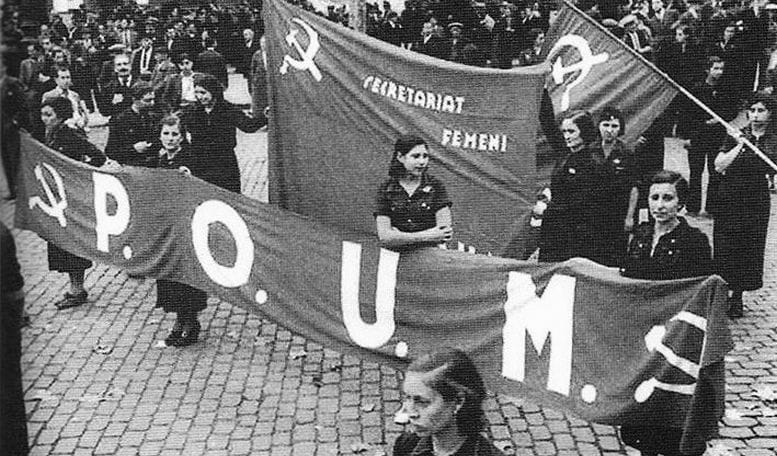
Trotsky had advised the Spanish group to join PSOE, where a strong radicalization was taking place—especially among the youth—and where there was a large left wing led by Largo Caballero. Caballero, leader of the UGT, had served in the 1931–33 government as Minister of Labor but was pushed to the left by the rise of the struggles. The leadership of the Socialist Youth, which had 100,000 members, offered the ICE the opportunity to join the organization to help train them as “Bolsheviks.” However, the ICE refused, leaving the field open to the Stalinists, who filled the vacuum and won over a mass base. Andreu Nin and the Communist Left then broke with Trotsky, merged with the BOC (Workers’ and Peasants’ Bloc, aligned with the right-wing opposition to Stalinism), and formed, in 1935, the POUM (Workers’ Party of Marxist Unification).
The first cabinet of the Popular Front government consisted solely of bourgeois republican ministers. Largo Caballero managed to prevent PSOE from participating directly in the cabinet, recalling the failure of 1931–33, despite strong pressure from PSOE’s right wing (led by Indalecio Prieto) and the PCE. However, he did so without breaking politically with the Front.
Even so, the victory of the Popular Front—which had received the support of the anarchists and the POUM in the elections—was greeted with enormous enthusiasm. The masses did not wait for the government’s decisions and began to impose their own demands. In the days following the elections, 30,000 political prisoners were freed directly by the masses. When Azaña took office as prime minister, he merely confirmed what was already a reality through an amnesty decree. Between February and July 1936, there were 113 local general strikes and countless other work stoppages, securing wage increases and better working conditions. In the countryside, peasants occupied land. Left-wing organizations grew rapidly. In six weeks, the POUM’s membership jumped from 1,000 to 60,000. Between February and July, an average of two people died each day in clashes between revolutionaries and fascists in the streets, with the fascists suffering the majority of the casualties.
The vast majority of the bourgeoisie came to the conclusion that the “bienio negro” had not been enough to defeat the revolutionary threat. They then bet on Franco’s coup to drown the movement in blood.
Fascist Coup and Revolutionary Response
On July 17, 1936, General Franco launched the fascist coup from his base in Morocco. The Popular Front government initially attempted to negotiate with the fascists, suppressed news of the coup, and censored newspapers that tried to alert the public. The government’s paralysis allowed Franco, supported by nearly the entire military leadership, to take control of one-third of the country within a week. However, the workers immediately recognized the threat and took direct action, blocking any attempt at reconciliation with the fascists.
On the 18th, hundreds of thousands marched through Madrid demanding weapons, triggering a government crisis. After two prime ministers resigned within a few hours, the third finally authorized the distribution of arms. Miners from Asturias organized a militia of 6,000 fighters and began a march toward the capital.
In Barcelona, the resistance began on July 19. Armed with pieces of wood, dynamite from construction sites, hunting rifles, and weapons obtained from sympathetic members of the local police, the workers confronted the military and stormed the barracks. Within four days, all of Catalonia was in the hands of the workers and peasants. Factories and land were collectivized under the control of elected committees.
In Aragon, the anarchist leader Buenaventura Durruti led a revolutionary military column, liberating towns and cities where the land was then collectivized and placed under the control of peasant committees.
“There are only two paths: either the victory of the workers—freedom—or the triumph of fascism, which means tyranny. Both sides know what awaits them. We are determined to put an end to economic injustices once and for all, whatever the cost,” Durruti stated in an interview with Canadian journalist, Pierre van Paassen.
Within five days, Aragon was under revolutionary control. Durruti did not take the regional capital, Zaragoza, only because the central government refused to send weapons to the anarchist militias. Later, he was called upon to defend Madrid, where he died under mysterious circumstances.
This was the turning point. The bourgeois state had collapsed, and much of the country was under the control of workers’ and peasants’ committees. It would have been perfectly possible to form a workers’ government based on these factory, peasant, and militia committees. However, the anarchist leadership of the CNT was opposed to the creation of a centralized state, while the other left-wing forces preferred to maintain their alliance with the bourgeois Republicans.
The contradiction in the position of even those groups with a formally revolutionary line became apparent when, in September 1936, the CNT and POUM leadership accepted posts in the Popular Front government of Catalonia (the Generalitat), alongside bourgeois representatives. In December, Andreu Nin was expelled from that government under pressure from the Stalinists, but the POUM continued to demand his reinstatement. In November, the CNT also assumed ministerial posts in the central government.
Pressure from the masses forced the Republicans to accept Largo Caballero as prime minister in September, forming a cabinet that included Stalinists and, later, the anarchists.
For Marx and Engels, the experience of the Paris Commune had already shown that the working class cannot simply seize the bourgeois state apparatus and use it for its own ends. It was necessary to dismantle that apparatus and build a new workers’ state, with truly democratic foundations and control over the economy. This lesson was tragically confirmed in Spain.
The only real force capable of defeating Franco’s troops was the revolutionary militias, but their advance threatened the bourgeoisie’s right to property. Liberal and Republican leaders feared the workers’ revolution more than the victory of fascism. In several cases, such as in the Basque Country, bourgeois leaders preferred to hand over the territory and industries intact to the fascists rather than arm the workers and risk them taking control.
The CNT leadership made no practical distinction between a bourgeois state and a workers’ state. While the workers in Catalonia controlled the factories and transportation, the local bourgeois government (the Generalitat) remained institutionally intact, tolerated by the anarchists. Faced with the need to centralize the war effort, the CNT chose to integrate itself into the bourgeois state rather than destroy it. For its part, the POUM formally defended the power of the committees (soviets), but in practice did not challenge the CNT’s political line and continued to support the Popular Front government.
Largo Caballero, despite speaking out in favor of a “dictatorship of the proletariat” (a term that at the time referred to the democratic power of the working class as opposed to the rule of the bourgeoisie), lacked a strategy to carry out the socialist revolution. He adopted the Stalinist line that it was necessary to “win the war first,” refusing to break with the capitalist ministers.
Andreu Nin correctly criticized this line, saying: “The fundamental problem of our revolution is not military; it is political. The war will only be won if the workers feel that they are fighting for their own gains—for collectivized factories and free land—and not to restore the bourgeois republic that repressed them in the past.”
The Stalinists used the fact that the USSR was the only country supplying arms to blackmail the government, demanding the suppression of revolutionary measures and the strict defense of the “republican order” and even “private property.” Under Caballero’s government, censorship measures against workers’ newspapers and radio stations were maintained and expanded.
Stalin did not want a victorious socialist revolution in Spain, as he feared this would jeopardize his military alliance with France and England. In addition to this was his fear that a healthy workers’ revolution would inspire the Soviet working class itself to rise up against the Kremlin bureaucracy—which, at that time, was carrying out bloody purges, executions, and arrests of the opposition, the so-called “Moscow Trials.”
France and England, terrified by the revolutionary mobilization and fearing a direct confrontation with Germany and Italy, adopted a policy of “non-intervention.” International support for the revolution, however, was massive among workers around the world: some 40,000 volunteers formed the International Brigades that fought in Spain. Faced with Germany and Italy sending weapons and troops to the fascists, the Soviet Union sent weapons to the Republican side, but demanded payment in gold and used its political and police power to stifle the revolutionary process from within.
The Stalinists played a central role in the reconstruction of the bourgeois state.
“The paradox of Spain was tragic: while the workers in the factories and the peasants in the fields were laying the foundations of socialism, the Popular Front government, under the direct command of the Stalinists, used Soviet weapons not to advance the revolution, but to rebuild the old police force and the old state that would protect private property,” wrote Felix Morrow, a journalist and Trotskyist activist, author of the book Revolution and Counterrevolution in Spain.
In October 1936, the government decreed the dissolution of the workers’ militias and their incorporation into a regular, bourgeois, hierarchical army, even prohibiting the presence of women on the battlefront. Resources and weapons were frequently denied to the fronts controlled by the POUM and the anarchists for political reasons. Collectivized industries and lands came under attack by the central government, which sought to return them to their former owners.
Another tragic mistake of the Popular Front was its refusal to declare the independence of Spanish Morocco (from which Franco drew a large part of his troops), so as not to run counter to the imperialist interests of France and England.
1937—the Last Chance for the Revolution
The definitive turning point came in May 1937, when the Stalinists launched an armed offensive to seize the Barcelona telephone exchange, which was controlled by anarchist workers. This triggered a spontaneous armed uprising by the working class, which within a few hours regained control of almost the entire city. However, after four days, the leaderships of the CNT and the POUM called for a ceasefire and a withdrawal from the barricades. This was the last chance to turn the tide in favor of the revolutionary forces.
Retreat politically disarmed the proletariat and opened the door to a relentless repression led by the Stalinists. In June 1937, the POUM was declared illegal and its main leaders were imprisoned. Andreu Nin was kidnapped, tortured, and murdered in a secret prison run by the Soviet secret police. Largo Caballero, for having refused to lead the open repression against the POUM and the left wing of the anarchists, was replaced by Juan Negrín, from the right wing of PSOE and fully aligned with the Stalinists.
George Orwell, who fought in the POUM militias, described the retreat of May 1937 in his book Homage to Catalonia:
“The feeling that the workers were in control had vanished from Barcelona… Everyone knew that the Stalinists were in charge and that the revolution had been postponed until after the war—which meant, in practice, postponed forever.”
The destruction of the revolution sealed the military fate of the republic itself. By crushing the revolutionary enthusiasm and economic gains of the workers and peasants, the government destroyed the engine that sustained the armed resistance. In February 1939, the “democratic” powers (France and England) officially recognized Franco’s regime, while the Republicans were still holding out in one-third of the territory. In March, Franco’s troops entered Madrid. It was the beginning of a dictatorial era that lasted nearly forty years, marked by tens of thousands of summary executions and hundreds of thousands of people imprisoned in concentration camps.
What Could Have Been Done?
The victory of fascism was not a historical inevitability. The Spanish workers and peasants demonstrated sufficient strength to win. A victory for the socialist revolution in Spain would have completely altered the situation in Europe—neighboring France itself was experiencing a revolutionary upsurge of sit-down strikes in 1936, though this was also contained by the policies of the Popular Front. A victory for a socialist revolution in Spain, followed by one in France, could have altered the course of history and prevented World War II.
However, the official workers’ leaderships faltered at decisive moments or, in the case of Stalinism, consciously acted as the police wing of the counterrevolution. This capitulation did not even save the Stalinists. The bourgeois sectors of the Popular Front eventually abandoned them and made peace with Franco even before the formal end of the war, and many of them were arrested and executed.
Defeat was inherent in the Popular Front’s very political concept of class collaboration. The bourgeois ministers were not merely a right-wing faction within the Popular Front; they were representatives of the ruling class.
The Spanish Revolution and Civil War are a tremendous source of inspiration, demonstrating the working class’s capacity for struggle and heroism. But they also show that the will to fight is not enough. We must learn from the mistakes of the policy of class conciliation, which remains the dominant policy among left-wing parties today. We must build revolutionary socialist political parties prepared to carry the struggle through to its ultimate conclusion. By learning from the rich lessons of the Spanish Revolution, it will be possible to overthrow this nefarious system and win the future—a socialist world.