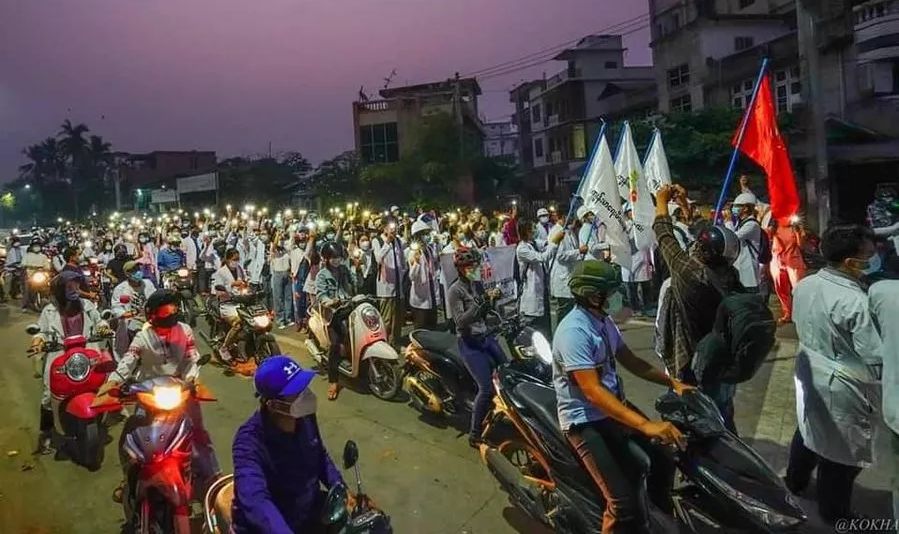

The student-led protests in India secured a major victory when their main target, Education Minister Dharmendra Pradhan, resigned on Saturday (25 July). His resignation is a major setback for the reactionary Hindu nationalist BJP government led by Prime Minister Narendra Modi.
However, the struggle must continue. “His resignation is only the first step”, as it said on a placard at one of the many victory demonstrations held after the Education Minister was forced out.
The recent protests in India have once again shown that the struggle pays off. The students initially focused on corruption and leaked exam answers. But the movement immediately expanded to include issues beyond those that had sparked it.
The Minister of Education is the first to be forced to resign as a result of protests during the BJP and Modi’s twelve-year rule.
“For the first time in his long political career, Indian Prime Minister Narendra Modi’s image of political invincibility appears to have been punctured. A new youth movement, founded just 37 days ago, forced his government into a humiliating retreat at the weekend and led to the resignation of the education minister,” wrote the Financial Times on 27 July.
It was the fear that the protest movement would spread and turn into a broader and larger protest against the government that led Modi to beat a retreat and give in to almost all of the students’ demands.
In the growing protests, which attracted both young people and parents and continued despite the repression, there were clear signs of a broader political awakening – against Modi’s rule.
“When I returned a month and a half later, on 20 July – the day the march to Parliament was planned – Jantar Mantar (in central New Delhi) was unrecognisable. A hunger strike had raised the political temperature of the protest. The government had forcibly removed the leading hunger striker and confined him to a hospital. The idea was that his absence would defuse tensions and break the demonstrators’ will to fight. That was not how it turned out. Tens of thousands of people were crammed into the cordoned-off area, and thousands of police officers were on the scene. The government had underestimated the size of the crowd streaming in by bus, train and car from Delhi and elsewhere. In the afternoon, the Delhi police force and its superiors compounded their misjudgement by attacking this massive gathering of young people with lathis (bamboo sticks) and tear gas,” reports a writer in the British Guardian, adding that the images of the police attacks brought “the violent clash into every home.”
The government also appears to have been taken by surprise by the new momentum the protests gained following the brutal police attacks on last week’s demonstrations.
What is now necessary is for the students’ successes to spur trade unions and farmers’ organisations in particular to renew the struggle against all of Modi’s attacks.
Modi’s retreat is a last-ditch manoeuvre to buy time and, if possible, to divert and divide the protest movement. Instead of immediately calling off the protests, as the leaders did after meeting with government representatives on Saturday, the students should build on the support and solidarity they have won from other sections of the population.
It is through continued struggle and organisation, together with a conscious effort to forge links with the working class and the poor masses, that the students can achieve lasting improvements. Modi must go!
Cockroach Janata Party
The initiative for the protests that have rocked India since June was taken by the newly formed Cockroach Janata Party (CJP), a party that emerged online in May in response to the country’s chief justice calling unemployed young people “cockroaches and parasites”.
The CJP quickly gained enormous traction. In just a few weeks, it became the country’s largest party in terms of Instagram followers, with over 22 million. But it was only after the protests spilled onto the streets in June that the movement became a genuine challenge to the government.
Deeper Causes
Behind this explosive development lie years of growing discontent and frustration, not least amongst the country’s many young people. Half of India’s population is under 30. Not even higher education paves the way to a job and a steady income. A recent report estimates that 40 per cent of young graduates are unemployed. Among those who do have jobs, only a small proportion are in permanent employment with a regular income, and even fewer have access to any form of social protection.
Youth unemployment has not only remained persistently high, but is rising. By June, it had risen to 16.2 per cent, compared with 13.8 per cent in April 2025.
“Unemployment is particularly high among those with higher education and postgraduate qualifications. Around twelve million applicants applied for 8,868 vacancies at the state-owned railway company Indian Railways in 2025. It is worth noting that those applying for these jobs are often overqualified for the role. Of the 2.5 million applicants for the 53,000 vacancies for caretakers in Jaipur, many were university graduates and some even held PhDs.” (from US left-wing magazine Jacobin, 27 July).
For several years, India has been described as a capitalist success story, but despite relatively high economic growth, not enough new jobs have been created. At the same time, the public sector has been downsized and workers’ protections have steadily eroded, a situation met with recurring large-scale protest movements throughout the 2020s.
Before the student protests in June and July, India had been shaken by one of the largest general strikes in history. In February this year, as many as 300 million workers and farmers went on strike against Modi.
The need for both a new general strike to bring down Modi and a revolutionary socialist party has only become even more urgent following the students’ struggle.