The general strike of May 1926 didn’t fall from a clear blue sky; the conditions for it had been ripening over decades. The situation had come near to general strikes in 1919, 1921 and 1925. The British economy was on its knees following World War I, with the capitalists making workers pay for their crisis. At the same time, workers had been radicalised by the Russian Revolution of 1917.
Prelude to the Strike
At the centre of these events were the miners, who were one of the most militant groups of workers. Some 1.2 million were members of the Miners’ Federation of Great Britain (MFGB) at the time.
By 1921, the mine owners were planning drastic cuts to wages. In response, the “Triple Alliance” – miners, railway workers, and dockers – called a national strike in their support. More than two million workers would join the walk-out. The leaders of the alliance, however, called off the strike before it even started, leaving the miners to conduct the fight on their own. After two months of struggle, they finally gave in and accepted the pay and conditions offered by the new owners. This serious blow to the workers’ movement became known as “Black Friday.”
Emboldened by this victory, other parts of the capitalist class forced through wage cuts in many other industries. The following period also saw a steep decline in trade union membership (from 8.3 million in 1920 to 5.6 million in 1922). This was driven partly by the rise in unemployment, but it was also an expression of workers’ disillusionment.
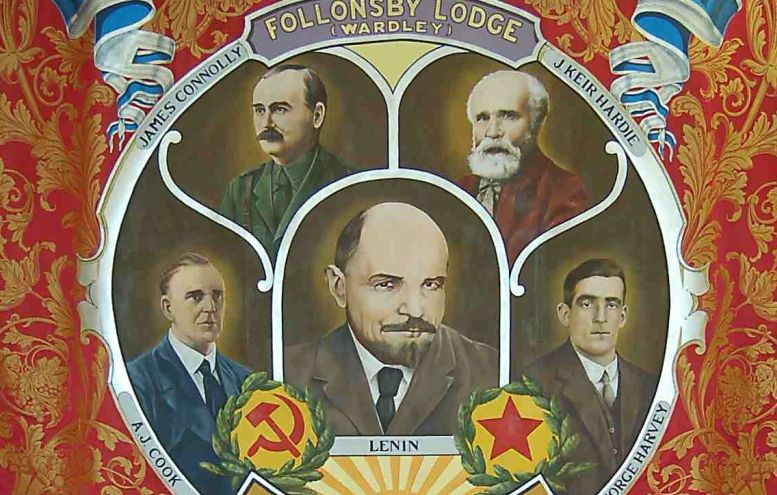
However, this betrayal also pushed many to draw more radical conclusions, including about the need for strong rank-and-file organisation. Left-wing militants started organising independently within the unions, calling themselves the National Minority Movement. Heavily influenced by the Communist Party, they scored a victory with the election of the militant trade unionist Arthur Cook – a self-proclaimed follower of Lenin – as the leader of the MFGB.
The mineworkers constituted a crucial part of the British economy. At the same time, being the most organised and radical meant they remained the main target of attacks from the ruling class, who saw defeating them as a means of “breaking the back” of the workers’ movement as a whole.
By May 1925, further cuts to pay and conditions for the miners were back on the table. It was clear the time was ripe for a reckoning between bosses and workers. At the 1925 TUC Congress, a clear majority of delegates voted in favour of a motion that called for the “overthrow of capitalism” and for the formation of workers’ councils (soviets). While the TUC leadership was dominated by right-wingers such as the National Union of Railwaymen’s Jimmy Thomas, it still represented over 4.5 million workers.
“Red Friday”
After negotiations, the government agreed to subsidise the coal industry for nine months and set up a Royal Commission, led by Home Secretary Herbert Samuel, to recommend a course of action. Although dubbed as a victorious “Red Friday” by the papers, this victory was shallow and temporary. The government used the time it had bought itself to immediately start preparing for the battle ahead. It set up the “Organisation for the Maintenance of Supplies” to organise an army of strike-breaking volunteers (a notoriously right-wing crowd, including many fascists) as well as coordinating food and fuel supplies, recruiting 240,000 special police and putting the army on standby.
The TUC, meanwhile, did absolutely nothing to prepare for the showdown that was clearly going to happen. They waited for the subsidies to run out and for the Samuel Commission to report. When the report was published on 10 March 1926, it recommended a pay reduction of 13.5% for the miners and for the subsidies not to be extended. In response, the mine owners announced wage cuts and longer working days. When the workers refused these terms, they were locked out of the mines. Rallying around the slogan of “not a penny off the pay, not a minute on the day,” the miners went back to the TUC for support.
Having done little since “Red Friday,” the TUC now entered into negotiations with the government, but still failed to make any attempts to rally their forces. It was obvious from the start they did not want a general strike. Right-winger Jimmy Thomas was heading the negotiations with the government and explained that “every sane miners’ leader wants, as every employer wants – peace”. But it was very clear that the ruling class did not “want peace.”
Even if the TUC leaders did not understand or acknowledge what was at stake, the ruling class certainly did. Winston Churchill, then Chancellor of the Exchequer, summed up the situation: “It is a conflict which, if it is fought to a conclusion, can only end in the overthrow of parliamentary government or in its decisive victory. There is no middle course open.” The options were revolution or the brutal defeat of the working class.
But it wasn’t just the trade union leaders who failed to do anything to prepare for the strike and engaged in self-sabotage. The Communist Party had numerous courageous revolutionary militants who wanted to mobilise the workers and empower them to defeat the government. However, the party leadership was increasingly under the influence of the Stalinist bureaucracy in Moscow, whose strategy was based on maintaining cosy relations with their counterparts in the British trade union bureaucracy, no matter the cost. As a result, the Communist Party’s primary slogan was “all power to the General Council [of the TUC]”. This simply left the TUC free to carry out its strategy unopposed.
Giving in to pressure from below, on 1 May the TUC held a special conference to announce plans for a strike to begin on 3 May – an announcement endorsed by delegates representing an overwhelming 3.5 million (99.9%) of the members. Meanwhile, the leaders were growing increasingly desperate in their efforts to secure a deal with the government, who were not conceding any ground.
The strike began on 3 May. Millions responded to the call, with hundreds of thousands more demanding to be called out. In addition to the one million locked-out miners, some two million workers across transport, printing and production were initially brought out, with another 500,000 joining as the strike went on.
The scope and intensity of the response seems to have surprised both the government and the TUC – it was immediately clear that the TUC’s fear of losing control had come true. As Charles Dukes, a leading official of the General and Municipal Workers’ Union complained:
“Every day that the strike proceeded, the control and the authority of that dispute [was] passing out of the hands of responsible executives into the hands of men who had no authority, no control, and [were] wrecking the movement from one end to the other.”
The TUC would spend the duration of the strike trying to control and subdue the movement. They had an additional one million members that were never called on to strike. They published a strike bulletin called the British Worker, which discouraged picketing. They advised strikers to maintain friendly relations with the police. Most of this advice went unheeded as strikers confronted strike-breakers and police across the country.
There were riots in Plymouth, Swansea and Nottingham, clashes with police across London, Leeds, Cardiff, Ipswich, Manchester, Stoke, Liverpool, Glasgow and Edinburgh. In Preston, 5,000 stormed a police station to free an imprisoned striker. Across the country, between 100 and 147 “Councils of Action” were formed in order to organise picketing, food distribution, dissemination of information, and tasks like issuing passes to vehicles moving essential goods.
The Sell-out
The structure of these councils was similar to what happened in Russia in 1917. They represented the early stages of dual power, in which the workers simply started taking over the running of society themselves. The next step would have been to link these councils up nationally, forming a workers’ government placed to take over state power and be at the helm of the socialist transformation of British society.
What was missing, however, was a consistent revolutionary socialist leadership to put forward these ideas and direct the energy of the workers. While the Communist Party were actively intervening, building the Councils of Action and often playing positive roles on a local level, their instructions were that they were not to take over the running of the strike.
Despite this lack of leadership, the strike was growing in strength and determination day by day. By the second week, key industries were closing down through lack of supplies. Despite all this, on 12 May, the TUC General Council went to the Prime Minister with the disgraceful proposal that they would call off the strike on the paltry conditions that the proposals of the Samuel Commission be adhered to and that there would be no victimisation of strikers. The government called their bluff and refused both these proposals. The TUC called off the strike anyway.
The news of this surrender was first met with scepticism, then with anger. Few workers actually went back to work on the following day. In fact, as they found out about the betrayal and of colleagues losing their jobs, 100,000 new workers joined the strike. This meant that 13 May, the day after the strike had officially ended, more workers were out than any day of the official strike!
Without the support of the unions, however, strikers did gradually return to work. Soon only the locked-out miners remained. They held out for another three months before they were ultimately forced to return to work with wages and conditions diminished.
Conclusion
As predicted, the defeat was a huge setback for the working class, paving the way for a period of repression and rolling back of workers’ rights. However, no defeats for the working class are ever final. The 1930s saw a huge resurgence of industrial struggle and workers’ militancy, along with huge revolutionary possibilities across much of the continent of Europe.
For a revolution to succeed and a workers’ government be established, workers must take power themselves – both on the streets, and through control of the economy. In the accounts of the general strike, we can see that in only nine days, things moved remarkably fast in this direction. Although the process was cut short, it disproves the common belief that a revolution “could never happen in Britain” because of the “British temperament.” It was never the determination or radicalism of the British workers which fell short!
The history of the general strike is rich in lessons for all workers and trade unionists today. Then, as now, a crucial task for our movement is to remove the “block at the top” by replacing the right-wing trade union leaderships with working-class fighters.
This is an equally important lesson of the strike: workers need a revolutionary party with a clear socialist program and the correct approach to linking the everyday struggles of workers with the need to fundamentally change society. This is the kind of organisation we are seeking to build today in Socialist Alternative.
Studying events like the general strike can not only teach us how not to repeat past mistakes, but importantly they can remind us that this kind of mass struggle will take place. As socialists, it is our job to prepare for these events and ultimately do everything we can to ensure the workers’ movement is successful.