This is the fourth World Perspectives statement produced by ISA since the inauguration of Donald Trump’s second presidency. This is based on a recent discussion n of ISA’s International Committee. The last, published on 12 February, commented on where his 2026 US imperialist offensive could lead to next: “Following his successful decapitation and subjugation of the Venezuelan government, his hubris has been turbocharged. At the time of writing, Iran and Cuba are foremost in the list of ‘easy targets’ and allies of Chinese imperialism which he is lining up to go after next.”
At the same time, we made it clear that Trump’s then oh so high-and-mighty posturing would backfire: “his hubris will inevitably lead to miscalculations in every sphere, and military miscalculations are the most costly of all. Trump’s increasingly unbridled aggression, combined with US imperialism’s inability to deploy significant ground troops, is a recipe for new crises and quagmires.” Less than three weeks later, this is precisely what happened when Trump began his calamitous war against Iran.
In June 2026, it is abundantly clear that a turning point in his second administration has been passed. After little more than one year in office, Trump 2.0 has been irreversibly plunged into crisis. His dreams of a place on Mount Rushmore have gone up in smoke. Instead, he will go down in (bourgeois) history as one of the most disastrous US presidents ever. His leadership will forever be associated not with American “greatness” but with the accelerated decline of US imperialism.
However, this does not mean that Trump will just limp through the rest of his presidency as a “lame duck.” After his humiliating defeat in Iran, he has Cuba firmly in his sights as the next appealing “easy target.” In the US itself, his reactionary agenda continues, with the last months marked by historic attacks on the democratic rights of Black Americans in particular.
It is also important to understand that Trump’s problems will not, in and of themselves, push back the international reactionary agenda of the ruling classes, which remains in full swing. Indeed, those among the billionaires and their representatives who are beginning to turn against him are not doing so because of any opposition to his overall program. They backed him not despite his reactionary policies, but because the essence of his reactionary promises was music to their ears. Moreover, a turn to reactionary strongman rule is in many ways a necessary response for the ruling class to the dramatically eroding base of social support for so-called liberal capitalism and all its institutions.
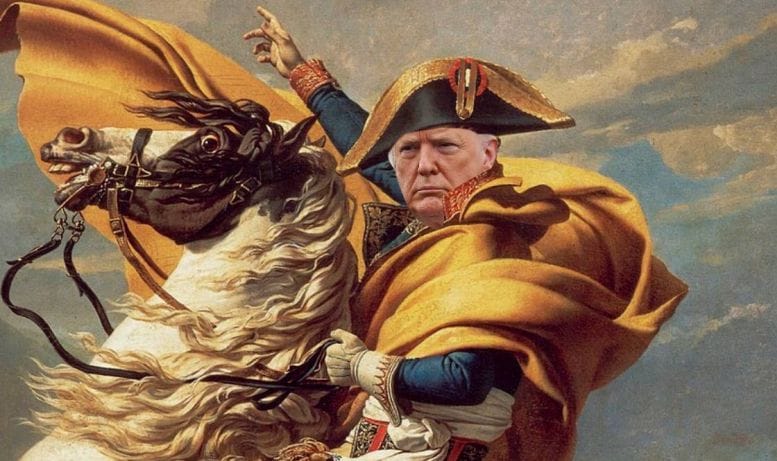
As with all Bonapartist regimes in history, Trump 2.0 was backed by the ruling class to pursue their interests in the midst of a deep crisis of their rule. The senile stupidity of this particular Bonaparte underlines the rottenness of decadent US capitalism and the dearth of political options at their disposal following the terminal crisis of the neoliberal political establishment.
What now has the US capitalist class and many capitalists internationally reeling are the “Frankenstein’s monster” consequences of their gamble on this disastrous president. This includes the economic recklessness which has seen Trump take the world economy to the brink of a slump on not one but several occasions—most recently with the Iran/Hormuz debacle. It also includes, however, the risk of social upheaval and revolt.
For the billionaires, Trump’s rapidly falling opinion poll numbers are far less of a concern than the fact that on his watch, the US has witnessed an historic upsurge in protest and crucially, the return of mass political strike action. And while the Iran war is decisive in the plunging of Trump 2.0 into crisis, it is not the only factor. Only weeks after Trump’s “big win” in Venezuela, his bloody ICE offensive was decisively pushed back by the working class of Minnesota in his first major defeat.
This is the most crucial question for Marxists. In analyzing the descent of Trump’s regime into chaos and crisis, we seek to identify potential openings for increased struggle and organization among the working class and oppressed. Often in history, the weakening of a reactionary regime, accompanied by splits among the ruling class, has increased the confidence of the working class to fight back. As we have often repeated, our perspectives are a guide to action: to help build this fightback, while simultaneously fighting to rebuild the working-class movement on the basis of a revolutionary socialist program.
Two Superpowers in Decline
Another crucial aspect of ISA’s analysis of World Perspectives which must be returned to at this moment of deep crisis for US imperialism is our understanding that the US/China imperialist power struggle sitting at the center of world relations today, is a battle between two superpowers in decline. This differs from the conception of most capitalist commentators, and indeed much of the international left. While most manage to identify US decline, they continue to see Chinese imperialism as, in contrast, a rising power. This misunderstanding breeds different forms of confusion.
At the Xi Jinping-Donald Trump summit in Beijing in May, Xi mentioned the “Thucydides trap,” a metaphor he has also used in meetings with previous US presidents. Thucydides wrote the history of the first 20 years of the 27-year long war between Athens and Sparta 2,400 years ago. The war was fought between a rising Athenian empire and the dominant power, Sparta. Xi’s purpose is both to point out there are also two superpowers today, one in decline and another rising to overcome it, and to claim that he wants to avoid an inevitable war between the two—the “trap” in question.
The main shortcoming in this comparison, however, is that China is no longer rising. The deep and intertwined crises of both the world’s competing superpowers were clearly expressed at the May summit. There, any real discussion about the most contentious issues was avoided, including critical minerals, rare earths, semiconductors, and AI. Both regimes wanted to project “strategic stability,” a key phrase launched by Xi. Trump echoed this, praising the relationship between the “G2” governments and even favorably quoting Xi’s mention of US decline—assuring us that he was referring to the Biden era!
In previous epochs of capitalist history—which have been marked by a succession of conflicts between rising and declining imperialist powers engaged in a constant struggle to redivide the world—blunders as calamitous as those of Trump would be quickly and decisively capitalized upon by major imperialist rivals. Today however, China’s weaknesses have largely prevented it from doing so. It has allowed allies to be bullied and beaten by Trump’s aggression with only words of strong “concern” issued in response, while simultaneously rolling out the red carpet for Trump in Beijing.
While Trump’s growing crises are livestreamed 24:7, the deep crisis in China to a large degree goes under the international radar. For a long period, Chinese economic growth was built on the property sector, which between 2006-2020 built half of all new housing globally. Since then, the sector has fallen from 33% of GDP to 11%, with this collapse continuing. New high profile sectors—EVs, solar panels, batteries, AI—are, despite huge investments, not compensating for this decline. Real growth is stagnating far below official statistics, with unemployment rising to 20% (in reality higher) among youth, and migrant workers leaving the cities because of the complete lack of a social safety net, unemployment insurance, etc. Total debt is equivalent to 330% of GDP, and among the highest in the world in the private sector, according to the IMF.
This is a process of “Japanification”—named after Japan’s 35 years of deflation, low growth and huge debts. In China’s case, we are five years into this phase of crisis. As a bigger, poorer society, with far greater extremes of inequality, caught in a sharp inter-imperialist conflict, the outcome can be significantly worse than in Japan.
This forms the background to the power struggle at the top. In January, general Zhang Youxia, member of the CCP politburo and the country’s highest ranked military leader, was arrested, accused of political crimes such as disloyalty and espionage rather than corruption, the more customary charge in CCP/PLA purges. This follows over 100 top PLA officers being purged since 2023, many of whom had been promoted by Xi to cement his control over the military. However, months after his arrest Zhang Youxia, whose whereabouts are unknown, has still not been formally removed from his positions. This indicates fierce pushback from the army and other elite sectors of the CCP-state. On 7 May, two former defense ministers who were arrested three years earlier in Xi’s purges, generals Wei Fenghe and Li Shangfu, got suspended death sentences for “disloyalty to the party.” This draconian sentencing is about sending a message to the anti-Xi factions in the army, and shows that the power struggle is far from over.
While his catastrophic miscalculation in the Iran war has severely undermined Trump and US imperialism’s position, it is striking how Xi’s regime has been incapable of turning the tables in the inter-imperialist conflict. Trump’s 2025 tariff war resulted in a “truce,” agreed in South Korea in October, with 30% tariffs on US exports to China and 47% on Chinese exports to the US.
Despite both sides’ wish for a period of de-escalation, there can be no long-term stability in this “relationship.” All areas of confrontation still remain, and could trigger new explosions. The military build up continues with increased pace, as does the great game of struggles for resources, energy, AI, and power. China’s extreme dependence on exports in a deglobalizing world, and the US’s place at the heart of the financial sector’s bubbles, are vulnerabilities which can fuel sharp new turns and crises. So is the growing discontent inside both countries, building up for explosive struggles.
Broadly speaking it remains the case that at this stage neither side in this ongoing showdown can either inflict a decisive “knockout blow” against the other, nor can they afford to simply back down and grant the other side a full victory.
Iran: Trump’s Vietnam? Or Worse
On 31 May, the UK Guardian’s diplomatic editor posed the question “Could Trump’s Iran excursion be a bigger global turning point than Vietnam?”. While the loss of life in Vietnam (including for US personnel) and the devastating crisis sparked in the US military and society is much greater in comparison, it is certainly the case that the international consequences of Trump’s humiliation in the Middle East are more far-ranging. This reflects just how far the decline of US imperialism has progressed since the 1970s.
Far from a “minor excursion” as Trump claims, the US/Israeli war on Iran was a colossal endeavor. Over the 40 days of war which preceded the April 10 “ceasefire,” US and Israeli forces dropped more bombs on Iran than were fired during the US invasion of Iraq in 2003. During the same 40 days, US forces fired 850 Tomahawk missiles, compared to the 57 that were scheduled to be produced in the whole of 2026.
This is a significant depletion of US stockpiles, with consequences which will reverberate far beyond the Persian Gulf. As Trump entered the quagmire, weapons, systems and personnel were diverted in large numbers from the Western Pacific (US imperialism’s strategic priority) and Europe. It will take several years to replenish the munitions expended, despite the massive acceleration in production which Trump is demanding. The real cost to the US treasury will run into the hundreds of billions, with one leading Harvard economist predicting an overall cost of up to one trillion dollars.
And what did Trump get in exchange for such a devastating outlay? Not even a pyrrhic victory as in the case of Iraq, but a defeat. At the time of writing, the fragile deal agreed between Washington and Tehran makes this outcome crystal clear. The Iranian regime, even at a time of historic weakness, was simply too strong for crisis-ridden US imperialism to overcome.
Initially, when Trump failed to force Tehran’s capitulation, a scenario of escalation towards a ground war was seriously contemplated in Washington. In the days prior to the announcement of the June deal, Trump openly told reporters that “taking Kharg Island” had always been his “preference” but that “I don’t know that America has the stomach for it, to be honest.”
Here, Trump is really referring to one of US imperialism’s most important limitations on the world stage today, which ISA has pointed out repeatedly in recent material: its inability to conduct large-scale land wars—to “put boots on the ground.” This is a reflection of US imperialism’s long decline: “Vietnam syndrome” followed its defeat there in the 1970s, which was compounded by Iraq/Afghanistan syndrome following the disastrous “war on terror” at the beginning of this century. Far from successfully addressing this fundamental problem for the world’s main superpower, Trump has now made it much worse.
Regional Balance of Power
The impact of this US defeat on the balance of power in the Middle East is difficult to overstate. Trump’s war has not only blown up US authority and credibility in the region, but also dynamited the entire economic and geopolitical foundations of the Gulf states, whose dictatorships had been full of optimism in the preceding period. The entire fabric of these states’ dependent relationship with Washington—the idea that US military might and the extensive import of US arms could secure their fossil fuel industry—has gone up in smoke. When push came to shove, their sacred alliance with Washington became a source of vulnerability, not strength.
Even if the current deal holds, the situation in the Gulf will continue to change rapidly. Alongside repairing damaged infrastructure, which will take several years to be fully operational, regimes in Saudi Arabia, the UAE, Qatar, etc. will have to sink billions into new infrastructure—especially pipelines—to reduce their dependence on the Strait of Hormuz. The war has also taken the already strained relationship between Saudi Arabia and the UAE to a new low, with the UAE moving closer to Israel and leaving the Saudi-led OPEC oil cartel.
For some regimes, a rapprochement with Iran—which has proved itself the most important guarantor of the region’s oil and gas exports—will also emerge as an option once the dust has settled. In the case of Oman—a US ally which Trump threatened to “blow up” if it made arrangements with Iran—this appears to already be on the cards. Moreover, the June deal reportedly includes the payment of vast sums from other Gulf states to Tehran for reconstruction.
The strength of the Iranian regime should not be overstated. While it clearly emerged on top, it too was pushed to the brink. The war took inflation in Iran to its highest level since WWII—77%—and it suffered the decapitation of several tiers of its state, military and political hierarchy. Trump’s repeated claims that “regime change” had been carried out are patently absurd. However, the regime has undergone a certain recomposition, with the police state, represented by the IRGC, now playing a more central role, despite the formal maintenance of clerical leadership and political oversight.
That being said, the most significant outcome of the war for the regional balance of power is the clear de facto control Tehran now exercises over the Strait of Hormuz. This dramatically enhances Iranian power. It also sends a message to countless other states and non-state actors as to how effectively, and relatively easily, such choke-holds can be exploited. This follows the successful curtailment of transit through the Bab-el-Mandeb strait (to the Red Sea and Suez canal) by the Houthis in 2024, a repetition of which was one of US imperialism’s foremost fears in the case of further escalation with Iran.
The outcome of the war and the June deal between the US and Iran is of course also a stunning blow to the Israeli regime. Its bloodsoaked “progress” in shifting the regional balance of power in its favor is now under severe threat. The war on Lebanon, with almost four thousand killed at the time of writing, is the most explosive fault line which threatens the deal. Netanyahu’s far-right government is in no mood to rein in its regional onslaught. It is also continuing to twist the knife in Gaza, and stepping up the ethnic cleansing of the West Bank. Al Jazeera reports that the IDF has fully occupied over 1,000 square kilometers of Gaza, Lebanon, and Syria in the past two years, an expansion of over 5% of the total territory under its control.
One of Trump’s most absurd statements during this war (with a crowded field to choose from!) was made on 25 May. In a flurry of posts, he claimed that the outcome of the conflict would lead to a huge extension of the “Abraham Accords,” with a long list of countries from Turkey to Saudi Arabia to Pakistan named as among those about to “normalize” relations with Israel. The reality is precisely the opposite.
In fact, this war has further advanced the process of Israeli capitalism acquiring “pariah status” on the world stage, which has been turbocharged since October 2023. Its genocidal onslaught on the Palestinian people is one of the most dramatic consciousness-shaping events in recent memory.
Driven by international mass rage, which was expressed in an historic international mass movement spanning more than two years, global politics is beginning to shift decisively. The open and enthusiastic defenders of Israeli state terror—which recently included the vast majority of the Western media and political establishment—have been reduced to a narrow fringe in most countries in the world. Even in the US, support for Israel has plummeted in polling, among supporters of both major parties and especially among the younger population.
Trump himself—Netanyahu’s enabler in chief—hypocritically came out in criticism of Israeli attacks on civilians in Lebanon in June. Of course, this had nothing to do with concern for Lebanese civilians and everything to do with his desperation to not have his surrender to Iran disturbed by more Israeli bombardments. But what is the significance of the tensions which exist between these two murderers?
Much discussion among commentators critical of the Iran war, in particular within the US, has emphasized the idea that Israel, assisted by its powerful Washington “lobby,” is really the “tail which wags the dog” of US foreign policy. This is a particularly prominent part of the discourse of the “anti-war” right in US politics, exemplified by figures like Tucker Carlson and Marjorie Taylor Greene, though it is not confined to these sectors by any means.
Marxists understand that conflict in the Middle East, as with all regions, is part of a global imperialist balance of forces. Within this context, the US and Israeli regimes are indeed closely connected and integrated with one another, an “alliance” which stretches across each passing administration. And certainly, no imperialist geopolitical relationship is one between equals.
However, by any and all metrics, it is the US which is the senior partner in this case, and by a very long way. Israeli capitalism plays a fundamental role in enforcing US interests in a region which has been decisive for its interests. But it in turn is completely and utterly dependent on Washington for its survival. The idea of Trump being at Netanyahu’s beck and call is therefore an inaccurate caricature.
However, this does not mean that the Israeli regime has no leverage in this situation. While Trump has dynamited the Western bloc, Israel is the only traditional US ally with which he has forged closer relations in his second term. Netanyahu has made several attempts, often with success, to derail Trump’s initiatives to push through botched deals and “peace plans.”
The escalation of the war on Lebanon in June was an extremely transparent attempt to stall the momentum towards Trump’s surrender deal. And nothing indicates that the Israeli government will not stop trying. It is also motivated by political considerations, with Netanyahu desperate to enter the October Israeli election as a “wartime leader” to retain power and avoid prison, while Trump is determined to enter the US midterms in the exact opposite scenario.
This is one of the reasons which makes a more lasting end to hostilities in the region highly unlikely in the foreseeable future. Trump’s new definition of a ceasefire as “shooting in a more moderate manner” is, in the cases of Gaza and Lebanon, already the new norm. A scenario of continued armed conflict between Iran and Israel without the (formal) participation of the US is also possible. In early June, Iran cited Israeli attacks on Beirut as a direct motive for missile attacks for the first time and its Houthi allies have also waded in intermittently with attacks on Israeli targets.
However, this would put major pressure on Trump. The Israeli military is a formidable force in its own right, but it is entirely dependent on the US, not only for supplies but also the intelligence, satellite and radar facilities which make its bombardments of Iran possible. Whether an emboldened Iranian regime will allow for the conflict to be “decoupled” in this way—agreeing, for example, not to close Hormuz again in response to Israeli aggression—is also an open question.
In reality, the June “deal” between the US and Iran is an agreement for 60 days of continued negotiations, which can be extended longer. It means that the Middle East continues to be on the edge of renewed wars and crises, including the potential of movements from below to challenge local regimes and imperialism.
Energy Crisis—Not Out of the Woods
The timing of the June deal and Trump’s increasing desperation to push it through had everything to do with the ticking time bomb of his personally handmade energy crisis—the worst in world history. Panic was spreading throughout industry, with the IEA chief warning in late May of an impending “red zone” for energy markets starting in July. While Trump’s constant reassuring of the markets, and now the June deal, may have fended off the worst-case scenario of a catastrophic economic crash, the lingering effects will continue to hang over the world economy.
Even if Hormuz is reopened—a very big if—the world economy will be very far from being out of the woods. The clearing of mines and evacuation of the hundreds of vessels containing more than 20,000 seafarers currently trapped in the strait will take weeks by itself. It would then take many more weeks for global supplies to fully flow, as tankers take months to transit from Hormuz to Asian and American ports. Maritime insurers would also take time to be convinced that large-scale transit through the strait is worth the risk. The example of the Bab-el-Mandeb strait—which has still not returned to anywhere close to pre-2024 levels of traffic—is illustrative. In addition, the Iranian regime will almost certainly favor a slow and gradual reopening of the strait, in order to maintain leverage in future negotiations or standoffs with Trump.
Most economists expect elevated oil and gas prices to continue for at least the remainder of 2026. The knock-on inflationary impact is only beginning to be registered in the world economy, and will have profound impacts, especially in the neocolonial world where millions are being tipped over the edge from misery to starvation. The impact of the disruption to fertilizer supplies caused by the war is also already baked in, with smaller harvests and higher prices guaranteed over the coming 12 months.
The energy crisis is also about more than a clogged supply chain. Extensive damage has been done to production facilities, and reopening shuttered wells is a complicated process. The same IEA chief quoted above predicted that a return to full oil production in the Gulf would take at least one year, and some of the world’s biggest gas facilities will take between three and five years to be fully repaired following Iranian attacks in March.
AI and the World Economy
In short, the war will lead to a lengthy, costly, and complicated process of repair and restructuring of the region’s energy industry, which will have long-term world implications. Among the worst hit sectors of the economy by this energy shock will be the industry which is responsible for over 80% of stock market growth and the only factor holding the world economy back from a deep recession: Artificial Intelligence.
By inflating the AI bubble to its current extreme proportions, investors are gambling not only on the development of the technology itself, but also on a rapid expansion of cheap energy for the endless data centers required to deliver a return on their investments. More than $300 billion of these investments have been made in the Persian Gulf itself! This underlines the unsustainability of the AI bubble, and ergo of the situation in the global financial sector, bound to burst at some point.
The sheer dependence of the world economy on a single industry, which has yet to deliver real profitable returns, is a stark symptom of the ultra-parasitic stage which capitalism has reached in the 2020s. So is the fact that this bubble has propelled the grotesque Elon Musk to the title of history’s first trillionaire. That he just so happens to simultaneously be the world’s leading funder of white supremacists and neonazis only adds to the picture.
Indeed, AI is a reflection of the system’s reactionary turn in general. Alongside obscene ultra-profiteering, it is defined by turbocharged climate killing and environmental destruction. From Africa to Arizona, domestic water supplies will run dry and carbon emissions soar in order to feed its monstrous appetite. Together with the other global growth industry—militarism—it underlines the speed with which capitalism is hurtling towards nightmarish vistas of climate breakdown.
It is also deeply reactionary from the point of view of the class struggle. The aspirations of the ruling class regarding AI are ultimately based around qualitatively reducing labor costs. Amazon, Microsoft, Meta and other mega corporations have already begun to take advantage of the “benefits” of AI by announcing mass sackings. As with all other “labor saving” technologies implemented by the capitalist class in history, the rollout of AI will inevitably become a battlefield in the class struggle.
AI is at the heart of the new era of imperialist conflict and militarism. Its models allow for the near-instantaneous planning of murderous US and Israeli missile salvos in the Middle East, and millions of dollars and hours of human energy are being invested in pursuit of automated killing machines.
It is also a crucial front in the US/China conflict and was already a key factor in the banning of advanced chip sales to Beijing under the Biden presidency. US imperialism is now going all out to capitalize on its advantage over Beijing in advanced tech. Trump’s state capitalist proposal for the US Treasury to buy shares in big AI firms is an indication of this, but will also have the unintended consequence of further exposing Washington’s public finances to the impact of the coming crash.
China is no less invested in the AI race, but appears to be focused not on outdoing US firms’ technological advances but rather on rolling out existing technology more rapidly and extensively. Its more centralized system and the total absence of independent trade unions have allowed it to normalize “lights out” (fully automated) factories. It is clear, however, that this will be no antidote to Chinese capitalism’s underlying crises of overproduction, suppressed consumption, and deflation. It could even exacerbate these trends in some respects, as the displacement of workers by AI and robots will aggravate the collapse in consumer spending.
Perspectives for the world economy must remain open, but the fundamentals—in particular an historic energy crisis and overinflated financial sector—point in a clear direction. The coming crisis will also be made much worse by the fact that the capitalist system is in an immeasurably weaker position compared to the buildup to the 2008 financial crash. Mountains of debt, the end of China’s rise, and the absence of any effective institutions of international cooperation mean that the system’s toolkit to address a serious downturn is depleted.
US Domestic Crisis
Domestically, Donald Trump is at his weakest point during either of his terms in office. His overall approval numbers in the polls are in the 30s, with a net favorability rating in only four out of 50 US states, according to the Economist. His numbers on the economy—which were central to his reelection—are particularly bad. This follows key setbacks.
His personal ICE army, whose mission is to terrorize the immigrant population and anyone who stands in their way, was pushed back in the Battle of Minneapolis, culminating in the general strike of 23 January. Trump’s lost war in Iran and its economic effects have been deeply unpopular from the beginning, especially the spike in inflation. By late May, the price of gasoline had gone up 47% and overall inflation had reached 4%, the highest in three years.
Nevertheless the US economy is performing better than other major capitalist powers, driven by the AI investment bubble and a growing domestic fossil fuel industry. If the AI bubble were to burst in the near future, certainly leading to a 2009-type crash, Trump’s domestic position would become completely untenable.
Even now, a large section of the working class faces a precarious position. A measure of this is that credit card delinquencies across the country have reached their highest level since 2011, when the economy was still recovering from the Great Recession. There are numerous reports of the strain on food banks triggered by the cuts to federal assistance under Trump and the massive affordability crisis. NPR recently headlined “More People Are Going Hungry than at the Height of the Pandemic,” when there was mass unemployment.
In this situation, a sharp economic downturn could detonate the anger below the surface at the unprecedented level of corruption by a US administration as the Trump family has enriched itself to the tune of billions; the fury at the coverup of the Epstein revelations; the unceasing provocations against Black people by the most overtly racist administration in over 100 years; the litany of attacks on trans people; and Trump’s multifaceted authoritarian measures. Nor is the economy imploding the only scenario where Trump faces a more decisive reckoning.
But despite the pile up of combustible material, it would be quite wrong to conclude that Trump is a lame duck. He will seek to deflect and find “easy” wins whether by attacking Cuba or carrying out new attacks against oppressed sections of society.
While the Republicans in Congress and the right-wing dominated Supreme Court have shown a bit more willingness to push back on some of Trump’s wilder requests—if only for self preservation—like a billion dollars for his White House ballroom, he also continues to score important wins for his reactionary agenda. Two of these stand out. First is the effective gutting of the Voting Rights Act of 1965, a gain of the Civil Rights movement which provided for majority Black congressional districts in the South, as part of reversing the historic disenfranchisement of the Black population under Jim Crow.
Trump’s other key recent win is the $70 billion passed by Congress to fund ICE operations until the end of his term in 2029. The regime continues its relentless attacks on immigrants with 60,000 currently in ICE detention in terrible conditions. A hunger and labor strike in the Delaney Hall detention center in New Jersey has led to weeks of protests.
Trump’s “immigration czar,” Tom Homan, has threatened to surge ICE forces into New York City in response to “sanctuary city” measures. This could provoke a reaction that would dwarf what happened in Minneapolis, and would immediately put mass strike action on the agenda. It is not clear if Trump is ready for this battle but the fact that it was even raised shows that his minions are gearing up for more provocations.
Meanwhile the regime has stripped protections for at least 1.6 million “legal residents” including people from particular countries granted temporary asylum, and is looking for pathways to deepen this assault. The goal is to pressure people to leave and hundreds of thousands are already doing so. Trump’s relentless effort to push for “remigration” is a model for the right-wing internationally, with the European Parliament in June deciding on a huge deportation program.
The indictment of 15 people involved in the anti-ICE resistance in Minneapolis on completely spurious charges of criminal “conspiracy” is also a sign that Trump will seek to ramp up repression against all those resisting his lawless rule. The question of how the labor movement and the left respond to these attacks will be crucial.
Looming Midterms
The Congressional midterm elections are now less than five months away. The Democrats are on course to win the House and possibly the Senate. This does not mean, however, that Trump and the Republicans have given up looking for every way to steal the election “legally” or otherwise. Gerrymandering, including by taking advantage of the gutting of the Voting Rights Act, could give them an extra 10 seats for example.
There is massive disillusionment in the Democrat base with their own party establishment—particularly for their failure to fight Trump in any meaningful way. While Democratic voters will come out in big numbers to vote in the midterm elections in an attempt to push back Trump, this will not be fueled by any deep-seated enthusiasm for the Democratic party.
Already there are some examples in the midterms of candidates wishing to emulate Mamdani, the mayor of New York City, as well as AOC and Bernie Sanders in Congress. AOC is likely to run in the 2028 presidential race, which effectively begins the day after the midterms are over in November. This, and the lack of a clear leadership and direction for the establishment-wing of the Democrats, has the potential to open up a new round of debates about the direction of the party.
The beginning of candidates declaring their intention to run and party debates leading up to the primaries will also see the beginning of a public and chaotic debate about the post-Trump future of the Republican party. Trump will doubtless aim to crown a successor, but it would be illusory to foresee an orderly transition given the fault-lines that have begun to emerge within MAGA, which have been exacerbated by the Iran debacle. What is essentially guaranteed is that whoever emerges as the next Republican nominee, there will be no return to the pre-MAGA GOP.
Social and Class Struggle in the US
2025 saw a major reemergence of mass protest and social struggle in the US, from the No Kings mass mobilizations that brought out millions to the anti-ICE resistance in various cities, including the crucial rapid response networks in local communities. There have also been some important strikes, including by nurses in New York City, and the surge of inflation will likely provoke more economic strikes.
Opposition to the construction of data centers has also galvanized people in many rural areas in particular. A recent poll showed more than 70% oppose building data centers in their local area.
Despite relentless attacks on Black and trans people, there has so far been little struggle on these questions, but this can rapidly change. Provocations and atrocities are inevitable by this regime in retreat, and this will provoke a mass response. A period of more explosive and sustained mass struggle can be the factor that finally pushes the ruling class or a section of it to move more decisively against Trump. What is crucial is the social power of the working class being brought to bear as it began to be on 23 January in Minneapolis.
But even then, the ruling class will not abandon the reactionary agenda, which led them to back Trump in the first place. They will have to find new means however, and this can provoke splits in the face of an historic upsurge from the working class and the oppressed facing the whip of counter-revolution. Those splits will, of course, not be about siding with revolts from below, but strategic disagreements about how best to stabilize the situation for the ruling class.
Europe and Ukraine
A key characteristic of this period is the declining power of Europe, whose beleaguered imperialists are among the biggest losers in every race which defines the 2020s. European capitalists are investing in US AI, for example, instead of European startups. The EU is, as always, hamstrung by its fundamental contradiction—that it is not, and never can be, a nation state. It currently has 27 different regulatory frameworks for AI! The same problem is undermining its massive rearmament drive, with competing national firms producing fighter jets, drones and tanks incapable of coordinating a European-wide project.
Europe is also the biggest geopolitical loser of the 2020s. Trump’s rage at European powers’ refusal to support his Iran war has pushed the process of the Western bloc’s disintegration further along. In addition to the withdrawal of 5,000 US troops from Germany announced after the war began, Washington has also announced its intention to remove one third of its fighter jets currently stationed in Europe. This could go much further in the latter half of Trump’s presidency.
Another effect of the Iran war has been to distract international attention from the continued dangerous escalation of the longest European war since WWII. Within a matter of days in May, large-scale Ukrainian drone attacks hammered both Moscow and St. Petersburg, a scenario which would have been utterly unthinkable in recent memory. In parallel, Russia’s air war has dramatically escalated, with 24% more long range drones aimed at Ukrainian cities in May compared to April, with the highest number of civilian deaths since 2022.
Since the stalling of Russia’s winter offensive, momentum in the conflict has tended to shift towards Kyiv despite the front line remaining largely static. Putin is now under serious pressure. On the battlefield, Russian losses appear unsustainable in the longer run without another mass forced mobilization, which would be extremely politically risky only three years after the Prigozhin mutiny. The economic impact of Ukrainian drone attacks on Russian energy facilities is also significant. Refinery production fell by 15% in the spring, despite a bonanza of high oil prices and partial sanctions relief due to the Iran war.
Following the complete failure of Trump’s push for peace last year, the prospect of Putin seeking a deal from a weaker position today is even more remote. Instead, Russian imperialism may seek to escalate the conflict further in order to increase the pressure on Kyiv and European powers. In June, a Russian frigate fired warning shots at a British vessel in the English channel after a shadow fleet tanker was seized by UK forces. In recent months, Russian drones have strayed into the airspace of at least Romania, Latvia, Lithuania, Estonia, Finland, Moldova, and Poland.
While the nightmare scenario constantly pushed by European warmongers—of a Russian onslaught against NATO—is not on the cards, it is possible that Putin could seek to take a leaf from Iran’s playbook of “horizontal escalation.” For example, European intelligence has speculated about the possible entry of Belarus into the war in a fuller capacity, which would open up a new front to squeeze Ukrainian forces further.
Asia-Pacific
Trump’s decision to refocus US military power on the Middle East, if temporarily, and unveiling of a Western Hemisphere “first” doctrine, opens a new phase of imperialist conflict in the Asia-Pacific. This is the arena which remains objectively the most important in the overall inter-imperialist conflict. Even a partial downsizing of the US military presence in the region would have major consequences, with other powers stepping in, most notably a rapidly re-militarising Japan.
In June 2025, at the Asia Security Forum in Singapore, US secretary of war Pete Hegseth warned that a Chinese invasion of Taiwan was imminent. This followed statements by top US military officers predicting a Chinese military attack in 2027. At this year’s forum in Singapore, however, Hegseth did not even mention Taiwan. The conclusion to draw from this is not that the conflict is softening, but that both Washington and Beijing advocate preparation over confrontation at this stage.
The arms race in the region continues. Trump has paused the latest arms sales package to Taiwan, as well as the delivery of cruise missiles to Japan, but has still sold more arms to Taipei than any other US president with the $11 billion deal in December 2025, the largest on record.
The fundamental positions of US imperialism and the CCP respectively over Taiwan have not changed. For both, it is the sharpest red line, with any retreat leading to their power being threatened. Nationalism, with Taiwan as the central issue, is the main basis of CCP propaganda, to contain centrifugal forces within the current Chinese state, while Taiwan is of crucial military, strategic and economic importance for the power of US imperialism in Asia-Pacific.
Military footprints and large-scale exercises in the region are constantly scaled up. The annual US-led Balikatan exercise “in defense of the Philippines” in April-May involved 17,000 troops, including 1,400 Japanese troops for the first time. At the end of December, the Chinese PLA conducted a large drill with fighter jets and warships simulating the encirclement of Taiwan. In June, Taiwan’s army held a large exercise preparing for the defense of the Taiwan Strait.
The confrontation over Taiwan takes place completely over the heads of workers and youth in Taiwan and the region. The Taiwanese DDP government is increasing its military budget, completely reliant on US imperialism. The two opposition parties, KMT and TPP, mostly go along with this, though the KMT also profiles itself as “talking to both sides”—Washington and Beijing. The government also uses its militarist policies to implement cuts and to restrict democratic rights.
The ongoing push to change Japan’s “pacifist” constitution—which restricts its large army purely to “defense”—has sharply increased pace with the right-wing nationalist Sanae Takaichi as Prime Minister. Military expenditure increased by 9.7% last year with a target of almost doubling the budget in the coming years. Takaichi’s militarism is also meeting resistance, with 50,000 demonstrating in Tokyo in May. Her policies also include attacks on “foreigners” encompassing many different groups.
Takaichi’s statement last December that a Chinese blockade or war on Taiwan would be an “existential crisis” for Japan triggered a new crisis in the relationship between Beijing and Tokyo, including Chinese marine exercises near Japan and restrictions by Beijing on Chinese travel to Japan, an important source of tourism income. The Japanese government has approached its South Korean counterpart for military cooperation, a very contentious issue because of Japan’s brutal occupation of Korea from 1910-45. The election of a more pro-China, “left” president, Lee Jae Myung, has not in any way slowed Seoul’s accommodation with Japanese imperialism, which began under his far-right predecessor. Extreme anxiety over the direction of Trump’s Asia-Pacific policy is a major factor pushing Tokyo and Seoul closer.
The last few years have also seen a consolidation of the position of the North Korean regime, with a sharp pivot away from “reunification” and “sunshine” diplomacy with the South, especially since Pyongyang entered the Russian war on Ukraine. Xi Jinping’s recent state visit was an attempt to reassert China’s dominance in North Korea, which has been diluted by Pyongyang’s growing ties with Russia. It underlines how much Chinese imperialism has been put on the defensive, its ambitions redirected towards steadying its core spheres of influence.
The global effects of the war on Iran—on oil and energy, supply chains and transport routes, inflation and more—have been sharpest in Asia, with its high dependence on imported energy. The Asian Development Bank reported “15 countries had applied for funding, including Bangladesh, Fiji, the Philippines and Sri Lanka, as they face the loss of remittances and tourism revenue as well as restricted fuel and fertilizer supplies. The largest single request was for $1.75 billion from the Philippines, which has declared a national energy emergency and shifted to purchasing Russian oil” (Financial Times 13 June). India, previously predicted to have the highest growth among the larger economies, has also requested support.
Price hikes and rationing caused by the war on Iran have led to widespread protests. 1,200 demonstrations against shortages and high prices across South Asia have been recorded by the monitoring NGO ACLED since the war started. The pace is increasing, with 15 per day taking place in early June. In the Philippines, transport workers went on strike at the end of March. Protest movements will grow, with the fallout from war threatening governments, many of whom are allied to US imperialism.
Cuba in Trump’s Crosshairs
Following Trump’s humiliation in Iran, the most likely next target for his aggression appears to be Cuba. How exactly he will get the “easy win” he is hoping for remains to be seen, however.
The situation on the island following months of an extreme embargo is completely unsustainable—a massive humanitarian disaster in the making. The regime in Havana is bending over backwards to accommodate US imperialism’s demands and high level negotiations—recently involving the CIA director in Havana—are ongoing. Cuban President Díaz-Canel has announced several “reforms” including the removal of all restrictions on private investment on the island by Cuban exiles. These measures are significant advancements in the already-established policy of the regime towards capitalist restoration.
Despite these concessions, however, there are indications that Trump is planning acts of military aggression against the island. The indictment of Raul Castro for historic allegations has widely been understood as the creation of a pretext for a Maduro-style military abduction. The deployment of significant US naval and military assets to the region, including the aircraft carrier USS Nimitz points in a similar direction. It is also possible that Trump intends on using airstrikes—a limited show of military force—as a tool to pressure the regime into further capitulations at the negotiating table.
Cuba is not Iran by any stretch of the imagination. There is no prospect of effective military retaliation to a US attack, and Havana has no real economic leverage over the US or wider region. Its powerful allies have also already all but confirmed that no meaningful assistance is on offer. However, this does not mean that Trump’s hubris could not again see him end up in a quagmire.
The execution of a “Delcy Rodriguez maneuver”—establishing a quisling continuity regime led by an insider—is far more difficult to imagine in Cuba than in Venezuela. The regime in Havana has been fully entrenched for decades, with no internal opposition or Washington-friendly factions, and is much more consistently ideologically defined by its opposition to US imperialist domination. The powerful “Cuban lobby” in the US—which is essentially based around heirs to the former capitalist elite dispossessed by the 1959 Cuban revolution—will also be extremely difficult to convince that any quantity of pro-market reforms will convert the Communist Party regime into an acceptable partner. A US invasion of the island to install a completely new capitalist regime is also completely impossible.
Therefore, a US attack which leaves a defiant regime in Havana presiding over a Trump-made humanitarian catastrophe cannot be ruled out. The unsustainable status quo of Trump’s forced starvation of the island can also become an acute source of crisis for Washington, and lead to powerful protest movements in the region and internationally.
Socialists must fight for the mobilization of the working class and oppressed throughout the region and in the US in opposition to the strangling of Cuba, and to stop any US bombings. International working-class solidarity is the only force that can save the Cuban people.
Socialists also oppose the pro-capitalist policies of the Cuban regime, which are undermining the very conquests of the Cuban revolution which have caused its people to withstand decades of imperialist aggression and encirclement. The regime’s broken dreams of a successful Chinese-style controlled capitalist restoration are an illusion. A capitalist Cuba, on an isolated island with primitive productive forces and a lack of resources, would much more resemble Haiti or Puerto Rico than China.
The only way out for the Cuban people is the road of international socialist change—the fight for workers’ governments based on public democratic ownership of resources and the key sectors of the economy throughout Latin America and the Caribbean.
Bolivian Workers Lead the Way
At the time of writing, the working class and peasants of Bolivia represent the most powerful force pushing back against Trump’s imperialist offensive on the continent. The indefinite general strike and road blockades, which have paralyzed the country for more than seven weeks demanding the fall of Rodrigo Paz, give a glimpse of the response which the new raft of right-wing governments throughout the continent are beginning to meet with. It also demonstrates that the continent’s revolutionary traditions have survived a series of defeats over the course of the past two decades.
At the same time, with the threat of capitulation by the leadership of the powerful COB union federation looming large, the absence of revolutionary leadership in this situation shows that the fundamental problems which led to the defeat of the revolutionary wave of the early 2000s remain unaddressed. Following the failure of the successive “pink tides” of reformist governments which swept to power over the past two decades, the rebuilding of a new Latin American left armed with revolutionary socialist policies is the primary political need of the hour.
Crucial and hard-fought June elections between the Trumpist far right and reformist left in both Colombia and Peru will also play an important role in perspectives for the region. In Peru, while an official result has yet to be announced and there are serious concerns regarding the vote-counting process, far-right Keiko Fujimori has the smallest of leads (0.1%) with over 99% of votes cast. Whatever the outcome, the recent pattern of mass upheaval and unrest is certain to continue. The narrow victory for far-right candidate De La Espriella in Colombia in runoff elections on 21 June against Gustavo Petro’s candidate Ivan Cepeda is a major boost for Trump’s agenda.
Africa
Africa is another center of the inter-imperialist conflict and on the sharp edge of the consequences of the war on Iran. Strikes in May by transport workers in Kenya and Comoros and minibus drivers in Mozambique against increased diesel prices caused large-scale disruption. Mass protests, or the fear of them, have forced governments to mitigate price hikes in many countries. But this is only the beginning, with increasing state debts leading to further attacks. Increased food prices and shortages will also have an increasing effect as the impact of the Iran war continues to be felt.
The continent has seen many impressive movements in the last few years, mainly initiated by Gen Z youth—in Kenya, Madagascar, Tanzania, Morocco, and more. These brave movements, however, have not led to fundamental changes but rather been derailed by self-proclaimed leaders, opposition party leaders and even, in Madagascar for example, by the military. The lessons of the need for democratic organizations of the working class and a revolutionary socialist program must be drawn.
In Nigeria, which will hold elections in early 2027 in the midst of extreme austerity, repression and increased violence, the need for a strong left-wing alternative is urgent. MSA (ISA in Nigeria) is involved in discussions with other left forces, in a situation where the trade union bureaucracy is shying away from providing leadership to channel the mass anger against the Tinubu regime. This only leaves the official bourgeois opposition, who do not represent anything different from Tinubu, as an alternative for the working masses to turn to.
Previous youth protests, as in August 2024, have shown strong support for action against the government and its IMF-initiated policies. The possibility of building an anti-capitalist movement that can pose a socialist alternative has also been on display, but this will require an organized fight to make the working class conscious of its role in providing leadership to all the working masses to take on the ruling elites and overthrow capitalism and landlordism.
In South Africa, recent waves of violence against workers from other African countries are a result of the desperate situation and the lack of a mass workers’ alternative. The ANC government has led the country to a dead end, with mass unemployment and poverty, a consequence of implementing capitalist neo-liberal policies, attacking the conditions of the working class. No fundamental action has been taken to reverse the economic structures put in place by apartheid South Africa. The current reactionary mass anger and xenophobic violence only aims to blame immigrants for the cul-de-sac that capitalism and the ANC has driven South Africa into.
Only the united action of the working-class movement under a revolutionary leadership, posing the question of power, can ultimately win the mass of South African workers and poor peasants from the reactionary backlash of xenophobia, and turn its anger against capitalism. This is the general position needed all over the continent.
In the Sahel region, developments in Mali have shown how the military, after coming to power and allying themselves with Russian mercenaries, have not been able to stop Islamist insurgent forces. The military regimes in Sahel, initially with broad public support, have failed to deliver security or improve the conditions of the masses. Despite sometimes radical rhetoric, and some tokenist gestures, they stay within the framework of capitalism and act in a top-down military way against the masses, as opposed to facilitating a movement of the mass of the working people to take on capitalism and imperialism.
The war in Sudan continues despite this being another country in which US imperialism has attempted to impose Trump’s kind of peace agreement—more about US access to natural resources than anything else. Sudan was one of the countries that saw strong mass movements in 2019, toppling the government and offering a short period of rank and file organizing. But the bourgeois democratic transitional government was then swept to one side and the catastrophic civil war began. Regional powers are on different sides, with Saudi Arabia and Egypt supporting the official army, and UAE together with Ethiopia giving support to the RSF forces. Some observers predict that wars in the region will spread if Ethiopia, after its recent undemocratic elections, attacks Eritrea.
In Congo, now there are reports of the US being offered critical minerals by M23, the major rebel group. Washington pursues such priorities—more imperialist looting—amid the spread of a new Ebola variant, for which there is no vaccine. This new outbreak is partly a result of the US withdrawing from the World Health Organization and the closing down of USAID.
Perspectives for Africa are closely linked to international events, and new movements and workers’ struggle on the continent will also get an international echo. Climate change and environmental struggles are also crucially important, with shortages of water and electricity triggering struggles.
Political Crisis Sharpening
Political crisis is omnipresent on a world scale, from the CCP dictatorship to the bourgeois democracies of Europe and North America. In general, its main expression is one of sharp and growing polarization, amid the rapid collapse of the political “center” (the forces being held accountable for the miseries of the bygone neoliberal era).
In Britain, local elections in England and national polls in Wales and Scotland on 7 May delivered a crushing blow to the Labour government, which is a fatal one for Kier Starmer. Amidst the fallout, it is truly striking that not a single one of Labour’s 402 Members of Parliament is seen as a viable replacement Prime Minister.
It is instead the mayor of Greater Manchester, Andy Burnham, which the party is turning to in an attempt to steady the ship following his by-election victory on 18 June. The spectacle of a politician in a government party running an election campaign with the explicit aim of then immediately bringing down the Prime Minister is certainly a bizarre one, and illustrates the depth of British capitalism’s political crisis.
Burnham is uniquely popular precisely because he has kept a distance from Parliament and the Labour government. His rise to power, accompanied by signals of a vague shift to the left with talk of greater “public control” (in specific contrast to public ownership) over the water and energy sectors, will undoubtedly improve Labour’s popularity in the short term. It will also draw an important section of the trade union bureaucracy back towards the party.
His profile can also have a limited impact internationally, and be used to sow illusions in a leftward shift by social democracy. Burnham’s ability to defeat the racist Reform UK at the ballot box can also give a major boost to the idea of Labour’s utility as a lesser- evil national force to keep Nigel Farage out of 10 Downing Street. This will also present a challenge to the Green Party, which has been surging in membership and support under new left-wing leader, Zack Polanski.
However, the underlying mess of British capitalism’s crisis is unlikely to allow Burnham to enjoy a lengthy honeymoon. Under pressure from “the markets” even before being elected, he has made commitments to respect the government’s “fiscal rules” which limit public spending. He has also given his backing to the government’s draconian migration plans.
France’s 2027 presidential elections are of great importance for European and World Perspectives. The commanding lead of far-right Rassemblement Nationale’s Jordan Bardella in all opinion polls is another indication that despite the floundering of Trump—who has become a major liability for his international friends—the rise of the right has yet to peak on a world scale. The far right now leads the polls in each of Europe’s three most important powers—Germany, Britain and France. Should it come to power in even one of these, the regional and global impact would be immense.
This process also goes far beyond Europe. Alongside a string of victories for the Latin American far right, Japan’s brand of Trumpism, led by Takaichi, is reshaping the political scene in the world’s fourth-largest economy.
At the same time, several key incumbent Trump acolytes have shared in his poor fortunes. The most prominent example is Hungary’s Viktor Orbán, who was roundly defeated in April. In Argentina, Milei’s opinion poll ratings hit an historic low in May amid an upturn in protests. And the right enjoyed no honeymoon upon returning to power in Bolivia or Chile, nor will it do so in Peru or Colombia (if Fujimori and De La Espriella are elected).
The fight to defeat the rising right is of huge importance in the program of Marxists today. On this front, our program has a clear starting point—the building of an independent working-class opposition. Legitimate fear of the political monsters of the far right can make the concept of popular frontist “rainbow coalitions” to defeat them appear to be a common-sense necessity. However, Marxists rely on the historical memory of the working class to patiently explain the dead end of clinging to the coat-tails of the discredited forces of the neoliberal era, the hatred of whom has propelled the rise of the right in the first place. This is the failed strategy which, through successive betrayals and capitulations, delivered the nightmares of Trump and Bolsonaro.
The right is not only rising but also itself moving further to the right, in tandem with the rest of the political establishment. The “overton window” (a concept which refers to the changing set of ideas deemed “acceptable” in official society) has shifted dramatically in recent years. In many countries, the right can now proudly spout the sort of filth that even the neofascists of the early 2000s were afraid to. The concept of “remigration”—which means literally kicking non-white citizens out of Western countries—has been mainstreamed in the US and European right. Racists—including the world’s first trillionaire—with millions of followers are “saying the quiet part out loud”: that European and North American societies are not white enough anymore. These are the ideas that fueled the racist pogroms, mobilized for by Elon Musk, which saw dozens of families burned out of their Belfast homes in June.
Along with blatant racism, the right has also continued to embrace reactionary ideology about gender and the nuclear family. For many far-right forces today, sexist ideas are not just excused, but are a central part of their branding. Their attacks are not just limited to misogynistic rhetoric—which in itself fuels gender-based violence and abuse—but also austerity measures and attacks on women’s rights. In a number of countries the right has also wrapped their racist, anti-immigrant ideas up in arguments about “defending our women” from “foreign men.” Attacks on LGBTQ rights are also a hallmark of the right wing globally, with transgender people as a particular target of vitriol. They aim to drive trans people out of public life, and attack even limited gains that were won in some countries in the recent decades.
However, this polarization is not one-sided. Even where the far right leads the polls, many more people hate them than don’t. This has often also been expressed on the streets, including in Britain where the 28 March “Together” demonstration dwarfed the historic far-right march of 100,000+ people in September 2025.
This also has a political expression. In France, Jean-Luc Melenchon’s campaign for the 2027 elections was kicked off at a rally of tens of thousands in Saint Denis, where his formation La France Insoumise (LFI) recently won a mayoral election against the racists. Polls show that he has a real chance of making it through to the second round of the presidential elections, which would represent a political earthquake. Such an epic left-right showdown would provide an enormous opportunity to mobilize the working-class and young majority in the type of movement which is needed to force RN back.
In elections in the Spanish state’s most populous region of Andalucia, a new force to the left of the crisis-ridden Podemos—Adelante Andalucia—made a major breakthrough in May. Canada’s New Democratic Party (NDP) has also undergone a resurgence under new self-described socialist leader Avi Lewis who defeated the party’s establishment in a leadership election with echoes of Jeremy Corbyn’s stunning rise to the Labour leadership in 2015.
At the same time, Corbyn’s calamitous and—politically speaking—criminal squandering of the historic opportunity presented by the formation of Your Party in Britain is among the most graphic illustrations of the bankruptcy of reformism in recent memory. Socialist Alternative (ISA in England, Wales & Scotland) mounted an effective and spirited fight to make YP the socialist force, rooted in working-class organization and struggle, which it needed to be. Leading figures like Zarah Sultana, together with thousands of activists, also grasped the need to move beyond Corbynism 2.0. But ultimately, the forces of the organized left, and in particular of revolutionary Marxism, proved too small in number to play a more decisive role.
Conclusion
It should be noted that, in contrast to the genocide in Gaza, Trump’s war on Iran did not generate an international anti-war protest movement. Nonetheless, the processes it has set in motion will be historic drivers of class struggle in the coming period, as has already been remarked upon in relation to Asia and Latin America.
We must look to how the inflationary trends which followed the Covid pandemic and beginning of the Ukraine war propelled the class struggle forward in North America and Western Europe. The confidence and experience gained from these strike waves can now be a factor in new rounds of class battles on the horizon.
In Iran, once the fog of war has cleared, the working class and youth can move once more, including to demand a “peace dividend” and their share of the spoils from the multi-billion dollar funds which will reportedly be placed at the disposal of the regime. All factors causing the mass movement five months ago and earlier—extreme prices hikes, social crisis, brutal repression, water shortages—are worse following the war, with one million jobs being lost and the widespread destruction from the bombing. In the US, Trump’s exposed weakness can invite righteous aggression from a working class with the Battle of Minneapolis under its belt.
Capitalism’s AI offensive will also be a source of struggle. This will include environmental struggles in communities against climate-killing data centers, and a fightback in the workplace against attempts to roll out labor-saving technology at the expense of jobs and conditions.
Scientists predict that there is a 90% probability of a “super El Niño” weather phenomenon in the second half of 2026, which could be the biggest ever. This phenomenon has historically been associated not only with famine and misery but also with revolution.
Hundreds of thousands returned to the streets of Argentina against femicide in May following the brutal murders of two teenage girls, almost exactly 11 years following the historic “ni una menos” movement which shook the world. And millions will continue to organize and mobilize against war, racism and the far right. The heroism of Renee Good and Alex Pretti—and of countless other unknown fallen class fighters—is only the tip of the iceberg of the new generations prepared to fight to the end against the capitalist system in this time of monsters.
Ultimately, the most burning necessity in response to the sharp turns and sudden changes outlined in this document is the building of an international revolutionary party. Marxism alone can provide an explanation for the system’s manifold crises, all rooted in capitalism’s fundamental contradictions—in particular, private property and the nation state. And socialism alone—which will resolve these contradictions by socializing the economy and uniting the world in peace and partnership—can offer a future of hope and dignity for people and the planet. It is time to redouble all efforts in pursuit of these goals.