Working people may wonder if they will ever understand economics: the stock market soaring while most people are struggling, the scale of the AI data center boom, inflation off again and on again. Despite its legion of experts, capitalist economics, unlike Marxism, claims no single unifying theory. So, it is natural that it seems to make no sense.
How much we want to understand the huge vocabulary of capitalist economics depends on whether we want to wet our toes or go for a swim: money supply, deficits, hedge funds. The more we explore bourgeois economics, the more we can understand and how they relate to each other, but it’s absolutely not the essential thing about economics – which is that from a Marxist perspective, simply put, capitalism is a system of organized theft.
Marxism is a science that attempts to recognize and understand patterns, trends and processes and be able to determine their positive and negative driving components. This method we use in understanding the world, including economics.
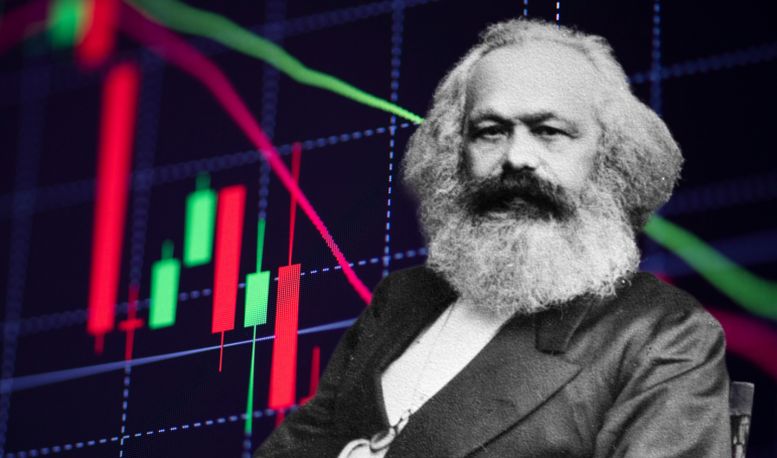
When Marx wrote Capital, he confirmed that the value of things was generally based on the labor embedded in it and that profit was not created by the bosses’ cleverness, but based on the theft of the value created by labor. Workers can never be paid the full value of their labor and so big business is unable to sell all their products back to those workers. This results in what Marx called a “crisis of too many things,” or overproduction, that brings the system momentarily crashing.
This tendency to overproduce things can be partially and temporarily overcome by a multitude of measures: new technology, exporting or borrowing (debt), but it cannot ever be eliminated.
Capitalism also exists under national borders with each nation duplicating and competing against other countries’ industries. This inherent problem can also be partially and temporarily overcome, but it is always present. Periods of globalization are followed by periods of isolation and conflict. The great global trade uncoupling currently underway with rising tariff walls is a sign of the current phase.
Exports, New Technology and Debt
Simply put, capitalism overproduces, unemployment rockets (as it did in 2008) and then eventually after the economy has contracted, people begin to buy again and the cycle starts over. Booms and busts, order and chaos, are written into its economic fabric, even though the distance between recessions often make people feel that they are always a thing of the past.
Capitalism tries to overcome its tendency towards overproduction by selling its surplus production overseas, that is to say, by going beyond the nation state. But this is limited by every country also attempting to do the same. For instance, China makes 25 million more cars than it can sell to its domestic workforce and is forced to attempt to sell them globally. However, Germany, the US, Brazil, India are also seeking to sell their own surplus cars globally.
Bosses use new technologies to cut down labor costs, but layoffs also lower workers’ buying power. Additionally, new technologies like AI, can also grow into speculative bubbles as they did with the railroads, electrification and the dot com boom. All of these past “productivity revolutions” ended in burst bubbles as investors failed to get the returns they expected.
The system of credit allows capitalists to borrow increasingly vast sums of money to inject into the economy and delay crashes, but this doesn’t prevent the crisis of overproduction. And like new technology, it too eventually turns from an initial positive to a net negative factor.
Credit initially lubricates the system by providing fresh investments to expand production, but as debt, its owed interest payments almost immediately becomes a drag on profits or revenue. Capitalism’s long-term crisis can perhaps be best illustrated by how much it owes. Twenty years ago, total world debt was $32 trillion, but after the 2008 recession and the pandemic, it now stands at around $350 trillion.
Interest on owed debt increasingly eats away at disposable income for workers, and profits for companies, exacerbating capitalism’s crisis of overproduction.
Tariff Wars and Real Wars
Trump’s “Liberation Day” tariffs were not some gaffe, but an attempt to deal with the deeper problem of the global decline of US imperialism by squeezing its trade partners. The trade drawbridges going up globally are a sign that the previous era of relative international cooperation is over. However, taxing incoming goods creates upward inflationary pressure on prices and eventually dampens working class consumer consumption further.
Capitalism’s attempts to make its national competitors pay for the crisis through tariffs is also like a dress rehearsal for war. Almost every single nation today is upping its defense budgets, dragging all countries further into debt and cutting more money out of working-class family budgets.
The world is in the process of being divided into two great spheres of influence, with Russia, Iran and North Korea awkwardly gathering behind China, and Trump attempting to rally nations to be on team America. Europe as the weaker superpower wants to remain independent, but it is unable to escape the shadow of the US. This division of influence economically affects access to export markets and raw materials around the world.
How We Got Here: the Birth of Neoliberalism
Once assumed dead, the specter of inflation is back again, striking disruption into business cohesion and wreaking havoc for working class people’s budgets.
Following the Vietnam war and the oil crisis of the mid-70s, the world was ravaged by inflation rates above 10% for several years. A period of stagflation began, characterized by simultaneous economic stagnation and inflation. This represented two parallel processes: demand continuing to decrease, with people participating less in the economy, with prices simultaneously sharply rising due to supply shocks and other causes.
Faced with lethargic economies, right wing governments in the US and UK took radical action to return profitability and stability to capitalism. By 1980, US interest rates were hiked to 20% in an attempt to temper inflation by making borrowing expensive and essentially shrinking the money supply.
The ruling class sought to restore profitability by cutting taxes to the rich and using austerity measures like welfare cuts, together with handouts to the bosses by privatizing previously nationalized industries. The working class bore the brunt of the crisis, facing the highest levels of unemployment since WWII.
At the same time, big business looked abroad to outsource cheap labor for a better return on investment. Neocolonial countries were forced to take out predatory IMF loans in exchange for these investments, taking on massive, escalating debts.
Neoliberalism was given a huge additional boost in the 1990s with the collapse of Stalinism opening new markets and lucrative privatizations. However, the biggest boost for capitalism was the reintroduction of capitalism to China, creating an ocean of cheap products for the West.
The collapse of Stalinism in Russia and eastern Europe and the restoration of capitalism in China additionally gave ideological fuel to, and accelerated, “free market” capitalist policies as the ones that led the US to become the world hegemon coming out of the Cold War.
The expansion of Chinese manufacturing with very cheap labor meant consumer prices were kept down throughout the West while keeping wages down, masking the fall in the real buying power of the working class. Industries in the imperialist countries moved their operations to China and other countries in order to take advantage of cheaper labour overseas. This was facilitated by the rise of new international structures such as NAFTA and the European Economic Community to facilitate the free movement of capital across borders.
The left and labor movements took major hits during this period. Reagan crushed the air traffic controllers union in the US and Thatcher defeated striking British miners. These hits were necessary for capitalism to force down labor costs and deregulate industries.
High inflation was also used as a battering ram against workers’ wages by blaming unions for price hikes. This era of trickle down economics, where tax cuts for the rich would supposedly boost investment and create jobs, was accompanied by expanding credit, so workers could borrow to make up for declining pay. But this didn’t magically create profitable industries for the rich to invest in.
Reagan and Thatcher deliberately allowed unemployment to rise, which kept wages down because of the threat of layoffs. It also tamped down inflation because there was less money circulating in the economy, furthering the cycle of workers not being able to buy back what they produce.
GDP growth in the neoliberal period, while far weaker than during the postwar upswing, was fueled by globalization and a massive shift of wealth from the workers to the ruling class. The 2008/9 crisis following the real estate bubble bursting ended with bank bailouts and a recovery based on low interest rates and massive unprecedented debts.
The Menace of Inflation Returns
Neoliberalism’s era of free movement of capital reached its limit of new markets and industries by the mid 2010s, leading to this current period of decoupling and deglobalization. Tariffs are pushing prices up by taxing goods coming into countries. Supply lines are breaking down and international trade is weakening, undermining growth.
The Iran war and blocking of the Strait of Hormuz is impacting fuel, fertilizer and ultimately food prices, hitting the poorest in the neocolonial world hardest. Rising prices further undermine demand. Basic necessities, often not included in the official inflation indices, can be why it feels like prices are going up despite the bourgeois press reporting inflation leveling off.
Separately, asset values are also going up. This relates to capital holdings: primarily stocks, bonds and real estate. These are currently massively inflated, reflecting a booming speculative market, basically independent from the productive economy. These affect working class people primarily through rising rents and housing costs related to real estate speculation.
Rising interest rates will again be used as a monetary mechanism to attempt to undermine the surge of inflation, making borrowing and investing more expensive, decreasing money circulation. Interest rates also have a sort of internal supply and demand, where if everybody’s trying to lend, the competition for borrowers can force interest rates down.
There are now a number of inflation-related words coming into use. Alongside stagflation, there is “spikeflation,” referencing a sudden unexpected rise in prices, and more well-known is “shrinkflation”—where corporations sell smaller sized products for the old price. All these new terms are expressions that a new era of economic volatility and inflation are here to stay.
Supply-chain shocks are often the source of price spikes. Over the past five years there have been four huge supply-chain shocks: COVID, the Ukraine War, Trump’s “Liberation Day” tariffs and the current Iran War. Each of these put enormous pressures upwards on prices.
Breaking the Cycle of Capitalist Crisis
The world economy is in a much weaker position than in 2008/9 in terms of ability to tackle a recession. In the current epoch of rising nationalism, the next recession will not look like the last one. Nation states face mountains of debt, China is no longer on the rise, and there is an absence of international cooperation. As ever, clever monetary tricks can’t solve the fundamental contradictions of capitalism.
Inflation and sharp economic downturns can, sometimes after a certain shock, trigger struggle as people see the value of their wages disappear in front of them. The neocolonial world has seen movements of millions in in response to both government corruption and escalating prices. However, there will not be a final single crisis of capitalism.
The logic of capitalism leads all bosses to work their workers until they keel over, or automate themselves out of a workforce and a market. There are no lasting economic solutions to the blind alley of capitalism. A social and economic revolution is the only sustainable solution for human society.
A socialist society wouldn’t seek out profit and infinite growth in a world where the finite nature of our resources becomes more acute each day. Instead, it could resolve these contradictions through democratically planning the economy based on human need and capacity.
But for this to be possible, it helps to understand capitalist economics, specifically through a method that does have a single unifying theory: Marxism’s labor theory of value.