US imperialism has launched the harshest offensive against Cuba since the Cold War, blocking fuel shipments to the island to forcibly starve it into regime change. Cuba needs to import 22,000 barrels of oil a day. Trump has cut that down to 150 barrels, importable only by private businesses. A Russian tanker has been permitted to dock in Cuba, but this fuel will only last for a month at maximum. Out of ten million Cubans, five million live with chronic illness, one in four are over the age of 60, and one million get their water from electric well pumps. They have been the hardest hit by electricity blackouts, which happened frequently even before the fuel blockade, but have now become near-total.
The power grid completely failed several times in March. Soon, there will be no fuel to move food from the countryside into the cities, causing mass hunger and migration. This is the humanitarian collapse that US imperialism hopes to engineer so Trump can personally “[have] the honor of taking Cuba.” Socialists oppose all imperialist attacks and defend the social gains of the Cuban Revolution, against both the US and the Cuban Communist Party’s attempts to “liberalize” the economy and restore capitalism.
Why The US Targets Cuba
Before the 1959 Cuban Revolution, the country was ruled by the brutal, pro-US dictator Fulgencio Batista. Under Batista, US corporations owned 90% of Cuba’s mines, 80% of its public utilities, and 70% of its arable land. Batista banned most democratic rights, including the right to strike, while turning Havana into a playground of casinos, drugs, and prostitution for American elites. Havana alone had 270 brothels!
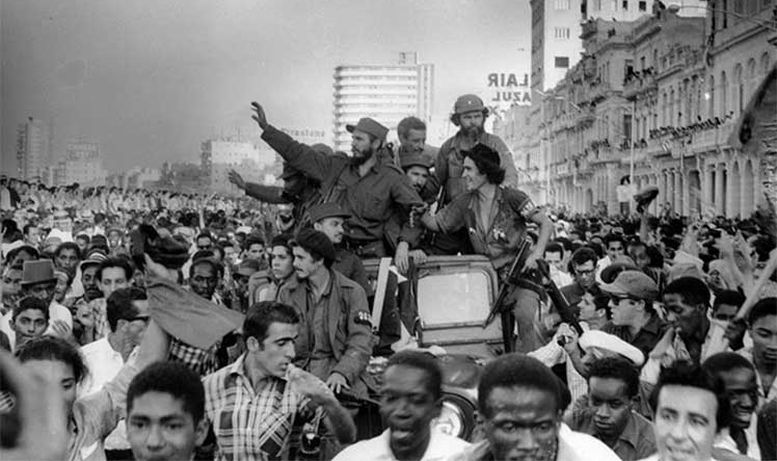
Batista was overthrown in 1959 by Cuban revolutionaries, led by Fidel and Raúl Castro and Che Guevara. Initially, the leaders of the Cuban Revolution only wanted to reform capitalism. But when Fidel Castro began taxing corporations to pay for reforms, the US capitalists who owned most of Cuba’s economy refused to pay taxes and asked Washington to blockade and invade Cuba. This pushed Castro into the arms of the Soviet Union.
Backed by mass popular support, in 1961, Castro nationalized US assets, abolished capitalism, and transformed Cuba’s economy into a planned economy controlled by an unelected bureaucracy, modeled after the Soviet Union. Because Cuba is not democratic and is run by a bureaucracy, and is not part of an international democratically planned economy, it never reached a socialist level of production. However, it does have a nationally planned economy where the main enterprises are state-owned. This means Cuba is not a capitalist society, and along with Castro’s ousting of US corporations, is the reason why to this day US imperialism hates the Cuban government and has had a trade embargo for decades.
How Did Cuba’s Economy Get This Bad?
Cuba was not always poor. During the Cold War, Cuba was a mechanized industrial farm that traded sugar to the Soviet Union for fuel and chemicals. Because they had a planned economy, the government used wealth from sugar exports to fund tremendous gains for the Cuban people. The new government launched an intensive literacy campaign in 1960 that reduced illiteracy from 77% of the population to 4% in two years. Cuba’s public health system, based on prevention has produced lower infant mortality and higher life expectancy than the US, at a fraction of the cost. Jobs paid well and families ate well.
The collapse of the Soviet Union in 1991 cut off Cuba’s source of fuel and chemicals, and Cuban tractors stood still. The island plunged into a decade of extreme poverty called the “Special Period.” With the US embargo still standing, Cuba lost 80% of its international trade, 35% of its GDP, 47% of agricultural output, 74% of construction output, and 94% of manufacturing output.
However, because Cuba kept a planned economy, the bureaucracy was able to restructure industrial, turning fuel-hungry sugar farms into small food crop farms relying on animal and human labor. This transition was a step backwards for the economy, but did feed the people even if barely. The “Special Period” finally ended around 2000, after leftist Hugo Chavez came to power in Venezuela and extended a lifeline of oil exports.
During the “Special Period,” Castro also reoriented the economy towards foreign tourists, and tourism revenue overtook sugar exports by the mid-1990s. Foreign tourism accelerated greatly after Obama eased the embargo. Today, tourism is the Cuban government’s main investment.
Tourist revenue has dried up in recent years which has greatly hurt the economy. In 2020, the pandemic practically halted tourism. At the same time, the Communist Party passed market-friendly reforms to the Cuban constitution and currency. These reforms unleashed market forces that caused regular blackouts and rising inflation, which turned off tourists and prevented a recovery. The years 2022-2025 saw only half the number of tourists compared to 2019. But despite having fewer travellers, Cuba’s government continued building new luxury hotels and opened a 40-story skyscraper in 2025, while existing hotels only have 25% occupancy.
Cuba didn’t have to be dependent on tourism and fuel imports. The recent government initiative to build solar parks proves this. With Chinese help, the Cuban government grew solar from 6% of total energy generation in 2024 to 20% as of March this year, building 49 solar parks. Each solar park costs only $16 million, and 160 parks could meet Cuba’s daytime power needs of 3.2 GW for just $2.6 billion.
Compare that cost to the $5 billion spent by the Cuban government to build luxury hotels. Moreover, the bureaucracy has allocated agricultural investment to be 11 times lower than tourism investment, in a country with food scarcity! These examples illustrate the need for genuine democracy in Cuba with a planned economy, which holds economic planners accountable and is the lifeblood of a socialist economy — one that neither puts Cuba in debt to capitalist China, nor relies on the greedy capitalists within Cuba. A democratically run economy would prioritize energy and food over hotels.
Can Capitalism Save Cuba?
The US ruling class has always blamed Cuba’s problems on a centrally planned economy, when in reality it has delivered historic gains for ordinary Cubans and others in Latin America. The real reason the US attacks the planned economy is because it has been an inspiring alternative to capitalism for millions of workers around the world.
The Cuban bureaucracy, under the pressure of imperialist blockade and seeing the rapid rise of capitalist China, has begun a process of capitalist restoration of the economy. In 2008, Cuba’s labor department declared that “egalitarianism [in wages] is not helpful” and introduced bigger wage gaps. More recently, President Miguel Díaz-Canel, has introduced a raft of privatization reforms that have damaged the economy.
In 2019, the Communist Party rewrote the constitution to allow private ownership of businesses (employing 100 workers or fewer) and foreign ownership of property. This created an explosion of small-to-medium enterprises (SMEs) and the return of foreign corporations to Cuba. There are now about 10,000 of the new SMEs, employing roughly 300,000 workers in total. The choicest private enterprises are run by former army officers or family members of bureaucrats who profit from their state connections. Adding up SMEs, private farmers, and the600,000 self-employed, Cuba’s total private sector employs 1.6 million workers and sells 55% of goods and services, out of a total labor force of about four million.
Unlike centrally planned state enterprises, private entrepreneurs set prices to maximize profit. Before the introduction of private enterprise, prices in Cuba were steady and inflation averaged a low 1.3% from 2000-2019. After the 2019 pro-market reforms, inflation hit 18.5% in 2020, then 77% in 2021 (after further pro-market reforms that impacted the currency and exchange rate), and has remained high ever since. In 2024, the government tried to cap the prices of chicken and other staple foods, but were forced to withdraw their plans after strong pushback from the new businessmen class—many of whom are former army or state officials. Private businesses also don’t coordinate electricity usage, and their growth has strained the decaying energy grid and caused big blackouts starting in 2024, long before the blockade this year.
It’s clear that the process of capitalist restoration has damaged Cuba’s economy and created a class of owners that influence government policy for the benefit of their businesses. The way out of Cuba’s economic crisis is not privatizing the economy, but democratizing the state ownership of it.
US Imperialism Tightening the Vise
Trump has chosen this moment of economic weakness to deal a blow against a historic rival. A capitalist Cuba would solidify US control of Latin America. Trump’s overthrow of Venezuelan leader Maduro and his pressure on Mexico have cut off Cuba’s two lifelines of oil. He announced that defeating Cuba is “next” after Iran, and has appointed Secretary of State Marco Rubio to lead the operation when it happens. Rubio is backed by the powerful Fanjul family, who are Cuban sugar barons who fled the Cuban Revolution and rebuilt their empire in the US. The Fanjul billionaires own brands like Domino Sugar and gave millions to MAGA politicians, with Rubio topping the list. These Cuban-American capitalists want US imperialism to give Cuba back to the old Cuban aristocracy — themselves.
Cuba is also a chess piece in the greater inter-imperialist conflict between the US and China. While Cuba is an ally of Russia and China, the capitalist ruling classes of those countries put their own interests first, and will not risk too much. Russia is sending a single tanker of oil, which has been permitted by the war-entangled US, but will provide at most a months’ relief. China has condemned the US blockade and is playing a role in Cuba’s solar energy development, but it could do much more to greatly improve Cuba’s energy position. China could send truly massive shipments of solar panels and wind farms, but the Communist Party has instead chosen a non-interventionist policy calculated for Chinese capitalism’s national interests in the broader US-China rivalry, and not a policy of solidarity.
Some of the most significant protests are now happening on the island. The government of Miguel Díaz-Canel is unpopular because it has mismanaged the economy. Without the authority of a Castro at the helm, the bureaucracy has lost a lot of its revolutionary prestige, and it’s clear the political structure of Cuba needs a total transformation. However, the masses in the region should have no illusions in US imperialism. The US would replace the forced poverty of embargo with the old tyranny of big business exploitation. A capitalist Cuba would be stripped of its planned economy, free healthcare, free education, and other social benefits.
The only way forward for Cuba is a political transformation that replaces the bureaucracy with an economy democratically planned by the masses of working people, alongside a socialist struggle across the Americas to replace the misery of capitalism with workers’ democracy. Only this way can the island’s wealth and people be channeled toward building renewable and reliable energy, improving agricultural investments, and a better future for all Cubans.