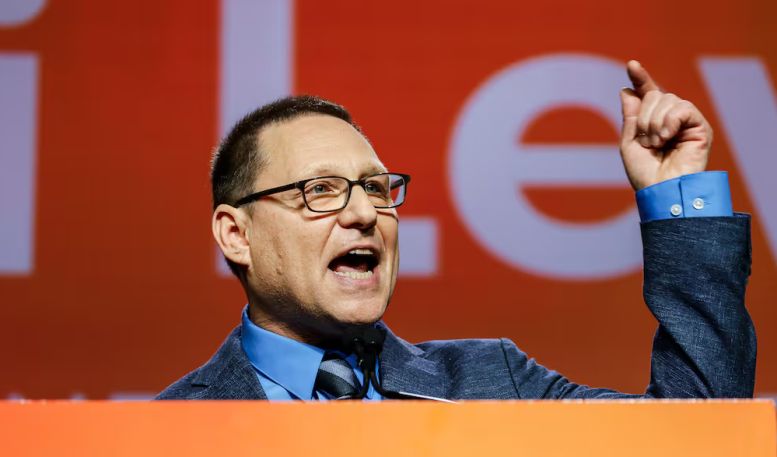
Avi Lewis handily won the NDP leadership race with 39,734 votes, 56% of the total, on the first ballot. His program is clearly popular with NDP members. His campaign raised more money, $1.23 million, than the other four candidates combined, and with an average donation of $105, smaller than Ashton’s average of $149, McPherson’s $133 and McQuail’s $113.
All five candidates vowed to rebuild the NDP, but now it is up to Lewis. The conference decision that the NDP will campaign year-round, rather than just at elections is an important step to rebuild the party as is the commitment to empower the constituency associations rather than having everything controlled by the headquarters.
In recent years, the federal NDP went from barely relevant, to circling the toilet bowl of history with its worst electoral results ever in the 2025 federal election. If securing only 7 seats wasn’t bad enough, the NDP caucus has since shrunk to 6 with Nunavut MP Lori Idlout defecting to the Liberals and it may shrivel further with Québec MP Alexandre Boulerice considering a switch to provincial politics. Granted, part of the NDP’s performance was due to Canadians “strategically voting” Liberal to avoid a Trumpish Pierre Poilievre Conservative victory. Between Trump’s win in late 2024 and the federal election, the NDP dropped from 21 percent to only 6 percent in opinion polls. Yet, the NDP only ever polled between 15 and 20 percent since its creation in 1961, apart from in 2011 when the NDP become the official opposition under Jack Layton. However, that was due to both Layton’s charisma and a sharp drop in support for the Liberals and the Bloc Québécois.
But NDP fortunes cannot be summarized in mere electoral calculus. For decades, the NDP has increasingly resigned itself to being the moral conscience in Ottawa. Barring some MPs’ hard work in their ridings, the federal NDP has not organized any major campaigns since the 1980s outside of election years, resorting to principled opposition statements of moral indignation and the occasional strategic vote in Parliament to advance the interests of working Canadians. The NDP puts forward far more private members’ bills than any other party, but few get passed into law. Thus, the NDP turned more into a get-out-the-vote machine, downplaying its strongest working-class demands to chase centrist voters in the hope that maybe the next election might be the game changer.
In recent years it has won in BC, Alberta and Manitoba, while it last won in Saskatchewan in 2003. In all recent cases these provincial governments have been marked by moderate pro-capitalist governments with a few minor reforms for working people. It won an election in Ontario in 1990, and Nova Scotia in 2009 and in both these cases fell to third place in the next election.
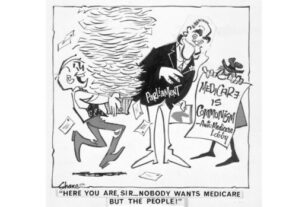
Over many years the NDP did not seek to build national, working-class movements for change between elections, much less talk to people in the streets, even though NDP leaders continued to honour the memory of NDP hero Tommy Douglas who did exactly that to get Canadians the Medical Care Act in 1966! And this while capitalism continued to make everyday Canadians’ lives worse with rising inequality, affordability, the housing crisis and climate change. Occasionally, vote trading saw some results. Jagmeet Singh entered into a confidence and supply agreement with Justin Trudeau, helping to win a partial, but flawed, national dental care plan and Pharmacare Act. By the time Singh broke off the agreement in 2024, Singh and the NDP were marred in the eyes of many potential supporters as being Trudeau’s crutch, as Socialist Alternative warned at the time.
Unless the NDP can recover, voters face a grim choice. On the one hand there is Carney’s conservative Liberals with cuts to public services, handouts to big business and massive military spending. Or Poilievre who continues his Trumpish faux anger, with very few clear policies.
Lewis’s Platform
Lewis’s platform is a sharp break with the present and past failed policies of the NDP both federally and provincially. He talked of an NDP “that works for the many, not the money,” offering a sharp contrast to the Liberals and Conservatives. His campaign understood that there is not much point of an NDP that is only fractionally more pro-worker than the Liberals.
His campaign focused on demands such as building public homes, protecting tenants, creating 1 million good green jobs, and free transit. Lewis wants “the unmatched power of public ownership” in groceries, postal banking, a public pharmaceutical manufacturer, taxing the ultra rich and ending corporate handouts. He opposes further fossil fuel industry expansion, including LNG, to truly combat climate change, and pledged that “no one who works in the industry will be left behind.” Tackling climate change is a good program to provide rewarding jobs.
Overcoming NDP establishment resistance
Lewis will face fierce resistance from the NDP establishment and provincial NDP representatives, if he tries to get the NDP to campaign on this program. The election of the slate of Niall Ricardo, Libby Davies and Kiera Gunn to the party’s executive will give him some support within the machine.
Corbyn’s experience in Britain is a stark warning. Corbyn was elected Labour leader twice — in 2015 with 59.5 percent of the votes and again in 2016 with 61.8 percent. However, some MPs preferred a defeat to a Corbyn-led government so did everything they could to sabotage the 2017 election. Labour still gained nearly 13 million votes, 3 million more than Starmer’s 2024 victory.
Immediately after Lewis’s victory was announced, Nenshi, the moderate leader of Alberta’s NDP falsely stated the election of the “new leader, someone who openly cheered for the defeat of the Alberta NDP government, is not in the interests of Alberta.” There is no evidence that Lewis cheered for the defeat of the NDP government in Alberta in 2015.
The clash of his policies and his supporters against the NDP machine will most likely open a debate about what sort of party the working class needs. Lewis will have to fully mobilize his supporters to resist inevitable sabotage.
Many in the media and some right-wing NDPers are already calling Lewis “divisive,” because they are comfortable with a moralistic but irrelevant NDP.
Socialist Alternative supported Avi Lewis and his program in the leadership elections and will help to transform the NDP so that it campaigns for working-class people. Standing up to the billionaire class on behalf of working-class Canadians is going to take unapologetic principles based on class analysis, serious movement building around immediate material struggles, and democratic structures in both these movements and the NDP, so that members’ voices matter. If Lewis can build such a movement, it will be the members who, with Lewis’ leadership, will write the NDP’s next chapter.