Soccer has always been celebrated as a working-class sport. Played in streets, parks and schoolyards, all that’s needed is a ball. But the Canadian working class will pay a heavy price for the FIFA World Cup 2026, while corporations and the wealthy benefit.
The huge, 104-game tournament is set to be the most profitable sporting event in human history, with FIFA expected to rake in $13.5 billion through sponsorships, broadcasting rights and other revenue streams. But much of the cost of hosting this event will fall on poor and working shoulders.
Host cities Toronto and Vancouver are now expected to spend an estimated $380 million and $624 million respectively, plus at least another $110 million from the federal government, on stadium upgrades, security, transportation, infrastructure, and logistics. This is hundreds of millions more than what the public was initially told it would cost to co-host the World Cup with the US and Mexico.
Meanwhile, public services are being cut in Vancouver and Toronto.
Poor and working people are subsidizing this corporate feeding frenzy in other ways, too. For example, FIFA tournaments rely heavily on volunteers to provide free labour in exchange for “experience” — unpaid work in service of a multi-billion-dollar private enterprise.
As part of the host city agreements, FIFA has even asked for designated hospitals, specialist care, and priority medical access for athletes and VIPs in both Vancouver and Toronto. In the context of an over-stretched healthcare system, this amounts to a request to restrict access for regular people.
The 2010 Winter Olympics in Vancouver boosted homelessness as landlords jacked up rents; the World Cup will do the same. No doubt there will be a push to “clean” up host cities, pushing unhoused and poor people out of sight.
Adding insult to injury, at the time of writing, available tickets to World Cup games in Toronto start at $810, pricing even loyal fans and supporters out of the stands. Poor and working people are paying dearly for this event, but few will be able to participate in it.
Pro-soccer, Anti-FIFA
Gianni Infantino, the president of FIFA, has said that without the support of FIFA “there would be no football in 150 countries.” But while it is true that FIFA sends much of its revenues back to its 211 member associations, it is also true that much of it goes to making a few people very rich. Infantino’s salary, for example, is around $6.3 million.
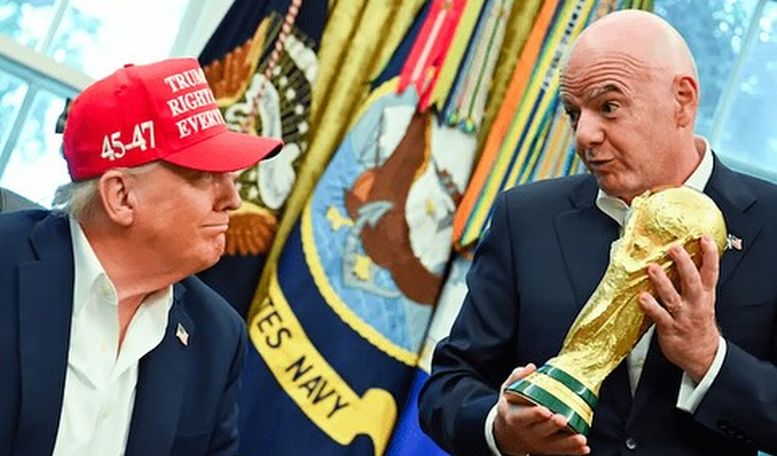
Some FIFA revenues are put to even more egregious purposes, like the gold-plated “peace prize” Infantino invented just for the Nobel-jilted Donald Trump. Trump bombed seven countries in his first year back in office.
Moreover, Canadian soccer culture stands to gain little from the World Cup in terms of youth and amateur leagues. Local culture, grassroots clubs, and neighbourhood communities are often sidelined during mega-events. And once the final whistle blows and the travelling corporate circus leaves town, little will be left behind — just debt and expensive infrastructure of questionable utility.
The World Cup is being sold as a once-in-a-generation celebration of sport, unity, and national pride, and the enormous costs of hosting it are justified as the price of being “on the world stage.” In reality, it is a celebration of exploitation and greed, and few local working people will even be in the stands, let alone on the “stage.”
Soccer is a beautiful game, and it belongs to the people who love it, play it, and watch it. FIFA turns it into an ugly money-making machine for corporations and the rich. Wherever sport intersects with capitalism, it’s the working class who get left out.
A socialist program for global sporting events would insist that:
- Ticket prices to be capped to ensure mass accessibility
- Fans be treated as participants, not revenue streams
- All workers and volunteers be paid fairly
- Revenue be reinvested into grassroots and community sport
- Ordinary people benefit, not rich capitalists