Mark Carney’s political image is of a “responsible progressive,” a pragmatist — someone who speaks about climate change, affordability, inclusion, and protecting Canadians during economic uncertainty. He talks nice about “Canada for All” and that “the government is protecting the essential social programs — child care, dental care, and pharmacare.”
But dig into the details and there are lots of cuts. There is no new money to create more child-care spaces. Federal health-care spending is drastically being cut — while hospital emergency rooms are inundated or even closed, the population is aging, and mental health needs are often left unmet. Ottawa won’t be renewing the $1.2 billion in annual transfers to the provinces that support mental health and addiction services, as well as home and community care, nor the $600 million in annual transfers for long-term care. It is likely that the $500 million annually set aside to increase Canadians’ access to expensive drugs for rare diseases won’t extend beyond March 2027. Meanwhile, the government is looking at privatizing airports and ports. Behind Carney’s polished image is a conservative program of austerity, corporate-friendly economics, and public spending restraint.
Carney often frames his approach as “spending less to invest more,” promising to cut government “waste,” improve productivity, and reduce operational spending, while still protecting affordability programs. He presents cuts as “efficiency,” and austerity as “responsible management.” One example of this is the government’s dragging its heels over implementation of the $1.5 billion, two-year-old “national pharmacare plan.” The intention was to study the initial roll out of the plan and then expand coverage to more drugs. However, only British Columbia, Manitoba, Prince Edward Island and the Yukon have signed on to the plan and now the federal Minister of Health has vowed to “protect” only these four agreements but has made no commitment to negotiations with the other provinces and territories.
The so-called affordability measures — such as targeted rebates (e.g., Canada Groceries and Essentials Benefit), temporary fuel tax relief, or housingaffordability — do not fundamentally challenge the reality of the cost-of-living crisis or its causes. Affordability problems are rooted in privatization, weak public services, low wages relative to inflation, corporate profiteering, and the financialization of housing (where housing is treated as a commodity — a vehicle for wealth and investment — rather than as a human right and a social good).
Cutting jobs to buy more weapons
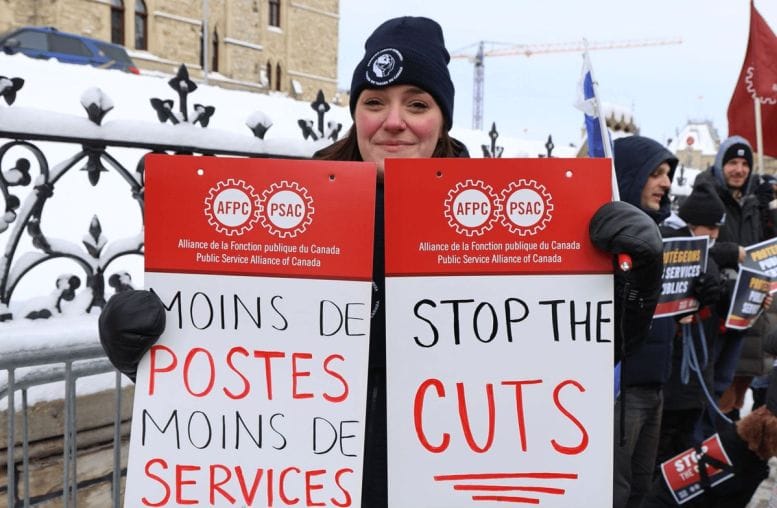
Carney’s policies soften the symptoms, while preserving the same economic system that created the crisis. There is a deep contradiction between Carney’s progressive rhetoric and his government’s actual fiscal direction. The government has announced cutting 40,000 jobs in the public services and is “sunsetting” social programs (letting them quietly die on the vine by not renewing their funding), while Canada Post is slashing 30,000 jobs. Most federal departments’ spending, except military and policing, have been reduced by 15 percent.
In contrast, military spending is exploding, going from $30 billion (1.3 percent of GDP) in 2023, to a target of $150 billion a year (5 percent of GDP) by 2035. This reveals the government’s true priorities: cuts to social programs, but massive funding for military expansion and corporate-backed infrastructure in the form of the Canada Strong Fund with its initial federal contribution of $25 billion.
This is not that surprising given Carney’s background. He was a governor of both the Bank of Canada and the Bank of England. He worked for Goldman Sachs and later was vice-chair of Brookfield Asset Management, two of the world’s largest finance companies, specializing in making money from property speculation and playing the stock and money market casinos, all at the expense of working people. He is progressive in tone, moderate on social issues, market-oriented in economics and comfortable with cuts if framed as “modernization.”
Carney seeks to present a progressive image, but his actions are rooted in protecting markets and corporate profits. Working people need public investment, workers’ control of key industries, stronger unions, and expanded social programs. Carney’s sweetness and light will not deliver these. It will take working-class organization and struggles.