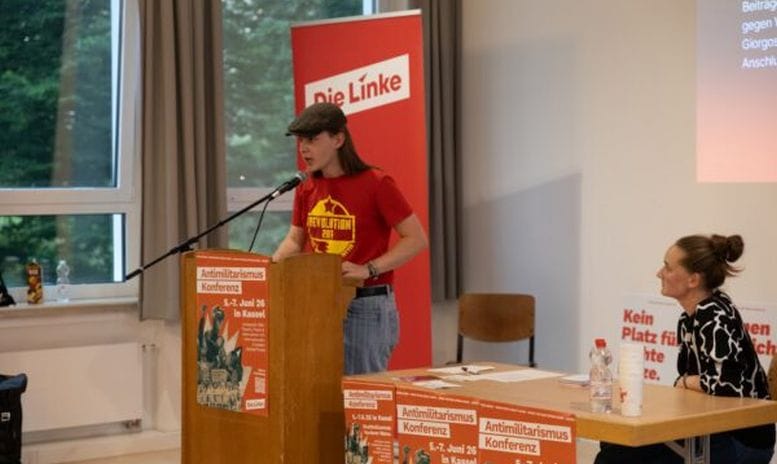
In Kassel, Germany, at the invitation of the local chapter of Die Linke, 180 people from all over Germany gathered to discuss the current situation of militarization and rearmament and to formulate plans for the resistance we need.
Ever since the federal government approved a military buildup package worth several hundred billion euros last spring, an era of active preparation for war has begun. Kassel’s mayor (Green Party) wants to turn the city into Europe’s arms capital. Recognizing that grassroots resistance is necessary to counter this, members of the Kassel district chapter of Die Linke, including members of Sozialistiche Alternative (SAV—ISA in Germany), took the initiative and organized an anti-militarist conference. On the first weekend in June, around 180 people from various cities gathered at the “Vorderer Westen” community center in Kassel to discuss strategies against rearmament and war. The conference was a complete success: the interest in learning and networking was evident in the consistently well-attended workshops and in the discussions that took place around them. The smooth organization and the spirit of solidarity also ensured a friendly and constructive gathering.
Political Focus
The opening event on Friday evening made it clear from the start: this weekend would draw out lessons to be learned from the struggles of the international working class. Jed, an activist with Socialist Alternative from the US, reported on mass protests against the racist deportation regime of ICE, and how these protests were able to halt the brutal crackdown for the time being. Giorgos Gogos, chair of the dockworkers’ union in Piraeus, described how the local workforce successfully blocked the transport of arms exports by sea. Through their action, they also illustrated their perspective on the role of their workplace: “our ports must be a bridge between our countries, civilizations, and continents—not part of the chain of militarism and war.”
The program on Saturday and Sunday covered a wide range of topics. Participants discussed the causes of current wars and domestic political crises, placing them in the context of intensifying imperialist competition. Other topics included the war on Iran and the Iranian people’s resistance against the authoritarian regime. Post-Soviet Left, an organization of left-wing Russian and Ukrainian exiles, shared firsthand accounts of conscientious objection in both countries. Volkswagen workers presented their campaign against the conversion of plants for arms production.
The capitalist class’s ideological preparation for war was also a topic of discussion at the conference. Education workers discussed, for example, how to counter visits by youth army recruitment officers to schools and how to defend the “civil clause” at universities (the commitment of many German universities to rejecting researching projects associated with arms and militarism). Young people from the anti-conscription school strike alliance jointly developed new ideas for action, and discussed how they could turn their strike into a broader resistance against war. A cultural highlight took place on Saturday evening at the Schlachthof Cultural Center with the play “Oops, We’re Dying! Rheinmetall: A German Story.”
A Common Struggle—Disarmament Instead of Social Cuts
One broad conclusion from the weekend was the need to launch a counteroffensive against the drive toward preparation for war, and that the anti-militarist resistance must also oppose the massive cuts in health care, education, and social services announced by German chancellor Friedrich Merz. In this context, the role of union leaders was emphasized: they must not bow to the logic that “rearmament secures jobs,” but must instead join forces with a class-struggle-oriented left to call for mass protests. Die Linke MEP Özlem Demirel, spoke on the potential for a “hot autumn” against social cuts this year. She made it clear in the conference’s review that a clear movement against the “Zeitenwende,” (Germany’s pivot toward militarism since the outbreak of the Ukraine war) against rearmament, against cuts, and against the shift to the right requires workplace actions, strikes, blockades, and even a general strike—all coordinated internationally.
What Was Achieved at the Conference, and What’s Next?
The conference demonstrated that it is both possible and necessary to bring together different perspectives and people from various anti-war movements in Iran, Afghanistan, Russia, Ukraine, Palestine, the US, Greece, and other countries. The reports from these activists served as a reminder that methods of grassroots resistance can be successful and can throw a wrench in the operation of the war machine.
Some participants described how they felt more confident and better connected than before the conference, noting that a new phase is now beginning in which we can seriously go on the offensive. That is a success. At the same time, we are only at the beginning. Preparations for war have been in full swing for months, and much of it was unable to be prevented so far. The majority of Die Linke’s leadership lacked the political clarity and courage to identify fundamental alternatives to the ruling class’s rearmament policy at an early stage and to proactively help build an anti-war movement. With the initiative for the Anti-Militarism Conference, the party rank-and-file took on this responsibility, bringing together large segments of the consistently anti-militarist Left Party. Also participating were several members of Die Linke’s parliamentary group, including Desiree Becker, Lea Reisner, Özlem Demirel, Violetta Bock, and Julia C. Stange.
The entire German left should urgently take responsibility for building and uniting an internationalist, class-based anti-war movement. Lea Reisner, Özlem Demirel, and many others, through their resolution to Die Linke’s federal party convention —“We Won’t Pay for Your Wars”—point toward how the struggle against social cuts should be linked to the struggle against militarization and rearmament, and what Die Linke can and must do. Further meetings are needed so that those involved in this movement across Germany and internationally can learn from one another, continue to build networks, and discuss next steps.
The situation is serious; we must change course. This can only succeed on the basis of an anti-war movement with a clear analysis of the capitalist causes of war, a clear plan to fight back, and a vision of how cities like Kassel can become capitals of peace rather than capitals of the arms industry. There is no time to lose in building such a movement.