How things have changed. The orthodox views of a few years ago are now out the window.
Until recently most mainstream economists argued that governments should get out of the way to allow private capitalists to invest in major projects and that profits were the “reward” for taking risks. Now, for many construction projects, the risks are too great for the capitalists to invest, so governments have to protect the capitalists’ investments from risk.
If property developers cannot sell the condos they have built, the governments of BC and Canada will step in to buy them, protecting the developers’ profits. Carney’s government wants to build ten nuclear power plants, but it is too risky for capitalist investors. So, the risk will be carried by the government and electricity customers. Canadian governments are using taxpayers’ money to boost the profits of the billionaires. Truly a reverse Robin Hood: take from the poor to give to the rich. “Corporate welfare bums,” a phrase former NDP leaders David Lewis and Ed Broadbent popularized, truly describes what is happening today.
In Mark Carney’s 2021 book, Values, and in many speeches before he became Prime Minister, he argued that action on climate change now was vital, as “the challenges currently posed by climate change pale in significance compared with what might come.” Now that he has the power to act, he is weakening action to reduce carbon dioxide and methane releases and doubling down on exporting more fossil fuels. As Carney has acknowledged, Canada will not meet its goals to tackle climate change.
In his leadership campaign for the Liberals and then in the 2025 election, Carney’s theme was to strengthen the Canadian economy by diversifying what was exported and where it was exported to. While the government has sought to find new export markets, what it aims to export is more of the same raw materials — food, minerals oil and gas. The over-reliance on exporting commodities is one reason for low productivity growth.
A second Pipeline: Speeding up climate disaster
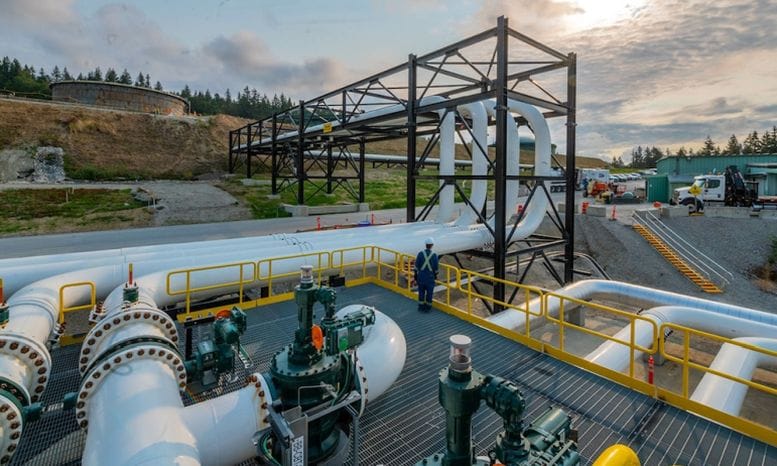
The Canadian and Alberta governments have agreed to spend billions to build a second bitumen pipeline to ship one million barrels a day to the Pacific coast. Danielle Smith, Alberta’s Premier, stated last October that “To be clear, Alberta taxpayers will not be on the hook to build this pipeline.” Now they are. No for-profit companies are interested in building it. So far, there are no customers signed up to ship through the pipeline.
It is not clear who will use this proposed new pipeline. The fees to use the new pipeline, given the large construction costs, will be higher than the existing pipelines. The Trans Mountain pipeline (TMX) has only run at full capacity since the US attacked Iran. There are plans to increase pipeline capacity of the Trans Mountain by an extra 360,000 barrels a day and Enbridge is looking to expand two of its pipelines to the US by 250,000 barrels a day. Will Alberta produce an additional 1,610,000 barrels a day? And at what cost to the climate?
The expansion of the earlier pipeline, the TMX, was only built with taxpayers’ money at a cost of $34.5 billion. The company that originally proposed it, Kinder Morgan, could not afford to build it, so the government bought it. It is now operating at a loss. The operating company, Trans Mountain Corporation, claims it is making money, but this is only by ignoring $23 billion of debt and the interest paid on that debt. The pipeline made a loss of $166 million in the first six months of 2025.
Trans Mountain Corporation and the Alberta Petroleum Marketing Commission (both government-owned bodies) will put up 90 percent of the investment. This is a total reversal of October’s Memorandum of Understanding to look at a new pipeline that stated it would be “private sector constructed and financed.” Pembina Pipeline Corporation has made a “non-binding” agreement to put up 10 percent of the costs. The current estimated cost is between $35 billion and $44 billion but is likely to cost far more. The TMX pipeline cost increased six times from a 2013 estimate of $5.4 billion to a final cost of over $34 billion.
The proposed pipeline will end at a massively expanded Roberts Bank terminal, increased by 640 acres, at the mouth of the Fraser River. This would be in addition to the current plan to expand the port; the federal environmental assessment stated the impact of this on salmon and orcas “is high in magnitude, permanent and irreversible.” The further planned expansion will have an even worse impact.
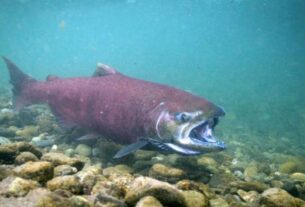
Pipelines leak all the time, and this pipeline will cross hundreds of streams and rivers, threatening communities’ water supplies and salmon. A spill in the ocean around the terminal would devastate marine life, damage tourism and cost many jobs. A major spill could cost 100,000 jobs.
Of course, the largest negative impact will be the burning of all this bitumen. Air pollution from burning fossil fuels kills around 5 million people a year around the world. The burning of one million barrels a day produces around 500,000 tonnes of CO2 every day; Canada produces around 550 million tones of CO2 a year, or 1.5 million tonnes a day. So, this new pipeline, if built, would add a huge amount of CO2 to the atmosphere and further super-charge the climate disasters.
The sugar-coated poison pill
The announcement of the proposed new pipeline has some sugar around the climate disaster poison. The bitumen will not be shipped through Hecate Strait, one of the world’s most dangerous waterways, as the ban on tankers sailing in the inshore northern waters remains. However, it is expected that a Very Large Crude Carrier, carrying around 2 million barrels of bitumen will leave every second day, sailing into the already-busy waters off Vancouver.
The federal government has thrown in $10 billion to expand the Roberts Bank port, as well as money to expand the ports of Prince Rupert and Stewart, in northern BC. There is also around $3 billion to expand the highway heading from Vancouver to the port and the US border, boosting car and truck traffic and pollution in the area.
The feds will also invest in the Red Chris copper mine in northern BC, which has a history of releasing pollution into the salmon-bearing Stikine River.
The Premier of BC gets backing for his own program to subsidize boosting climate disaster. The agreement restated the federal governments’ support to expand the export of fracked gas.
Don’t ask the corporations to pay
The Memorandum of Understanding, signed in 2025 by Carney and Danielle Smith, relaxed restrictions on the burning and release of methane, a powerful greenhouse gas, in a major concession to the fossil fuel industry. One of the remaining conditions on the fossil fuel companies linked to the new pipeline is that they introduce carbon capture and storage. The so-called Pathways project has been stalled for years. Up to now the technology has not worked effectively. It is very costly and although the major companies are all highly profitable, they want the Alberta and federal government to pay most of the costs.
It is staggering that the companies who are polluting the earth and driving climate change expect the taxpayer to boost their profits. Even more staggering is how the BC, Alberta and federal governments are all willing to give them money!
Stampeding for the Stampede
The announcement of the pipeline to Vancouver was rushed. The Tsawwassen First Nation, whose territory the pipeline would probably pass through, had no consultation before the announcement. The plan includes 15 oil tanks that would store 6.5 million barrels. Do the people in nearby Delta and Tsawwassen want this?
A week after Carney and Smith put forward a western pipeline, Doug Ford joined Smith to reveal plans for the Northen Shield pipeline to southern Ontario. This plan has no price for its 3,300 kilometres, which would go through the hard rock of the Canadian Shield. Many even in the oil business question the case for this proposal.
It would pass through Manitoba, but the provincial government is not on board. Indigenous nations were not consulted. The Anishinabek Nation covers much of the land the pipeline would pass through. Grand Council Chief Linda Debassige stated their “deep concern and disappointment” over the proposal as it “blindsided First Nations” and “represents a significant threat to our land, water and future generations.”
Smith is in a desperate hurry with these plans so they can be centre stage at the Calgary Stampede from July 3 to July 12, a time for a lot of pancakes and politicking.
Jobs myth
The government’s announcement of the proposed pipeline included grandiose figures for the number of jobs it will provide. Of course, spending over $40 billion on construction will provide jobs. However, if this same money was spent to build affordable housing, produce renewable energy or upgrade the rail network it would provide more jobs and more social benefits without the negative impacts of accelerating climate change. Once built, pipelines provide very few jobs. When Kinder Morgan announced its plan to expand the Trans Mountain pipeline it stated that it would provide 90 permanent jobs.
A review of the government’s Major Projects Office shows a heavy emphasis — 13 out of 18 projects — on mining and fossil fuels both directly and supporting their expansion. These are not major long-term providers of jobs. At the same time the federal government is slashing jobs in the civil service and Canada Post. The announcement of the new pipeline confirms the path of Carney’s government — trashing the environment and boosting profits for big business.
The understanding of this reality will grow as Canadian workers see declining public services and mounting federal debt to pay for war and big business.
A different path
Corporate welfare has a long history in Canada from the building of the railways in the 19th century to the bank bailouts in the Great Recession of 2008-09 and again during COVID. Capitalist economists and apologists talk about the free market, but the reality is that the profits are private while the costs and risks are often covered by taxpayers. Many inventions are made by public institutions, while private companies make the money.
The plan to build this pipeline makes no economic sense, even under capitalism, as if it did the capitalists would invest. It is an enormous waste of money that would provide far more jobs if invested in renewable energy, building homes and public transit. It is an enormous waste of money that will hasten climate disasters, deaths and devastation. The Carney and Smith governments worship gods of short-term profits.
The need for a socialist revolution to end this capitalist insanity is crystal clear. While a revolution will not happen tomorrow, Socialist Alternative is striving to ensure the working class wins when a revolutionary opportunity arises. Join us.